
Selling a home isn't simply about finding a buyer. It's about making a series of informed decisions before your property ever reaches the market. My role isn't to overwhelm you with more information. It's to interpret the market, explain what each decision means, and help you make confident decisions from beginning to end.
That is not a criticism. Selling a house is not something most people do often. The process is unfamiliar, the decisions are high-stakes, and the people guiding you through it have a financial interest in the outcome. That combination makes it easy to move quickly through the decisions that matter most and focus instead on the ones that feel most manageable.
This guide explains how selling a house works in Australia, with practical advice and examples relevant to Australian homeowners. Not a checklist of tasks to complete. Not a sales pitch for any particular agent or method. A clear explanation of what drives the result, what costs are involved, what questions to ask before you sign anything, and what separates a well-executed sale from one that costs you money you did not need to spend.
If you are thinking about selling your house and want to understand what you are getting into first, this is where to start.
Selling a house is not a single decision.It is a sequence of nine decisions. Understanding why each decision matters is what protects your final result.
Your Complete Roadmap
The Nine Decisions That Determine Your Sale
Each decision links to a dedicated guide. Click any box to go deeper.
How to Sell My House: The Steps Most Sellers Don't Plan For
Selling a house in Australia follows a consistent sequence regardless of state or agent. Understanding it before you begin means the decisions along the way are easier to make and harder to get wrong.
Decide Whether Now Is the Right Time
Timing a sale involves more than picking the right season. It requires understanding what comparable properties in your price bracket are currently achieving, what the competing stock picture looks like, and what your personal holding costs are for each month you delay. The decision to sell now versus in three months is a financial calculation, not a calendar one.
Get an Evidence-Based Property Appraisal
An appraisal tells you what your property is likely to achieve in the current market based on comparable sales, buyer behaviour, and real-time conditions in your price bracket. A good appraisal doesn't simply estimate a likely selling price. It explains why the property is likely to achieve that result, how buyers are expected to compare it against competing homes, and what that means for the strategy that follows. It is a price position built from evidence of what buyers are actually paying right now — not what the market might deliver in a better season or what you need it to achieve to fund your next purchase.
Common Mistake
The Appraisal Trap
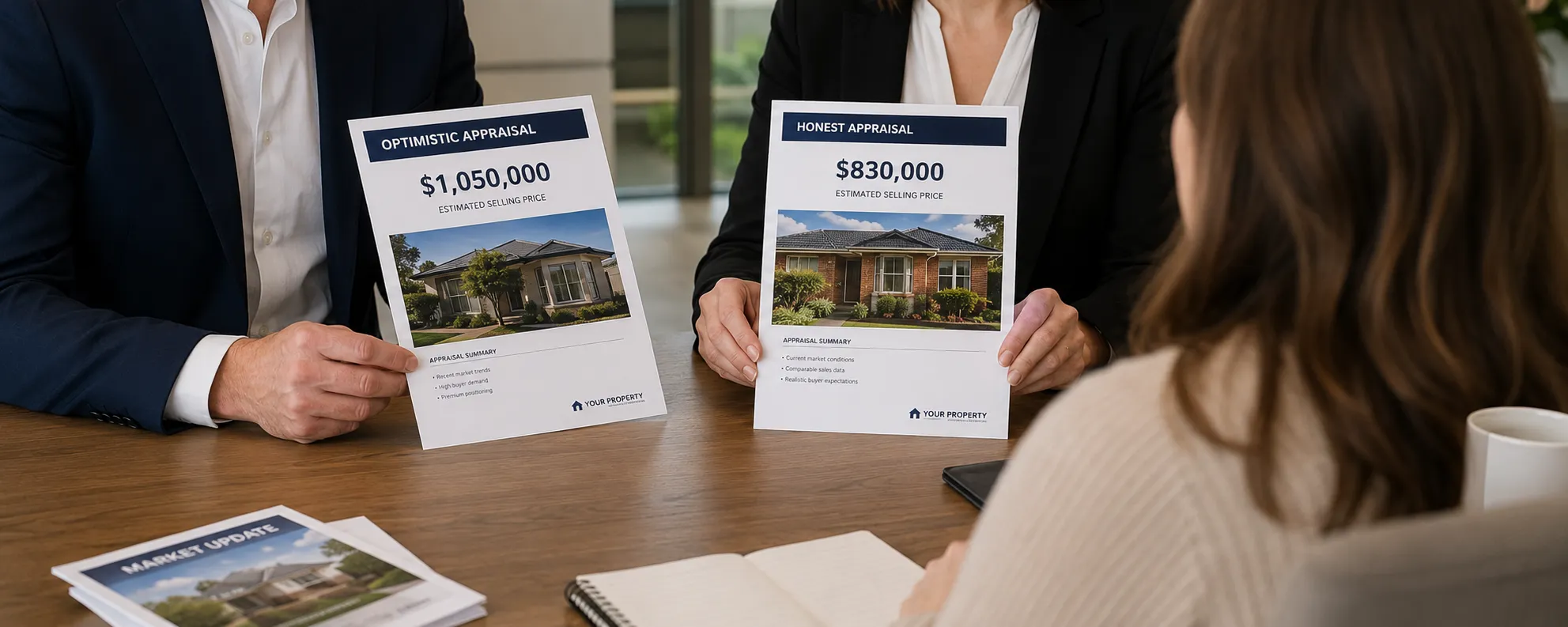
The most common mistake vendors make at this stage is choosing the agent who provides the highest number. In a competitive industry where agents win listings by being chosen over rivals, there is a structural incentive to provide an optimistic appraisal.
A vendor who hears $750,000 from one agent and $690,000 from another is more likely to sign with the first — regardless of which number the market will actually support. Six weeks into a campaign with no offers, the agent suggests a price reduction. The property sells for $705,000. The vendor lost the first three weeks of buyer momentum chasing a number the market never supported.
Protecting yourself is straightforward: ask every agent to show you the comparable sales they used to arrive at their number — and what happened to the properties in that list that were priced above where they eventually sold.
Choose Your Method of Sale
Most residential property in Australia sells by one of three methods. The method of sale is rarely the deciding factor in the final result — what matters is how the campaign is structured within that method. Two agents using the same method can achieve very different results.
Listed at an asking price or range. Buyers submit offers through the agent and the vendor negotiates to an agreed price. Most common method nationally — suits suburban and regional markets where buyers are finance-dependent.
Best for: Most Australian residential marketsBuyers bid publicly on a set date. Effective where genuine competition is expected and multiple parties are likely to bid — most common in inner-city Sydney and Melbourne markets. Requires buyers to be unconditional on the day.
Best for: High-competition inner-city marketsBuyers submit written offers by a deadline. The vendor reviews and negotiates from the strongest. Used for premium or unusual properties where the buyer pool is smaller and a defined end-date creates urgency.
Best for: Premium or unique propertiesPrepare the Property
Preparation covers two distinct categories: what buyers see and what buyers read.
What buyers see is the presentation — clean, decluttered, well-maintained, with any obvious defects attended to before the first open home. What buyers read is the contract — in most Australian states, the vendor is required to have a Form 1 or equivalent vendor's statement prepared before marketing begins.
Set the Price Correctly
Price position is the single most important variable in a residential property campaign — and the one most likely to be quietly compromised before the campaign even begins.
Proprietary Concept
The Freshness Window
The first 14 to 21 days of a listing are when buyer attention is at its peak. Portal algorithms surface new listings prominently during this window. Buyers who have been actively searching engage immediately. Genuine competition — the condition that produces the strongest offers — is most likely to emerge in this period.
A property priced where buyers are searching enters that window with momentum. A property priced above where the market is sitting enters without it — and the momentum, once lost, is rarely fully recovered.
- Strong inquiry in first two weeks
- Multiple buyers competing
- Offers at or above asking
- Sale within the Freshness Window
- Maximum outcome achieved
- Low inquiry in first two weeks
- Days on market accumulate publicly
- Buyers perceive it as overpriced
- Price reduction required
- Final sale below correct launch price
Launch and Manage the Campaign
A listing campaign is not a passive exercise. The agent's job during the campaign is to contact every buyer who has attended an inspection, create and manage urgency between interested parties, and respond to buyer questions in a way that maintains momentum.
An agent who waits for offers to arrive is not running a campaign — they are hosting open homes. The difference in outcome between an actively managed campaign and a passive one is rarely visible in the marketing material. It shows up in the final sale price.
Negotiate and Accept an Offer
Negotiation in residential real estate is rarely dramatic. Most of it happens in the 48 hours after a buyer submits an initial offer. An experienced agent manages this conversation with the vendor's interests as the priority. The four variables that every negotiation turns on:
The headline figure — but rarely the only lever. A motivated buyer will often move on price if other conditions work in their favour.
A higher deposit signals commitment. A buyer willing to put 10% down is less likely to walk away than one offering 5%.
A vendor who needs time or flexibility can sometimes achieve a stronger price by offering a settlement date that suits the buyer.
Finance and building inspection conditions add risk to an offer. An unconditional offer at a slightly lower price is often preferable to a conditional one at a higher figure.
Settlement
Settlement is the legal transfer of the property from vendor to buyer. In South Australia, settlement typically occurs 30 to 90 days after the contract is signed, depending on what the parties agree. Your conveyancer manages the entire process.
Conveyancer coordinates with the buyer's conveyancer, the lenders, and the relevant government bodies
Final inspection by the buyer confirms the property is in the agreed condition
Balance of the purchase price is transferred to the vendor on settlement day
Keys are handed over and the sale is complete — agent commission and selling costs are deducted from proceeds
Should I Sell My House or Rent It Out?
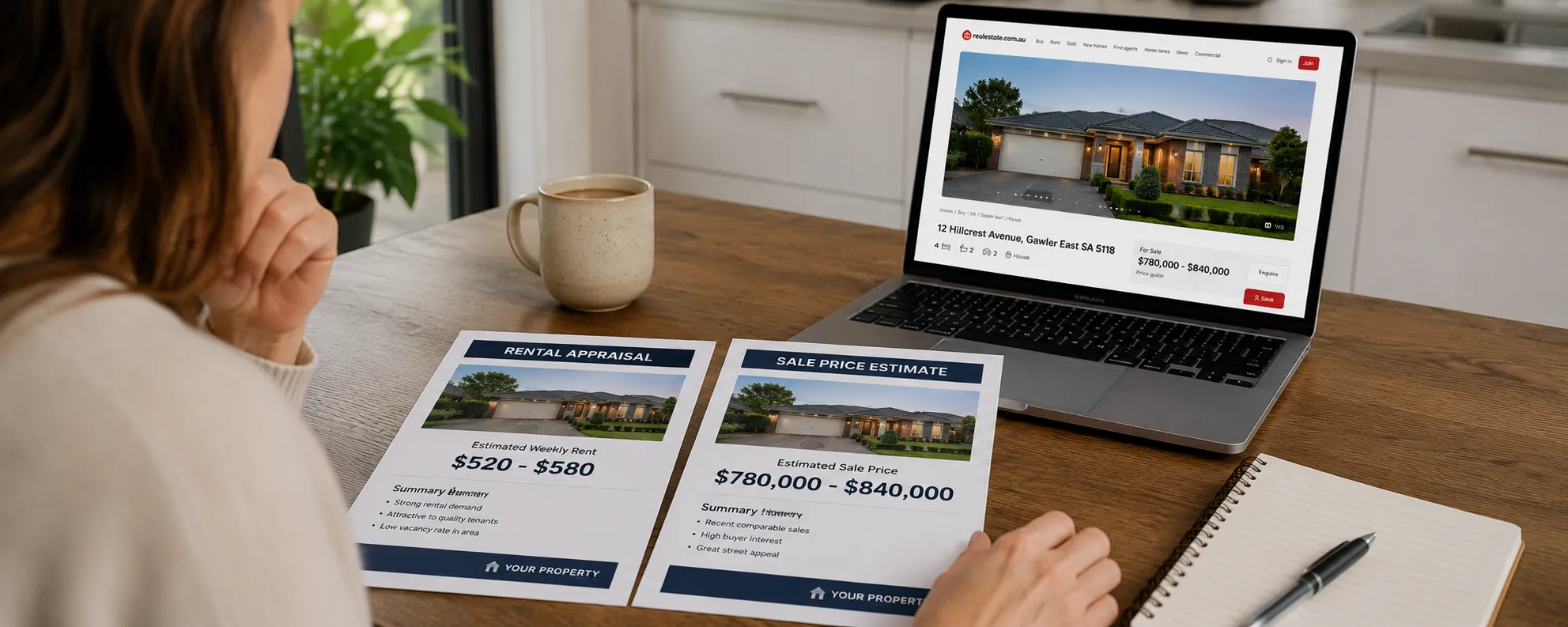
This is one of the most common questions vendors ask — and one of the least straightforward to answer, because the right answer depends almost entirely on individual circumstances rather than any universal principle.
Ask Yourself These Questions First
Do you need the capital from the sale now?
Probably sell. Holding a property you need to liquidate adds financial pressure that affects every other decision.
Is the rental yield strong relative to the property's value?
Model both options. Run the numbers with your accountant — yield, holding costs, CGT implications, and projected capital growth.
Does the property need significant maintenance investment?
Selling becomes more attractive. Deferred maintenance that a tenant will accelerate and you will have to fund is a real cost of holding.
Are your monthly holding costs covered by potential rent?
If yes, holding is worth modelling. If rent covers costs and you don't need the capital, a 12–24 month hold may improve your sale outcome.
Are you comfortable being a landlord?
Be honest. Tenancy disputes, maintenance obligations, and vacancy periods are real responsibilities. Don't hold because selling feels hard.
How Much Does It Cost to Sell My House?
Most homeowners focus on commission. The more important question is what you'll actually keep at settlement after every selling cost has been paid. Understanding the complete picture before you list helps you make better financial decisions.
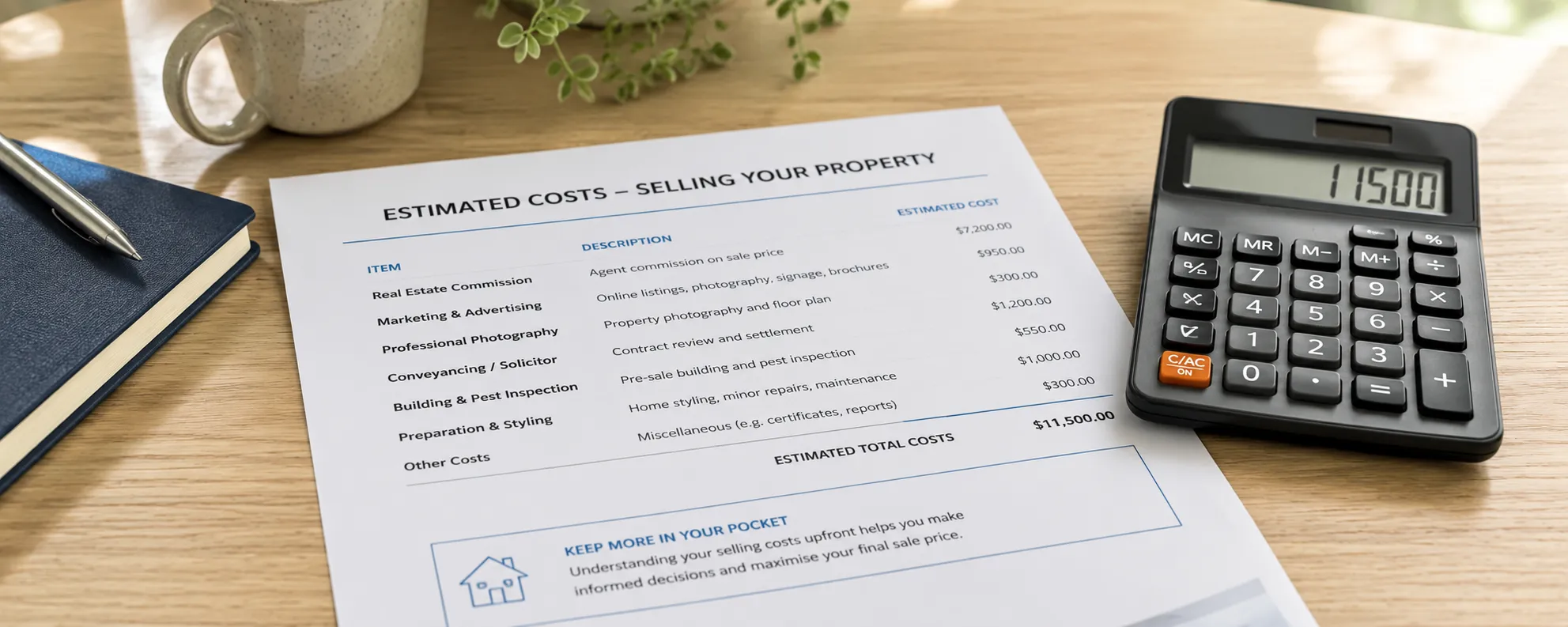
The largest selling cost for most vendors. In 2026, the national median sits at approximately 2% to 2.5% depending on state and agent. South Australia sits at the higher end of the national range. Commission is negotiable — most vendors accept the first rate quoted without questioning it.
Usually charged separately from commission and payable whether or not the property sells. Covers portal listing fees, professional photography, floor plans, and signboards. Premium packages with upgraded portal placement can run to $4,000 or more — not always necessary in suburban markets.
Covers the legal transfer of the property and preparation of the vendor's statement (Form 1 in South Australia). Get a written quote before engaging a conveyancer — some charge flat fees, others charge hourly.
Varies enormously by condition. A well-maintained property may need only cleaning and minor touch-ups. A property requiring painting, carpet replacement, or significant maintenance can cost several thousand. The question is always whether the preparation cost is likely to produce a higher sale price than it costs.
Commission Comparison — $650,000 Sale Price
Can I Sell My House Without an Agent?
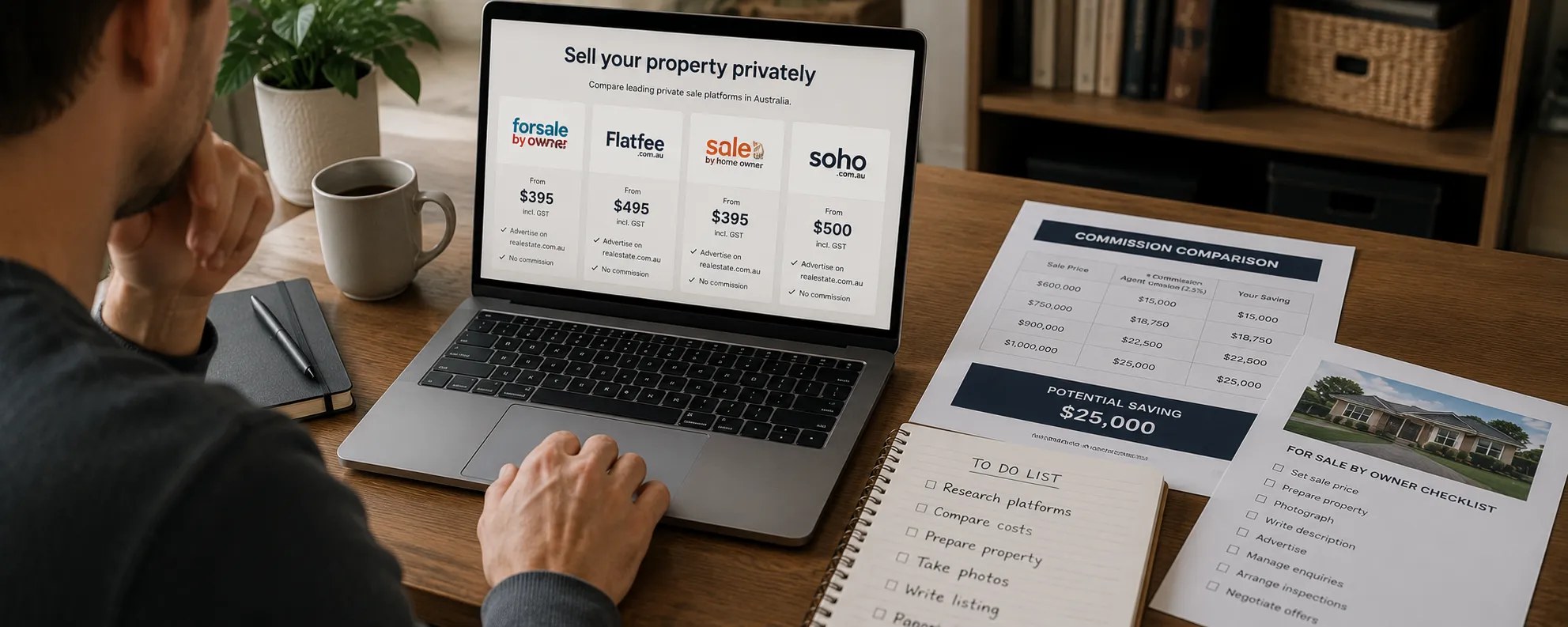
Yes — in every Australian state, a vendor is legally entitled to sell their property privately without engaging a licensed real estate agent. Private sale platforms exist that allow you to list on the major portals for a flat fee. The question is not whether you can sell privately. It is whether it is likely to produce a better outcome than using a skilled agent.
- Save the agent commission — potentially $10,000+ on a standard suburban sale
- Direct control over the process and timeline
- Deal directly with buyers without an intermediary
- Can work well for vendors with prior sales experience and strong negotiation skills
- Commission saving is only real if the final price is the same
- An experienced buyer negotiating against an inexperienced vendor has a structural advantage
- No professional management of buyer competition — the primary driver of strong prices
- Legal and administrative obligations remain identical whether or not an agent is involved
The most common outcome of private sales is not that vendors achieve a worse price. It is that they achieve a price without knowing whether a better one was available. Buyer competition is the primary driver of strong sale prices in residential real estate. An agent's job is to create and manage that competition. Without one, most vendors have no reliable way of knowing whether they left money on the table.
Andrew's Observation — The Three Private Sale Disadvantages Most Vendors Don't See Coming
1. You will never get the
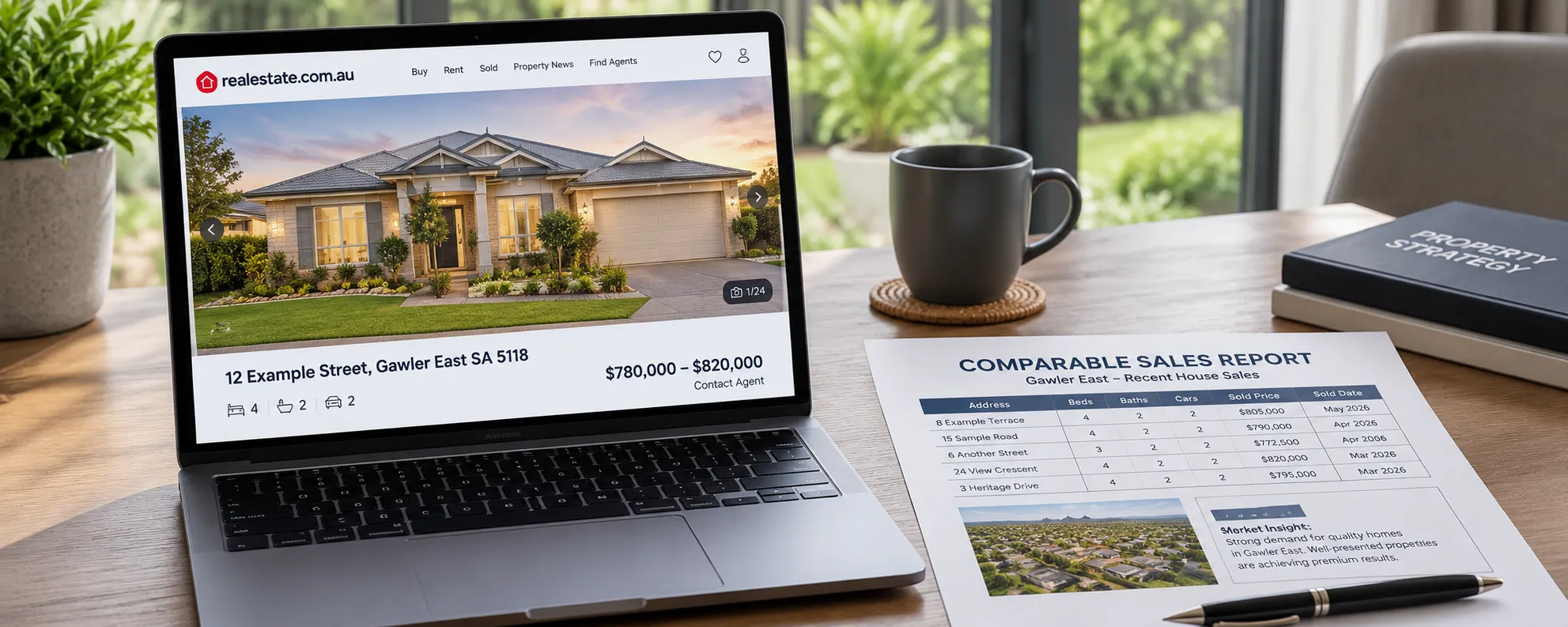
top spot on realestate.com.au
In South Australia, no private sale platform currently offers
vendors access to a Premium listing on realestate.com.au —
the dominant portal in this market. That means your property
launches smaller, further down the page, and with less visual
prominence than every agent-listed property from day one.
The Freshness Window — the first 14 to 21 days when buyer
attention and portal algorithms are working hardest in your
favour — passes while your listing sits below the fold.
That visibility gap is not recoverable.
2. You are negotiating
against someone with no emotional stake in the outcome
When you sell privately you are dealing directly with a buyer
who has no attachment to the property and may have purchased
many times before. You do have an attachment — and that
emotional tie makes it significantly harder to hold your
position. Most vendors reveal their bottom line earlier than
they realise simply because the conversation feels personal
in a way it never does for the buyer. A skilled agent has
no emotional stake. That distance is worth more than most
vendors understand until after the negotiation is over.
3. You don't know what
you don't know — and the list is longer than you think
Are you pricing where buyers are actually searching right
now — not where you hope they are? Do you know how to run
a comparable sales analysis from current data, not from
what sold six months ago? Do you know the specific listing
mistakes that quietly kill campaigns — the ones I see
experienced agents making every week in this market?
The people making those mistakes are licensed professionals
whose entire job is to get this right. They still get it
wrong. A vendor selling their own home, managing their
own emotions, negotiating their own deal, and running
their own comparable analysis is carrying every one of
those risks simultaneously — without the experience to
know which mistakes they are already making.
How to Sell My House Fast — What Actually Works
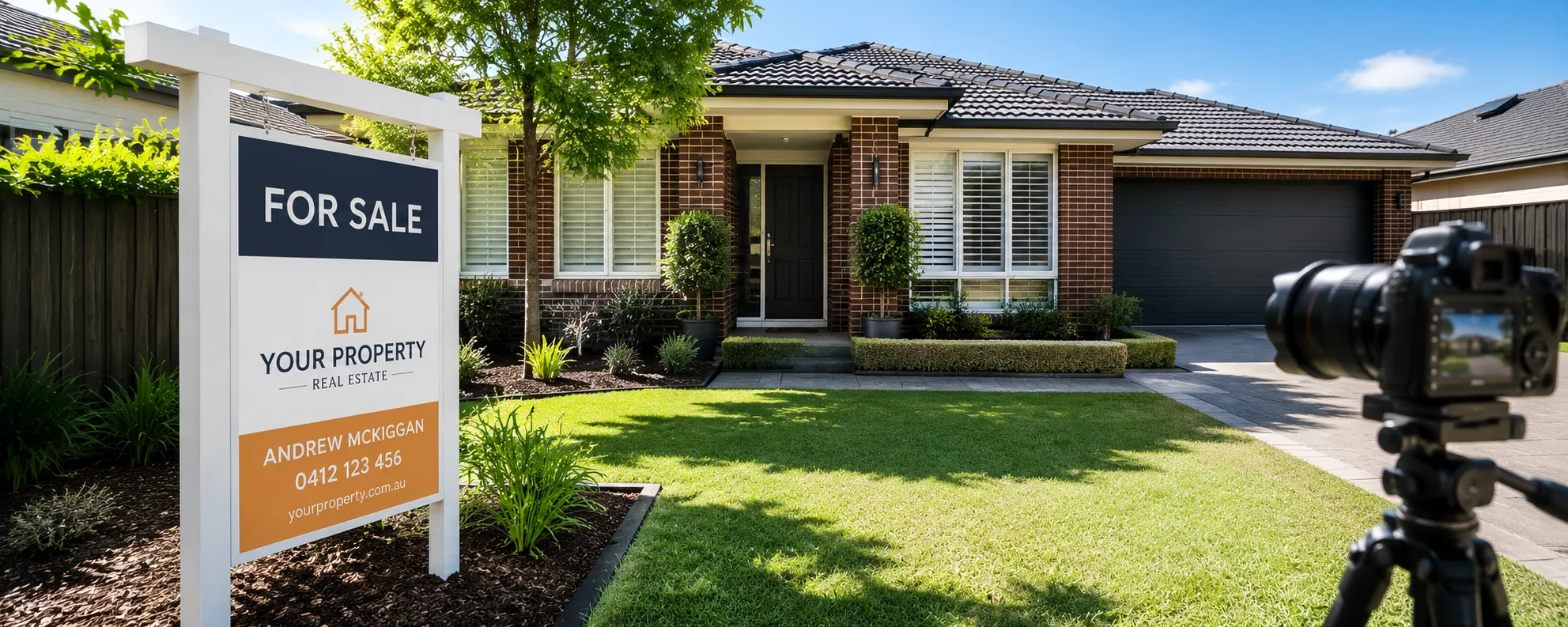
Selling quickly and selling well are not mutually exclusive — but they require the same foundation. A property that sells in the first two weeks of a campaign almost always does so because three things were in place from day one: the price was set correctly, the property was well-prepared, and the agent managed buyer interest actively.
- Correct price position from day one — buyers engage immediately when the price is where they are searching
- Professional photography — first impressions on realestate.com.au are formed in seconds
- Active agent follow-up after every inspection — urgency is created, not waited for
- Flexible settlement terms — removing buyer friction accelerates decisions
- Property fully prepared before launch — every open home counts
- Price reductions applied after the Freshness Window has closed
- Premium portal upgrades added in week three or four
- Increasing open home frequency without corresponding buyer follow-up
- Relisting under a new address format to reset days on market
- Waiting for the "right buyer" to self-select without agent-driven pressure
Getting My House Ready to Sell
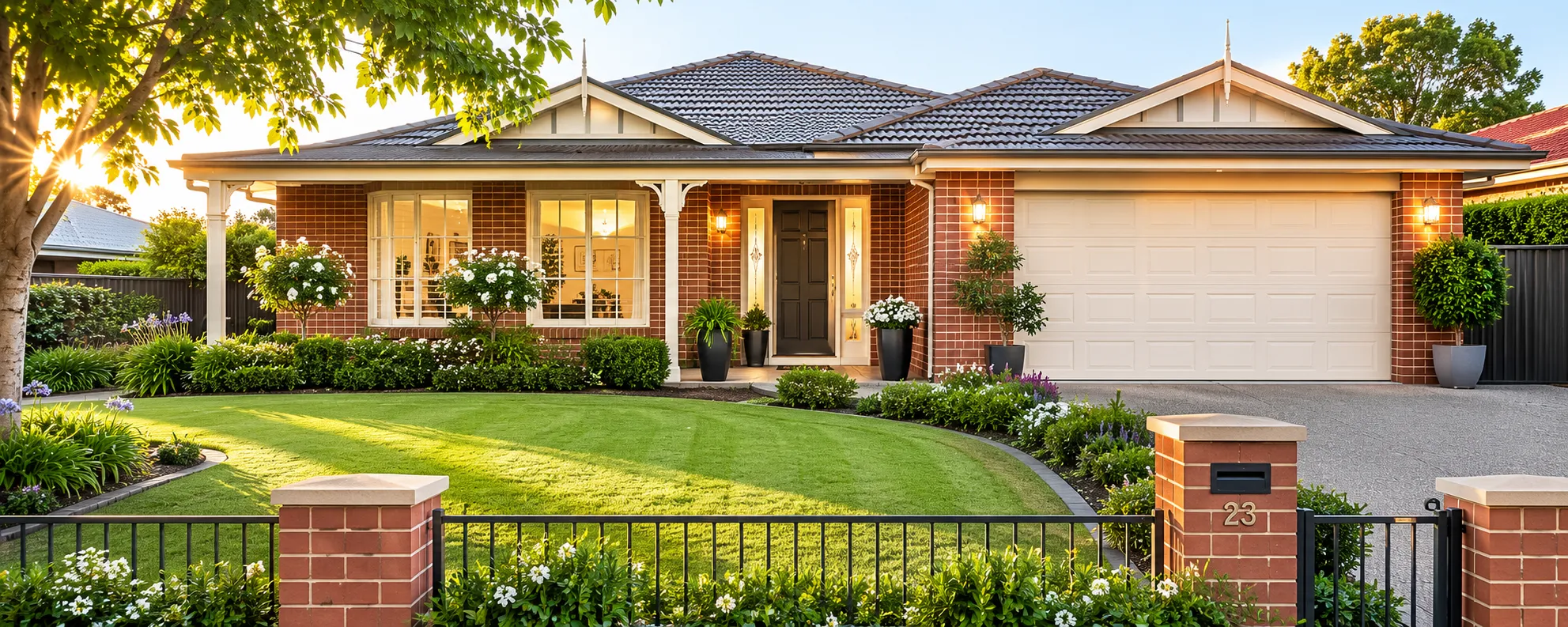
Preparing a property for sale is not about renovation. It is about removing the reasons a buyer might hesitate.
Buyers make decisions emotionally and justify them rationally. The emotional response to a property is formed at the kerb before they walk through the door and in the first 30 seconds inside. The practical details — size, price, location — are assessed afterwards. Preparation addresses the emotional layer first.
The front of the property is the first thing every buyer sees — at the open home and in the listing photographs. Mow the lawn, edge the garden beds, remove any items stored visibly at the front, clean the driveway, and touch up any paint on the fence or front door. These are low-cost improvements with disproportionate impact on first impressions.
Declutter before anything else. Buyers need to see the property, not the vendor's belongings. Remove personal photographs, excess furniture, and anything that makes rooms feel smaller or more personal. Clean thoroughly — including windows, light fittings, and kitchen appliances. Address obvious maintenance issues: dripping taps, sticking doors, cracked tiles, scuff marks on walls. Small costs that prevent buyers from mentally deducting thousands from their offer.
Professional home staging is not always necessary — but neutral, tidy, and well-lit presentation always is. If the property is vacant, consider minimal furniture hire for the living room and master bedroom. If occupied, focus on removing rather than adding. A well-presented occupied property consistently outperforms an overstaged vacant one.
Should I Sell My House Now or Wait?
This is the question most vendors are really asking when they ask about timing. The honest answer is that it depends on four things — none of which is the month on the calendar.
The Four Questions That Actually Answer This
What are comparable properties currently achieving?
If similar properties are selling within their range and in a reasonable timeframe, conditions are working in your favour. If they're sitting 60+ days and selling below listed price, the market is telling you something.
What is your monthly holding cost?
At $3,000/month holding cost, waiting three months to gain $5,000 is marginal at best. Most vendors overestimate the benefit of waiting and underestimate the cost of holding.
What is the competing stock picture?
Selling into constrained supply means more buyer attention per listing. Waiting for spring and entering a market with 40 competing listings instead of 15 is not always the improvement it looks like.
Are you ready to list correctly?
The most reliable predictor of a strong sale is not the season. It is entering correctly priced, well-prepared, with the right agent. If those three are in place, the argument for waiting weakens considerably.
Frequently Asked Questions — Sell My House
The standard process involves engaging a licensed real estate agent, obtaining a vendor's statement (your agent will advise how this is handled in your state), preparing the property for sale, setting a price position based on comparable sales, and running an open home campaign until an offer is accepted. Most residential properties sell by private treaty — a listed price or price range with offers negotiated between buyer and agent. The full sequence is explained in the steps section above.
Yes — private sale is legal in every Australian state. You can list your property on the major portals through a flat-fee platform without engaging a licensed agent. However, in South Australia no private sale platform currently offers Premium listing placement on realestate.com.au — the dominant portal in this market. That means your property will launch with less visibility than every agent-listed property from day one, and that gap is hardest to overcome during the critical first 14 to 21 days of a campaign.
A low-commission full-service agent is worth considering as a middle option — professional representation and negotiation at a reduced fee. See the Real Estate Agent Fees guide for a full comparison.
The main costs are agent commission (typically 1.5% to 2.5% of the sale price depending on agent and state), marketing and advertising (typically $800 to $2,500 for a standard package), and conveyancing (typically $800 to $1,500 in South Australia). On a $650,000 sale at standard commission rates, total selling costs typically range from $14,000 to $20,000. At 1.5% commission the total is materially lower. A full breakdown with worked examples is at the Selling Costs guide.
The most reliable way to sell quickly is to enter the market correctly priced from day one. The first 14 to 21 days — the Freshness Window — are when buyer attention is at its peak and genuine competition is most likely to emerge. A correct price position, professional presentation, and active agent follow-up during that window produces faster results than any post-launch tactic including price reductions, upgraded portal listings, or increased open home frequency.
This depends on what comparable properties are currently achieving in your price bracket, what your monthly holding costs are, and whether the current competing stock picture works in your favour. A detailed framework for making this decision is at the Best Time to Sell a House guide.
Yes — private sale is legal and some vendors do it successfully. The key risks are reduced portal visibility (no Premium listing access in most states), negotiating directly against buyers with no emotional stake in the outcome, and the knowledge gap around pricing, campaign management, and the specific mistakes that quietly compromise results. The legal and administrative requirements — vendor's statement, contract, settlement — remain identical whether or not an agent is involved.
A vendor's statement (Form 1 in South Australia or equivalent in your state) — your agent will advise how this is arranged, professional photography, a compliant sale contract, and a price position based on current comparable sales. If using an agent, a signed agency agreement before marketing begins. The complete checklist — including what to do before engaging an agent, before launch, during the campaign, and at offer stage — is in the section above.
If you need the capital, sell. If you do not need the capital and the rental yield is genuinely strong relative to the property's value and holding costs, modelling both options with your accountant is worth doing. The decision should be based on numbers — not on emotional attachment to the property or an aversion to the sale process. Capital gains tax implications vary depending on whether the property has been your primary residence — speak to your accountant before committing to either path.
Local Perspective — Selling Your House in Gawler and the Northern Adelaide Corridor

Andrew McKiggan is the principal and sole licensed agent of Gawler East Real Estate (RLA 248695), an independent residential agency based at 1 Lewis Ave, Gawler East SA 5118. Andrew sells residential property across the Gawler district and northern Adelaide corridor at 1.5% commission or lower — without franchise fees, without split commissions, and without handovers to junior staff.
Selling a house in the Gawler district involves the same nine decisions outlined on this page — but the market context shapes how each one plays out. The buyer pool here is predominantly made up of owner-occupiers purchasing at or near the limit of their borrowing capacity. That means price positioning carries more consequence than it does in higher-priced markets. A property that launches even marginally above where comparable sales are settling does not attract extended negotiation — it attracts silence.
The selling process in this market moves quickly when it is working. Properties that enter correctly priced with strong presentation and active buyer follow-up regularly achieve offers within the first two weeks. Properties that enter overpriced accumulate days on market publicly — and in a market where buyers are comparing every available option at their price point, a listing that has sat for 45 days is already working against itself.
If you are considering selling your house in Gawler or the surrounding suburbs — Hewett, Willaston, Evanston, Angle Vale, Munno Para — contact Andrew directly for an honest appraisal built from current comparable sales.
The Gawler real estate agent vendors in this district rely on most is one who tells them what the market will pay — not what they want to hear.
Call 0493 539 067 or email enquiries@gawlereastrealestate.au.
Selling a house is not complicated. It is a sequence of nine decisions — and the result is determined not by the market, but by how well each decision is made.
The vendors who achieve the strongest results are the ones who asked the right questions before they started. Not the ones who moved fastest, or listed at the highest number, or chose the agent with the most prominent signboard.
The right question is never "what is my house worth?" It is: "What does the current market evidence say my house is likely to achieve — and what is the strategy that gives me the best chance of achieving it?"
