
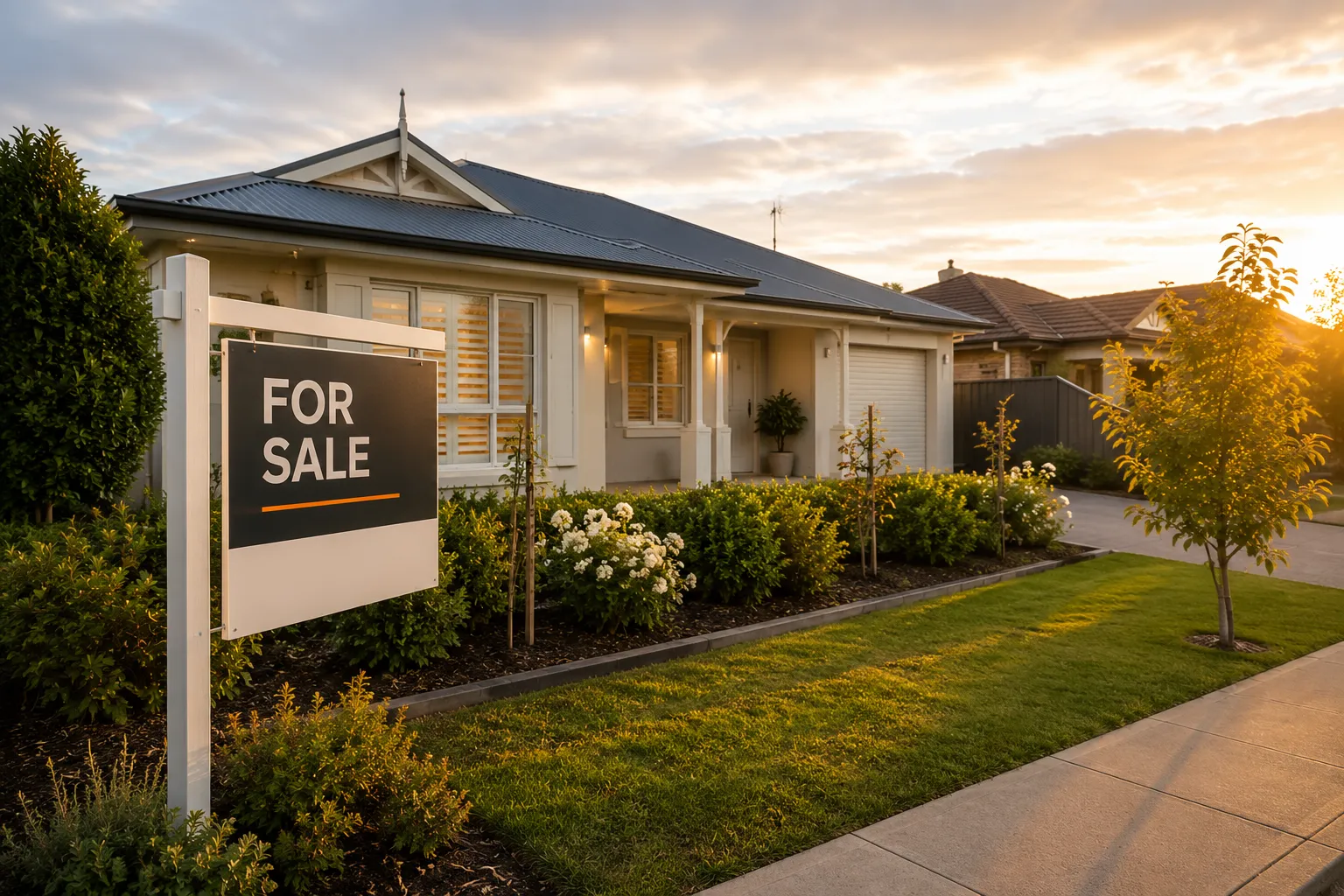
Most experienced real estate agents will often arrive at a similar range of comparable sales for your property. The difference isn't usually the data. It's how that information is interpreted — and the strategy built from it.
Most people only sell a handful of homes during their lifetime. There isn't much opportunity to learn from experience — which is why understanding what separates a good pricing strategy from a poor one matters so much before the sign goes up.
The pricing strategy — the deliberate thinking behind where that number sits relative to the market — often happens in the background, if it happens at all. This guide exists to bring it to the foreground.
Pricing a house to sell is not the same as valuing it. It is the positioning decision that shapes how buyers interpret your property from the moment it appears in their search results — and that interpretation, formed within the first two weeks of a campaign, is extraordinarily difficult to change once it has set.
Whether you're selling in Adelaide, Brisbane, Melbourne, or a regional town, the principles on this page remain remarkably consistent.
Markets change. Buyer numbers change. Comparable sales change. But buyer psychology changes far more slowly. The way people interpret price, urgency, and value is remarkably consistent — which is why the principles below apply regardless of where your property is located.
Every section of this guide is written to answer one question: how do you make sure that decision works in your favour, not against you?
What Is a Property Pricing Strategy — and How Is It Different From a House Valuation or Appraisal?
Three terms get used interchangeably at listing appointments — valuation, appraisal, and pricing strategy. They are not the same thing, and the difference matters more than most sellers realise.
Formal Licensed Assessment
Completed by a licensed valuer for lending, legal, or taxation purposes. Produces a point-in-time estimate based on prescribed methodology. Not a campaign tool.
Agent's Opinion of Price
An agent's view of likely sale price based on current market conditions and comparable sales. Not legally binding. Useful as a reference — not a strategy in itself.
The Positioning Decision
The deliberate decision about how a house is positioned in the market at launch — relative to comparable sales, current buyer demand, and the seller's risk tolerance and timeline.
Appraisals and valuations answer the question: what is this property worth?
The price isn't the strategy. Where your property enters the market — and how buyers interpret that position — is the strategy.
Those are not the same question — and confusing them is where many campaigns begin to go wrong before the first open home has been held.
→ For a full explanation of how a property appraisal differs from a formal valuation — and why the distinction matters before you accept any number from any agent: Understanding Property Appraisals vs Valuations in Australia
Why the First 14 to 21 Days Determine Whether Your House Sells Well or Sits — The Freshness Window
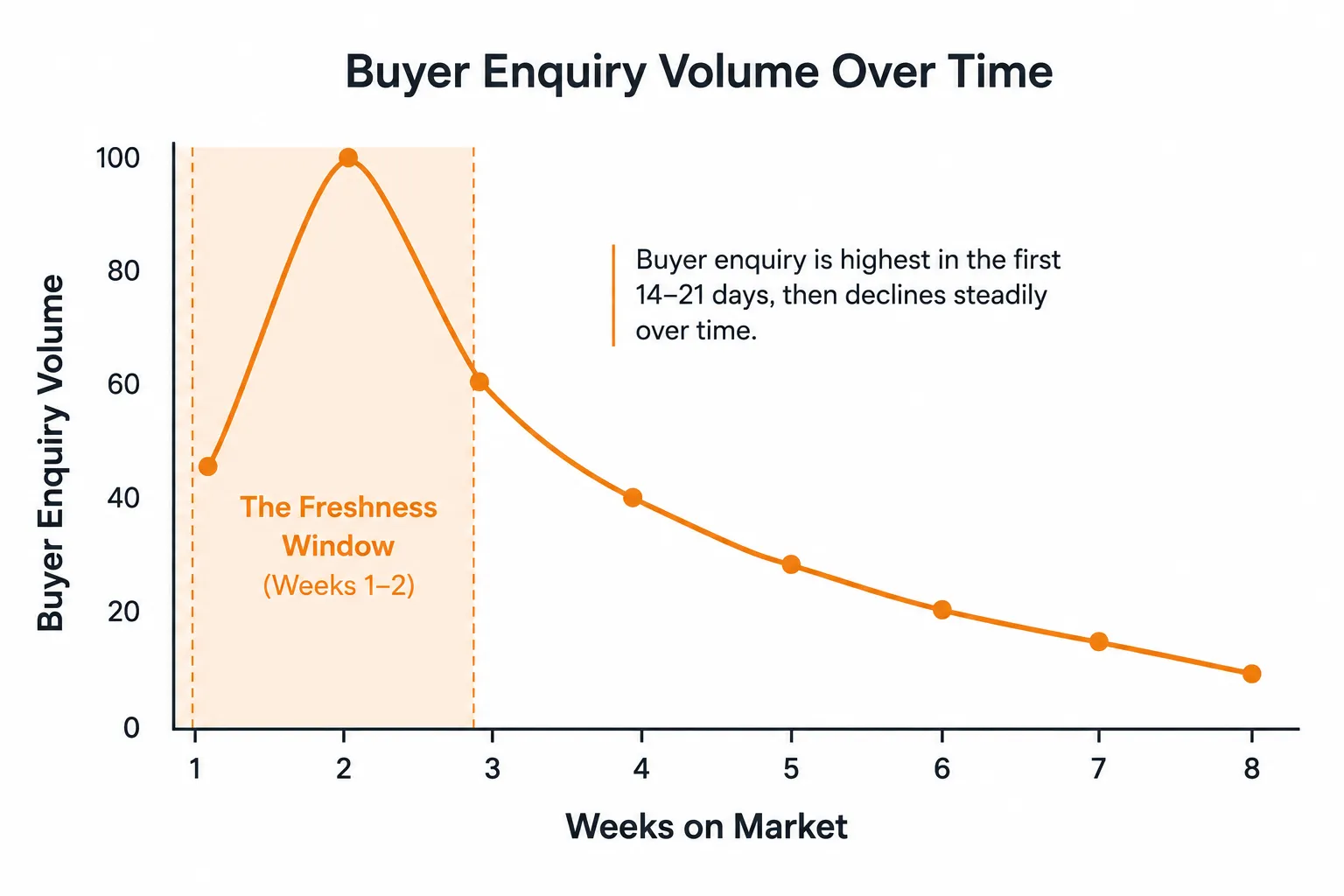
When a house enters the market it arrives with something that cannot be manufactured later: novelty. Buyers who have been monitoring the market in that price bracket see it for the first time. The property is fresh, uncompromised by history, and occupying maximum attention.
The Freshness Window is when inspection numbers are highest, enquiry is most active, and the conditions for competitive offers are most likely to exist. It is also when pricing errors are most expensive.
There is a mechanical reason for this specific to South Australia.
In South Australia, realestate.com.au is the dominant portal for residential property search. Domain holds significant market share in the eastern states but not in SA — which means your buyer pool is overwhelmingly concentrated on one platform.
When a property first lists, a premium listing enters at or near page 1, position 1 in the relevant search bracket — maximum visibility at the exact moment buyer attention is highest. As the days pass, newer listings push yours back. Page 1 becomes page 2. Then page 3.
Think about how you use Google. Do you regularly browse into page 2 or page 3? Most people don't — and when they do, the numbers drop sharply with each page. Buyer behaviour on realestate.com.au follows exactly the same pattern. The Freshness Window closes not just because buyers become familiar with your listing — but because the portal's own mechanics push you progressively further from where the majority of active buyers are looking.
This is why correct pricing and a premium listing tier on launch day are not optional extras. They are the only reliable way to occupy page 1 during the period when being on page 1 actually produces inspections.
Andrew's Observation
The sellers who use the Freshness Window well are not always the ones with the best properties. They are the ones who arrived at launch day with the right price, the right listing tier, and a clear understanding of what the first three weeks needed to produce. The sellers who struggle are almost always the ones who thought they could adjust later. You can. But later is never as good as now.
Andrew McKiggan — Owner & Principal, Gawler East Real Estate RLA 248695
Worked Example: From Comparable Sales to Pricing Strategy
To show how this framework actually works, here's an example drawn from an actual appraisal report, with the address and identifying details removed for privacy — this illustrates our method, not a specific current listing. Every appraisal is different: the comparables used, the weighting applied, and the final figure all depend entirely on the property in question. What follows is the actual reasoning from one real appraisal, kept exactly as it was calculated, to show the method rather than a number that applies to your home.
Consider a four-bedroom, two-bathroom home in Evanston Gardens, on a 450m² block with 177m² of internal living space, built in 2015.
Step 1: Same-Suburb Comparables
We start with recent sales in the same suburb, matched as closely as possible on land size, floor area, bedrooms, bathrooms, car spaces and build year.
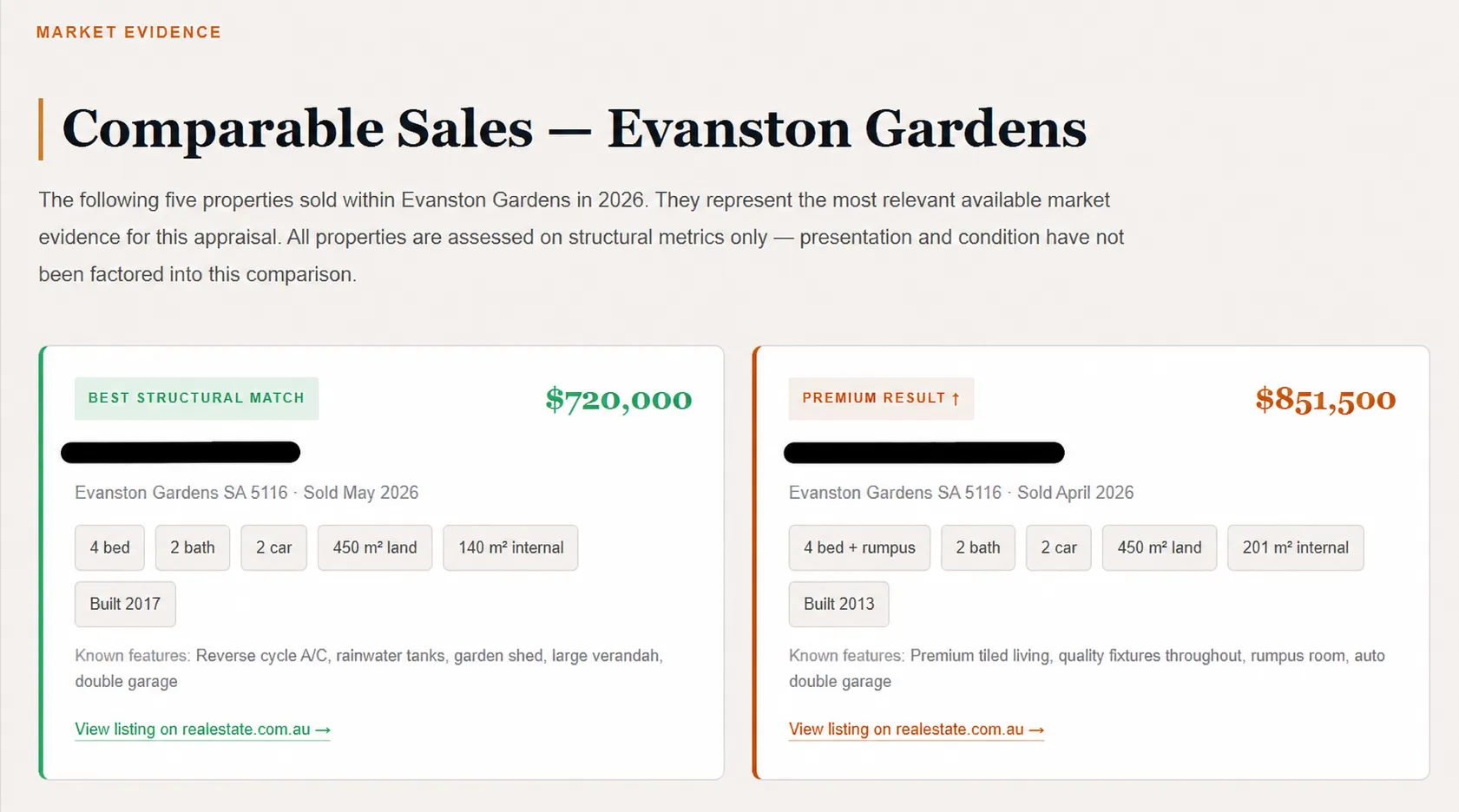
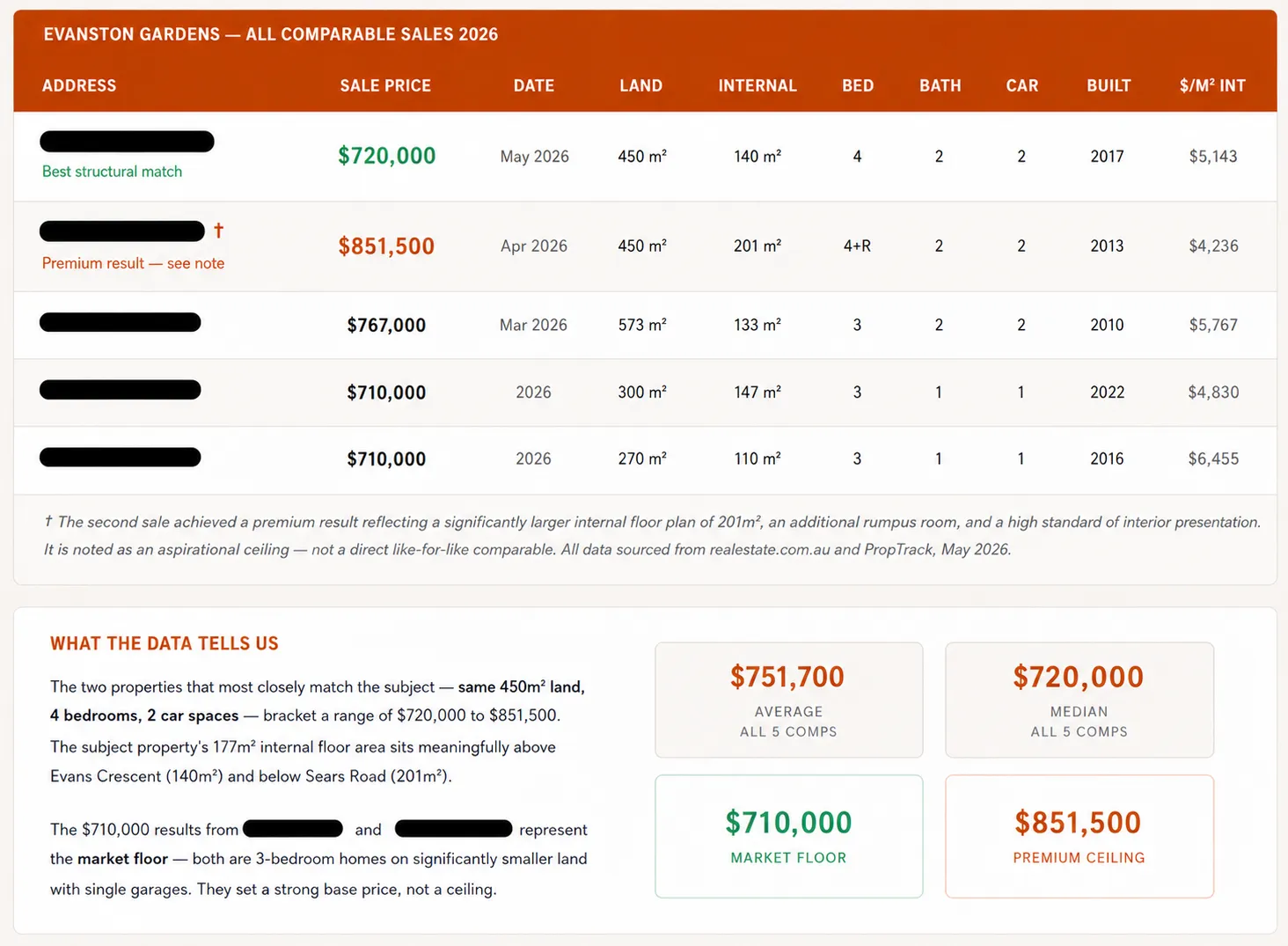
The closest structural match — same 450m² land, same bedroom and car configuration — sold for $720,000. The remaining results are smaller, three-bedroom homes on significantly less land with single garages; they represent the market floor for this type of property, not a ceiling. One result, on a larger 450m² block with a bigger floor plan and premium presentation, sold well above the rest — shown here as an honest reference point for what the top of the market can achieve, not a figure this property is expected to reach.
Step 2: Widening to Adjacent Suburbs
Same-suburb evidence alone isn't always enough. Where that's the case, we widen the search to immediately neighbouring suburbs — in this example, Evanston South, Hillier and Willaston — looking specifically for sales that structurally match the subject property, not simply for nearby suburbs in general.
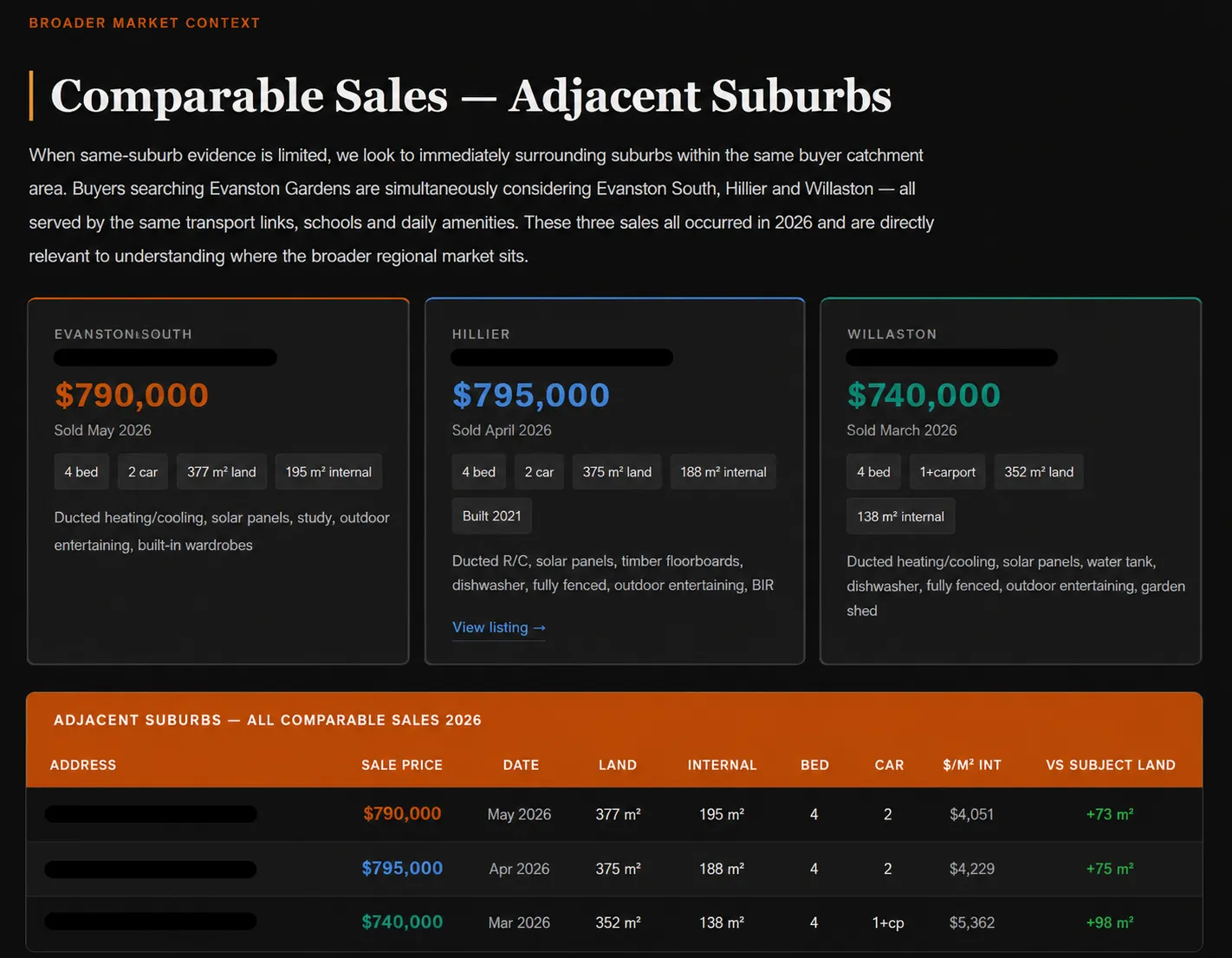
Both of these results were achieved on meaningfully less land than our example property. That's a genuine structural advantage worth factoring in — a larger, older-standard block isn't just bigger on paper, it's a scarcer feature these smaller, newer-release blocks simply can't offer.
Step 3: Checking the Active Competition
Once a property goes to market, it isn't just being judged against past sales — it's being compared directly against whatever else is currently listed nearby.
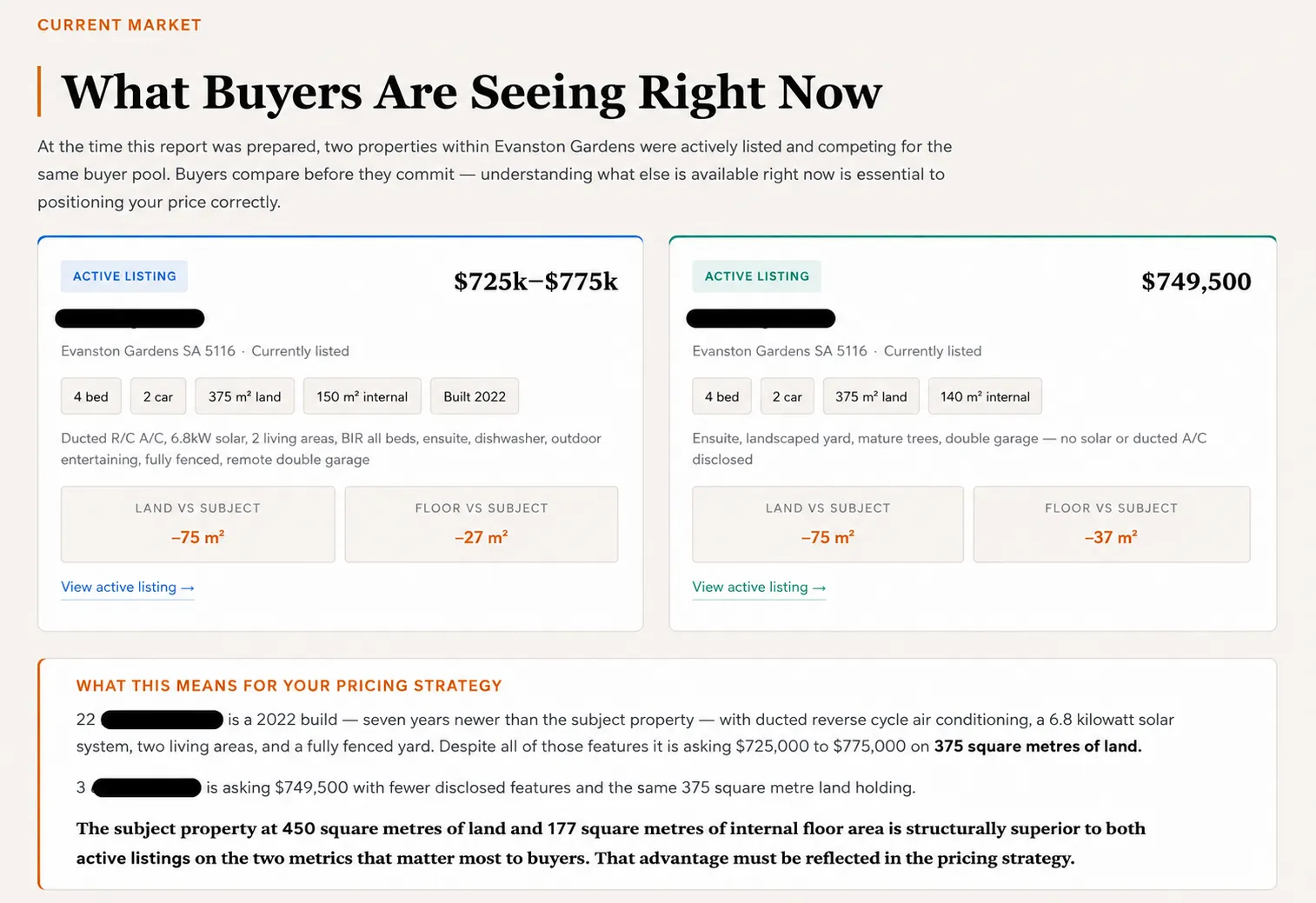
Both active listings are asking similar or higher prices than our example property's likely range — on meaningfully less land and less floor area. That's a genuine competitive advantage worth factoring directly into pricing strategy, not just noting in passing.
Step 4: Weighing the Whole Picture
Putting the evidence together, here's an honest look at where this kind of property sits — the case for a stronger result, and the factors that genuinely need to be weighed the other way.
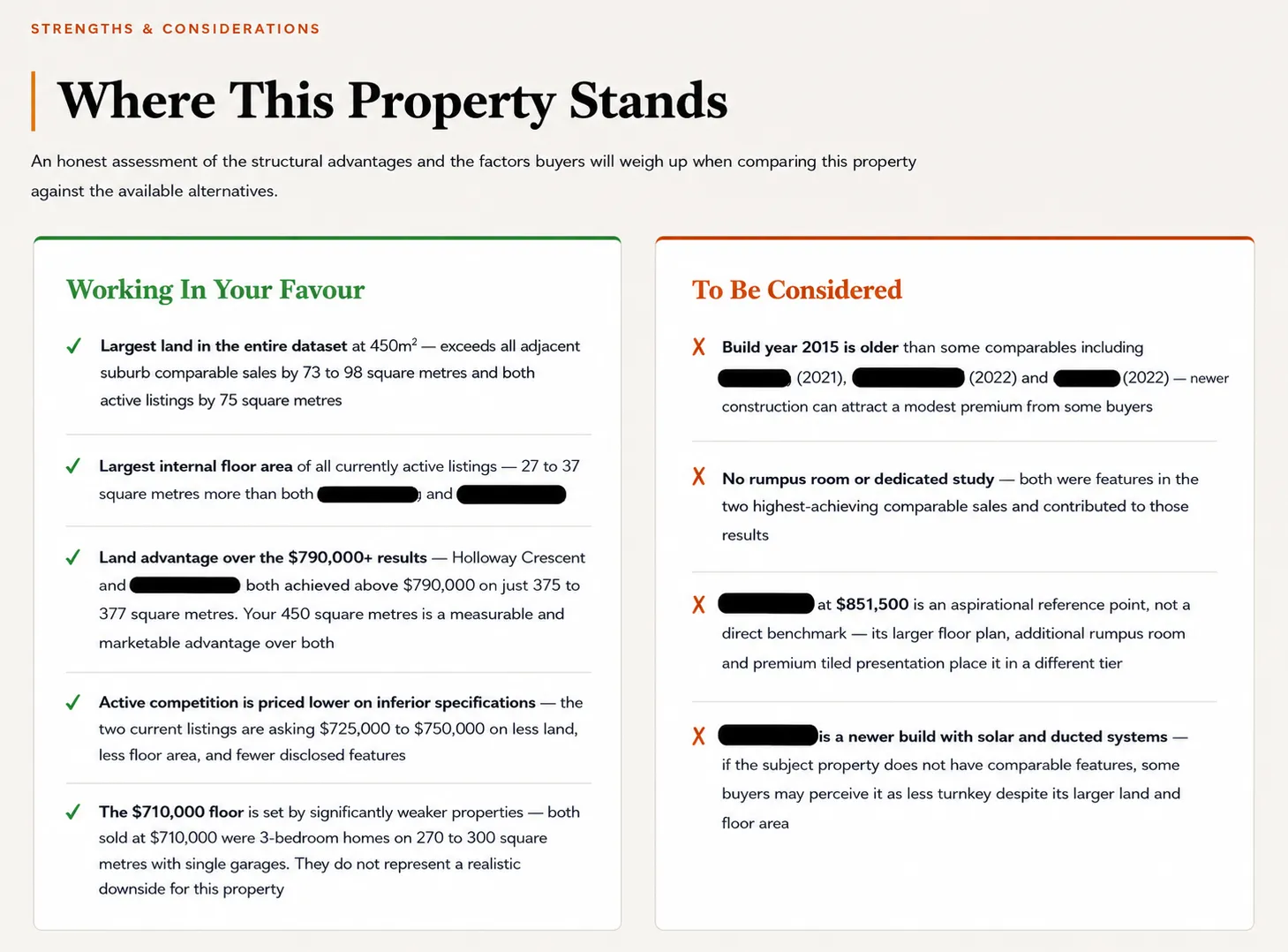
Working in favour
- Land size at the top of the comparable range — a structural advantage over every adjacent-suburb result and both active listings
- Floor area larger than every currently active listing in the same suburb
- The lower comparable results are set by smaller, weaker-specification properties — not a realistic ceiling for this profile
To be considered
- Build year is older than some newer comparables, which can attract a modest premium from buyers who value a newer build
- No rumpus room or additional living zone — a feature present in some of the highest-achieving local sales
- All comparables in this example share the same single-level construction; where a suburb has a genuine mix of single- and double-storey stock, that distinction gets weighted the same way land size and floor area are here
How the Numbers Come Together
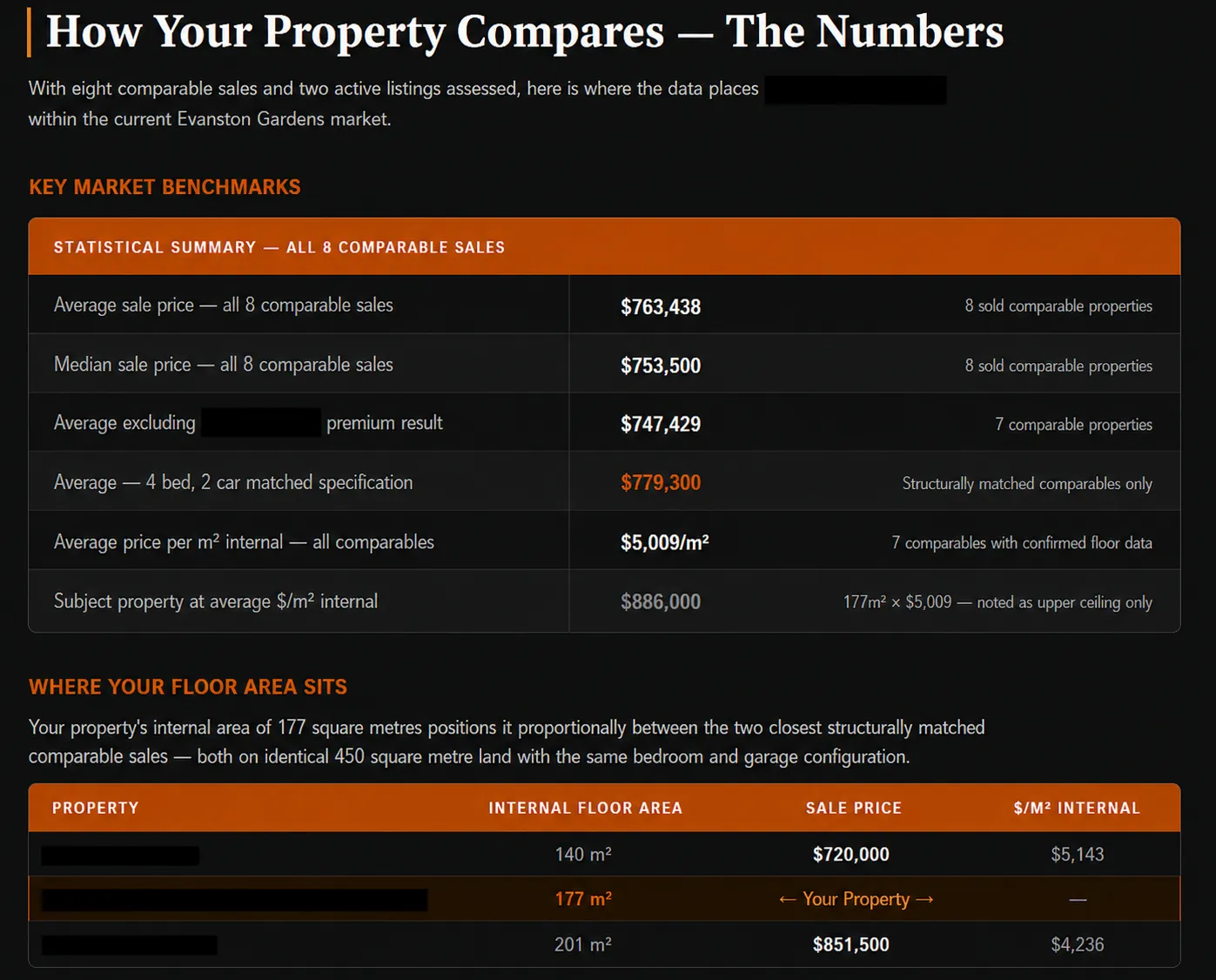
Beyond the individual comparable sales, we also cross-check using price per square metre of internal floor area, and interpolate where a property sits between two closely matched comparables by floor area. The two properties that most closely match this example on land size and configuration bracket a clear range — and where a comparable sale listing was still available online, we linked directly to it so the client could verify the evidence for themselves, focused on the properties closest in specification to the subject home.
A Note on Buyer Psychology
A buyer drawn to move-in condition and a contemporary finish might initially favour a newer, smaller-block property over an older home on genuinely larger land. That preference is real — fresh fixtures and the sense that nothing needs doing is a genuine drawcard for a section of any market.
Part of getting the price right is making sure every buyer understands what they'd be trading away by choosing the newer, smaller option — land that simply isn't being released at that size anymore, and what that means for long-term value. It's also worth naming the opposite temptation honestly: when a seller sees a high theoretical number — land size multiplied by the suburb's average rate per square metre, for instance — it's natural to want to believe that's what the home is worth. In this example, that calculation would suggest a figure well above $850,000. It isn't used on its own, because it assumes a level of finish and presentation the property doesn't actually have. Being upfront about the numbers we're not relying on is as important as the ones we are.
The Estimate
Bringing the structural comparison, the adjacent-suburb evidence, the active competition, and the statistical cross-checks together, here's how that reasoning was translated into a recommended range for this specific example.
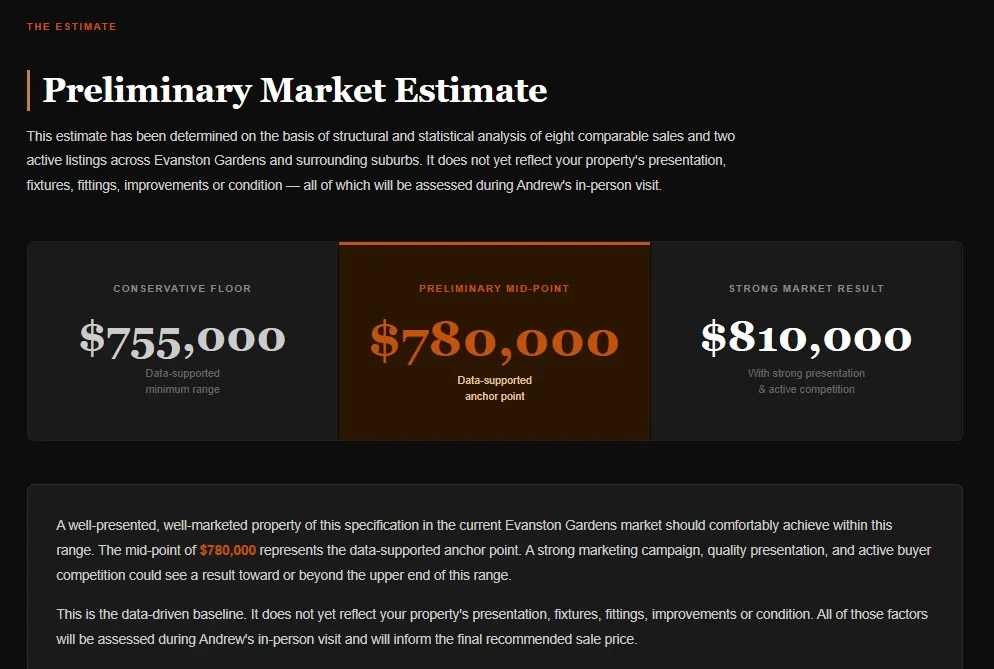
This is the data-driven baseline only. It doesn't yet reflect the property's presentation, fixtures, fittings, improvements or condition — all of which are assessed in person, and all of which can move the final recommended figure. Every appraisal we prepare follows this same structure; the specific comparables, weighting, and resulting range will always be tailored to the property in front of us.
From Evidence to Buyer Appeal
Understanding why a property's land size matters isn't just useful for setting the right price — it's directly useful for selling the property itself.
Once we know what a larger block genuinely offers a specific type of buyer, that becomes part of the story we tell — in the marketing campaign, in the brochure, and directly to buyers walking through on inspection day.
Take our Evanston Gardens example: newer estates in the same area are now releasing blocks closer to 300m², compared to the 450m² our example property sits on. That's not just a number — it's 50% more land than almost anything currently being built nearby. To a young family, that might mean room for a trampoline and a proper backyard without giving up the house itself. To someone planning ahead, it might mean space for a shed, a workshop, or simply the breathing room a smaller modern block can't offer.
We don't just calculate that advantage — we sell it. Buyers respond to what a property genuinely offers them, not just a square metre figure on a listing. Turning the data into a reason to fall in love with the property is part of the campaign, not an afterthought.
This is the kind of evidence-based reasoning — and the kind of honest limitation — that goes into every appraisal we prepare.
Request Your Free, Evidence-Based Property Appraisal
Receive a personalised, evidence-based pricing report built from genuine comparable local sales — followed by an on-site assessment to refine your property's likely market value.
Request Your Free Property Appraisal →Prefer to talk it through first? Call Andrew directly on 0493 539 067, or get in touch here.
What Buyers Are Actually Looking For Before They Attend an Inspection
Buyers in the Australian residential market rarely assess price in isolation. Before attending a single open home, they are comparing your listing simultaneously against:
- Recent comparable sales in the same suburb and price bracket
- Competing listings currently available at similar prices
- Their own pre-approved finance limit and what it realistically buys them
- The implied message the price sends about the vendor's flexibility
That last point is the one most commonly overlooked.
Consider a house listed at $790,000–$820,000 in a market where comparable properties have been selling at $740,000–$760,000. That price range is not just a number — it is a statement. It tells buyers the vendor believes their property is materially superior to every recent comparable sale. It may be. But if buyers cannot see why from the listing, the photography, and the street appeal, they do not give the benefit of the doubt. They move to the next property.
A price range that sits above where the market is transacting does not create curiosity. In most cases it creates one of two responses — and neither of them is the one you want:
Of these three responses, only one produces the outcome you are looking for. The pricing decision made before launch determines which response your listing generates.
A real estate pricing strategy is, at its core, the art of creating the conditions where urgency is possible. Everything else follows from that.
The Pricing Models — and the Trade-offs Each One Commits You To
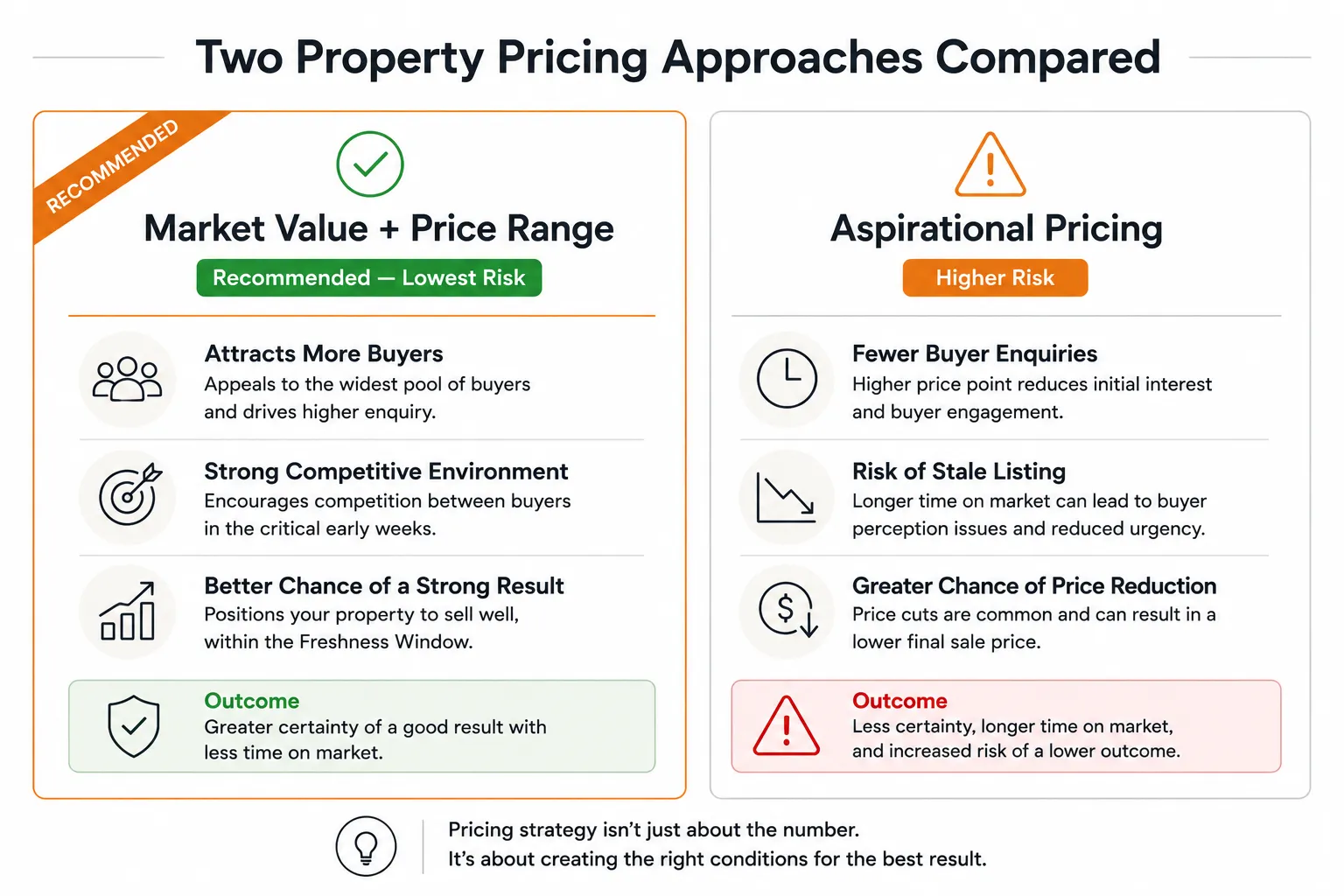
In practice, pricing a house to sell comes down to one fundamental decision — and then how that decision is expressed to buyers on the portals.
Market Value Pricing — Expressed as a Price Range
The price is set at market value, supported by recent comparable sales. It is then expressed as a well-calibrated range — typically 8–10% — which captures buyers searching across overlapping price brackets and signals genuine intent to transact. This is not two separate strategies. It is one strategy, correctly executed.
● Lowest RiskAspirational Pricing
Positioned above where comparable properties are transacting. Reduces the active buyer pool, extends days on market, and creates the conditions for strategic waiting behaviour.
● Higher RiskThe range is not a compromise or a hedge. It is how buyers actually search — in brackets, not at fixed points. A well-calibrated range at market value is the most effective way to ensure your listing appears in front of every active buyer in your price segment during the Freshness Window.
How Market Value Range Pricing Works in Practice
Market value pricing positions the house in line with recent comparable sales, adjusted for condition, features, and current demand. Expressing that as a range — rather than a fixed price — does several things simultaneously:
- Captures buyers searching across overlapping price brackets on realestate.com.au
- Signals the vendor is serious about transacting — not anchored to a single inflexible number
- Generates steady enquiry without requiring the market to recalibrate its expectations
- Gives the negotiation room to breathe without compromising the price position
- Carries the lowest risk of extended days on market of any approach
It is the most predictable path to a result. It is also, for sellers whose property has genuine differentiating features, occasionally the most conservative — which is why the agent's negotiation skill matters as much as the price position itself.
When Aspirational Pricing Is and Isn't Appropriate
Aspirational pricing positions the house above the level supported by immediate comparable sales. It is not automatically wrong — but it changes the campaign in ways sellers need to understand before committing.
It fails — when it fails — because:
- The active buyer pool at that price point is smaller
- Inspection numbers are lower and less consistent
- Days on market increases, which creates the strategic waiting behaviour described above
- The seller's tolerance for uncertainty is tested before an outcome arrives
Success depends on market depth at that price level, the property's genuine capacity to differentiate itself, and the seller's willingness to hold position under pressure. It is a legitimate strategy in the right conditions — but it carries the highest consequences when those conditions are not present.
Every pricing strategy interacts with market depth — the number of buyers willing and able to transact at a given price level. As the price rises above where comparables are transacting, the buyer pool narrows.
An Overpriced House vs a Well-Priced House — Why the Risks Are Not Symmetrical
Pricing decisions involve trade-offs — but the consequences of pricing too high and pricing too low are not mirror images of each other.
When Priced Too High
- Enquiry slows during the Freshness Window
- Buyers monitor rather than engage
- Inspection numbers decline before offers can form
- Price reductions confirm hesitation rather than create urgency
- Days on market reshapes how buyers interpret the listing
When Priced at or Below Range
- Enquiry typically increases, sometimes sharply
- Inspection numbers rise
- Active buyer pool is larger
- Competitive offers more likely to emerge
- Agent has more to work with in negotiation
The pricing decision made before launch determines which path the campaign follows. The Freshness Window closes before most sellers realise a course correction is needed.
Why a House Not Selling Is Rarely Fixed by a Price Reduction Alone
A common assumption is that pricing can be adjusted freely without lasting consequence. If the house is not selling, reduce the price. Problem solved.
In practice, the market does not forget.
Buyers track properties they have seen and passed on. When a price reduction appears after an extended campaign, the question it raises is not "is this now a better deal?" It is "why hasn't this sold, and what does that tell me?"
That question shifts the negotiating frame entirely. Before the reduction, the buyer was assessing whether the property was worth the asking price. After extended days on market and a reduction, the buyer is assessing what the failure to sell reveals — about the property, the vendor's position, or the original advice.
Price reductions do not erase that history. In many cases they confirm it.
Once the Freshness Window closes and early momentum is lost, later price adjustments rarely recreate the same level of buyer urgency or competitive tension. The campaign can still result in a sale — but the outcome is often below what a correctly priced launch would have achieved.
When to reduce the price: if a property has received consistent inspection traffic but no offers after three to four weeks, the price is sending the right buyers the wrong message about flexibility. If there has been no inspection traffic at all despite adequate marketing, the price is likely placing the property outside the search brackets where active buyers are looking.
Andrew's Observation
The most common conversation I have with vendors after a price reduction is not about the new price. It is about why the original price was set where it was. In almost every case, the answer is the same: the agent gave them a number they wanted to hear. The price reduction is not the problem. It is the evidence of a problem that existed from day one.
Andrew McKiggan — Owner & Principal, Gawler East Real Estate RLA 248695
A Real Example — How Pricing Strategy Interacts With Time and Buyer Depth
The following account is not a client campaign. It is Andrew's own property sale — and what it illustrates about aspirational pricing, honest marketing, and the discipline required to hold a position the market initially disagreed with. It also taught me something I still carry into every appraisal today.
A Personal Account — Andrew McKiggan's Own Property
When I sold my own home, every agent I consulted gave me a version of the same advice: the price I was targeting was not achievable because the suburb had a ceiling, and buyers who could spend that much would simply buy in a different suburb where that price was normal. They wanted me to sign the agency agreement on the spot and get it on the market at a lower figure.
What they didn't know was that I was a licensed real estate agent myself — and I had deliberately not disclosed that, because I wanted their honest assessment of the market rather than a pitch shaped around who I was.
I disagreed with their conclusion. Not out of stubbornness, but because I believed the presentation throughout the property would change what buyers were prepared to pay. New carpets throughout, all walls, ceilings, and woodwork freshly painted, painted fences, a renovated kitchen and ensuite. I calculated that an additional $5,000 in materials — doing the labour myself, which is not something I'd recommend without the tools and skills to do it properly — would produce an outcome $20,000 higher than what the agents were suggesting I'd achieve.
The Freshness Window produced strong inspections and two offers — both within 5–7% below my asking price. Both were genuine. Both were declined. I held my position.
Over the following weeks, enquiry slowed. Inspection numbers dropped. The doubt that accompanies any extended campaign began to surface — including, I'll be honest, my own. What I didn't fully appreciate at the time was how much harder that doubt is to manage when you are both the agent and the owner. Being emotionally tied to the property changes things. I knew the data. I believed in the presentation. But knowing something intellectually and feeling it when the phone stops ringing are two very different experiences. I was not as seasoned then as I am today — and I say that honestly, because I think it matters for any seller to understand that holding a position under pressure is genuinely difficult, even for someone who does this professionally.
Eight weeks in, two buyers arrived on the same day — coincidentally, not by design. Both had been monitoring the property since launch, both waiting for a price reduction that never came. Neither arrived expecting to buy. They arrived expecting to confirm the property was overpriced.
What changed their minds was the property itself. The presentation was immaculate. And the photography had been honest — no interior wide-angle distortion making rooms appear larger, no staging tricks, no gap between what the listing showed and what they walked into. Both buyers said the same thing: the property actually looked like the photos. In a market where that is genuinely rare, it mattered. Previous buyers had come close but hadn't fully appreciated what the property offered. These two did. When I named the figure I was prepared to accept, neither argued. Both understood the property was worth it — and both wanted it. The sale was achieved at the figure I had held to for eight weeks, the figure every other agent had told me was not achievable.
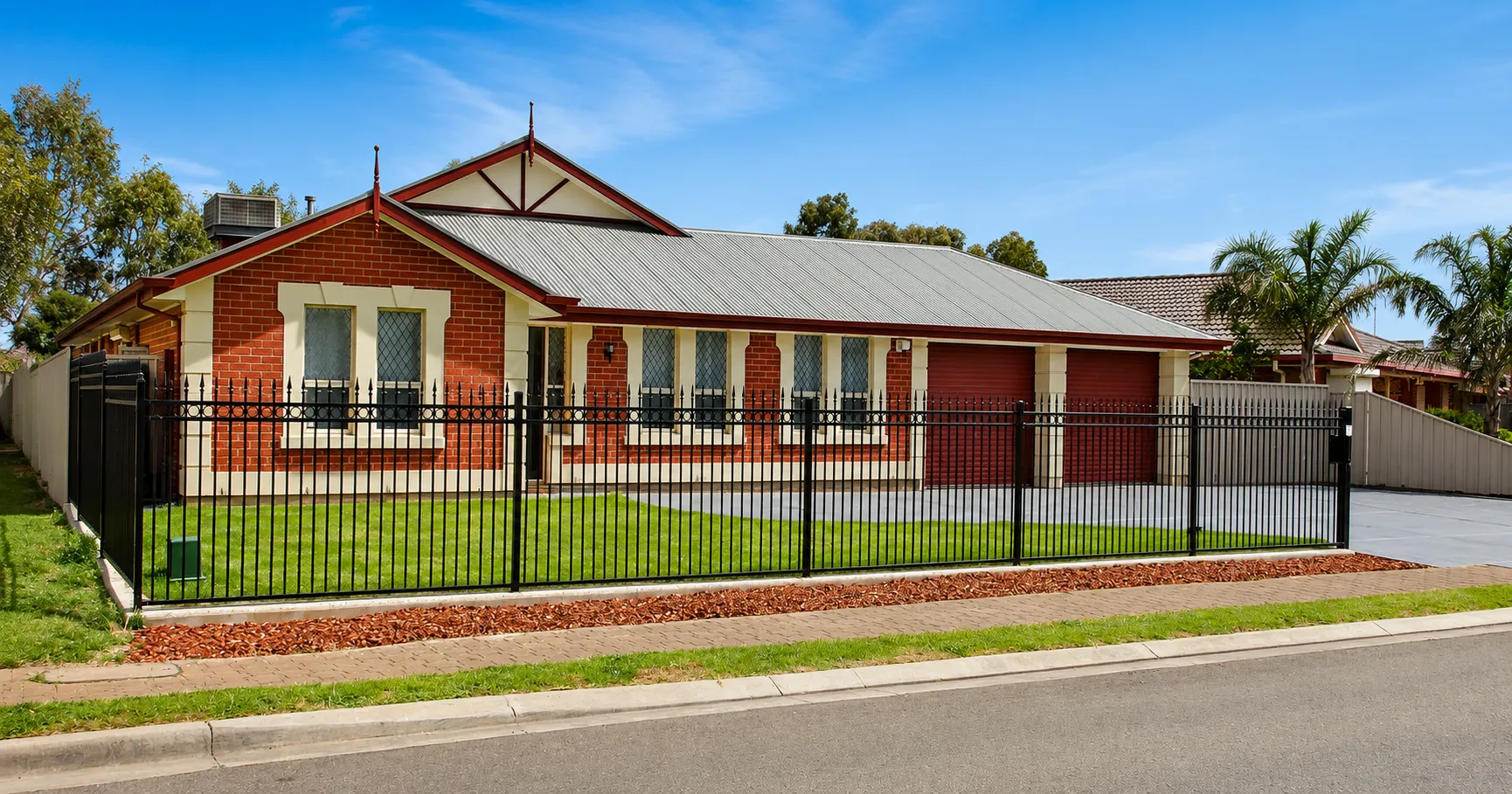
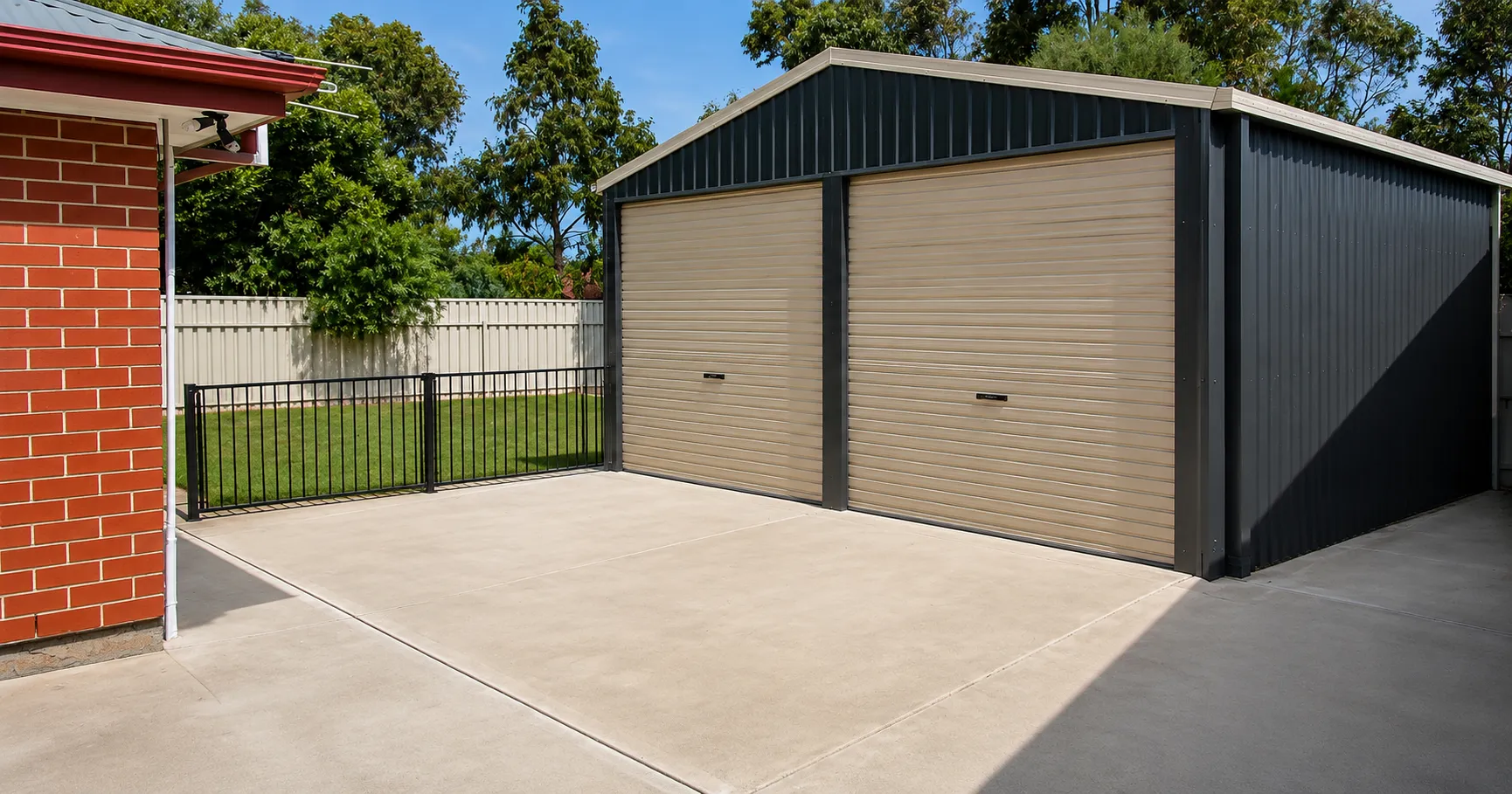
Andrew photographed his own property. What buyers saw online is what they found at inspection.

The fence installation — the preparation work that set the street presentation standard
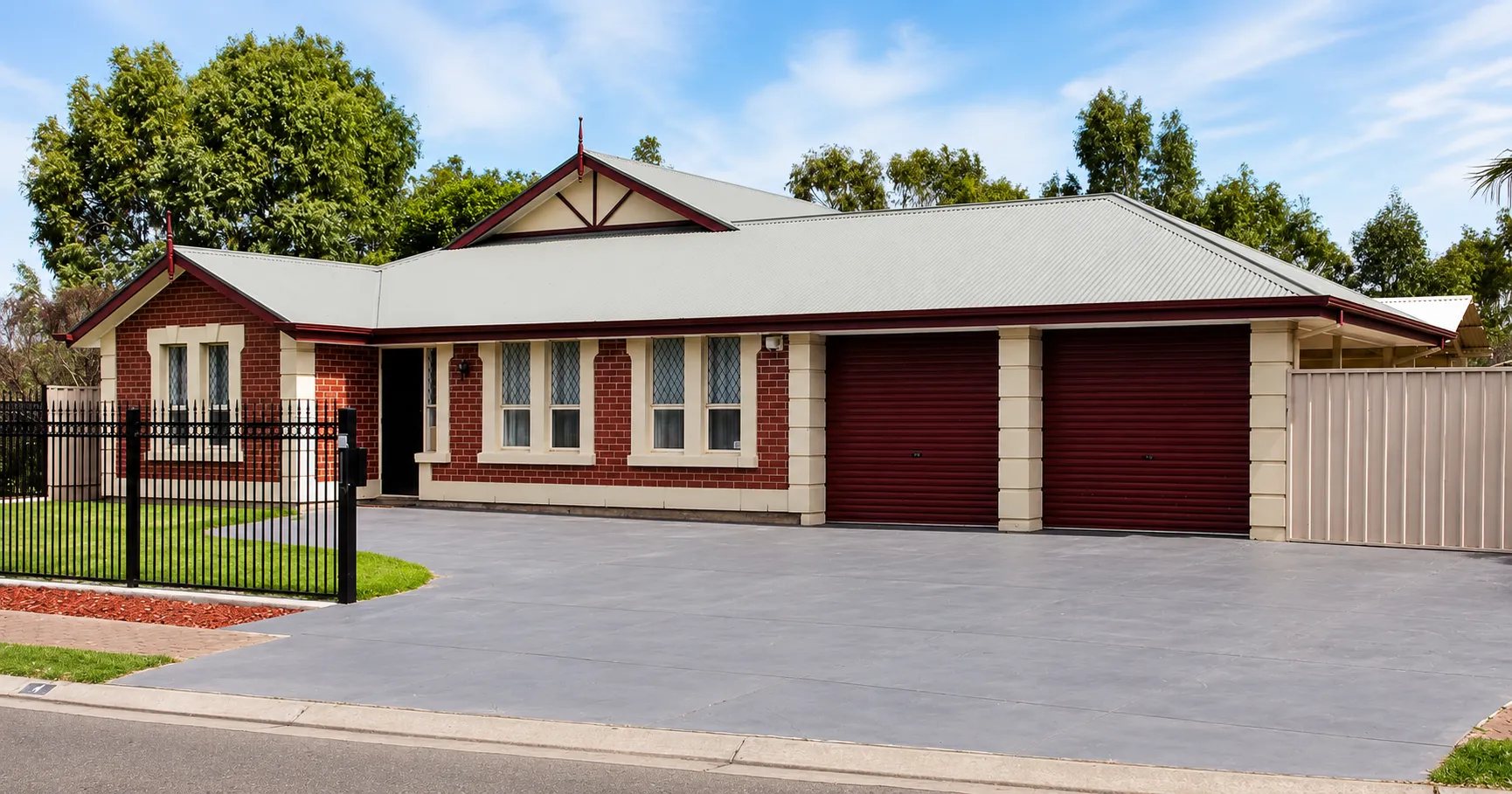
Driveway and double garage — the scale the listing showed is what buyers found
Rear workshop — a genuine feature most comparable properties in the bracket don't have
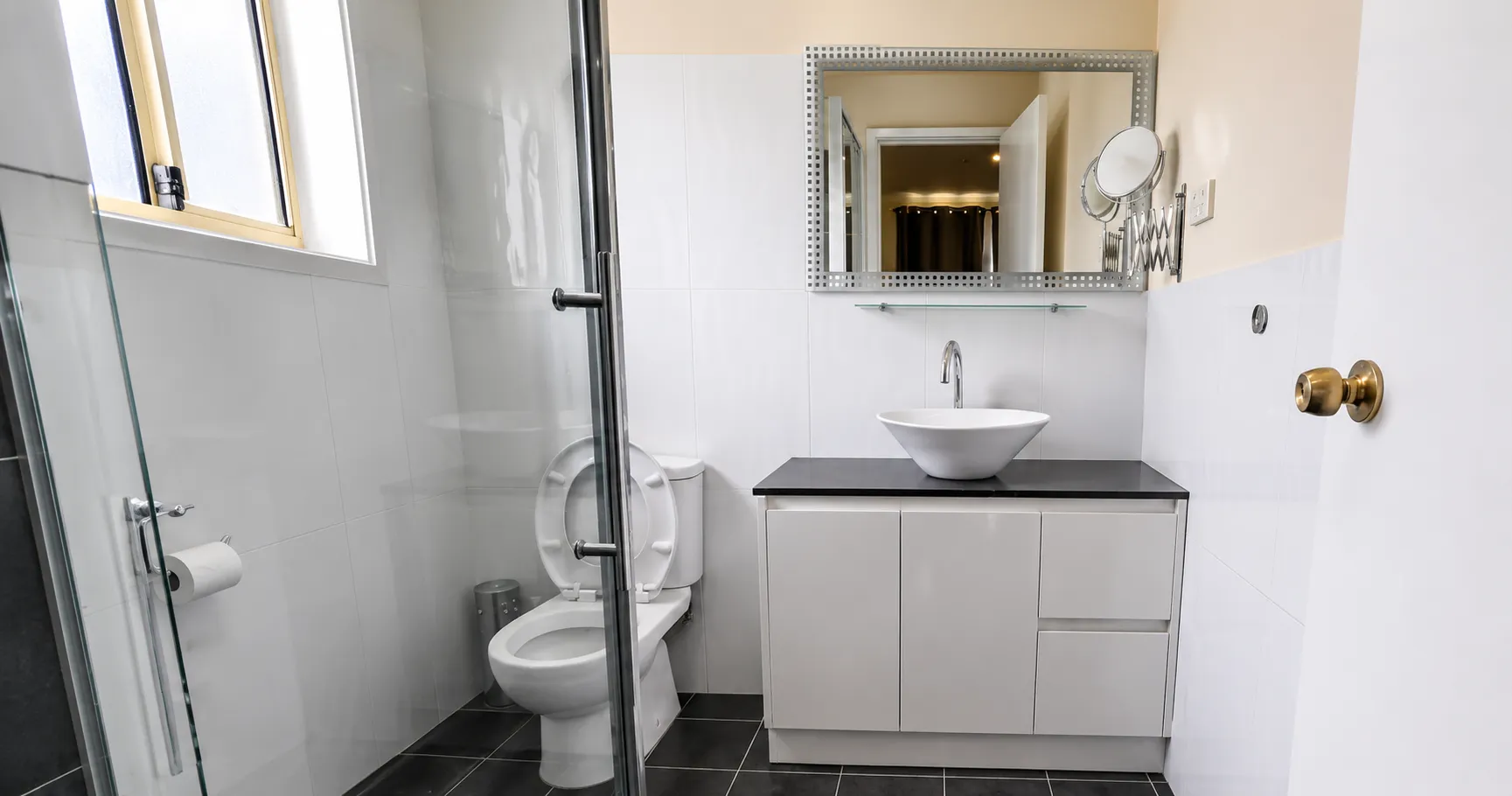
Internal presentation — renovated to a standard the photos honestly represented
Northern Adelaide corridor, SA. Address withheld — property no longer owned by Andrew McKiggan.
It is also worth being honest about one thing: at that stage I did not have the system I use today. My confidence in the price came from personally walking through comparable properties in the area — something I still do — but the data-driven pricing framework I now work from did not exist in the form it does now. I built it partly because of this experience.
What that process reinforced is something I believe every vendor deserves to understand: what sold yesterday should theoretically support what sells tomorrow — but the market moves, and someone needs to be actively watching it. Not just claiming to. Part of my commitment to every vendor I work with is that I am genuinely monitoring what is happening in the market, not simply stating that I am. When conditions shift, you hear about it from me before it affects your campaign, not after.
I tell this story not as a template but as an illustration of what aspirational pricing actually requires: genuine property differentiation, honest marketing, the evidence to support the position, and the personal capacity to carry uncertainty for longer than is comfortable. I had all four. Not every seller does — and that should be understood before the decision is made, not discovered halfway through the campaign.
Andrew McKiggan — Owner & Principal, Gawler East Real Estate RLA 248695
Andrew's Observation
In my experience, the five decisions below are not made out of carelessness. They are made out of assumption — the assumption that the buyer pool is larger than it is, that withholding price creates mystery rather than friction, that saving a few hundred dollars on a listing tier is a sensible economy, that staging furniture in the wrong type of property will move a buyer emotionally. Each assumption is understandable. Each one costs more than it saves.
Andrew McKiggan — Owner & Principal, Gawler East Real Estate RLA 248695
Your Property Marketing Strategy — Five Decisions That Can Undermine an Otherwise Correct Pricing Position
Even when a house is priced correctly, five common execution decisions can quietly erode the advantage that good pricing creates. The first four are structural rules that apply across every market and every campaign. The fifth is what happens when the others compound.
A property pricing strategy and a property marketing strategy are not separate plans. They are the same plan. A house priced well but executed poorly is not well positioned — it is well priced and poorly visible. The outcome reflects both.
Committing to a "Best Offers By" Deadline Without the Buyer Depth to Support It
A "Best Offers By" deadline is a legitimate tactic — under the right conditions. It creates a defined endpoint that concentrates buyer decisions and, in theory, generates competitive pressure. In a market with strong enquiry and consistent open home attendance, it can work well.
The mechanism breaks down when the active buyer pool is smaller than expected.
When a deadline lapses without an acceptable offer, the listing has publicly failed its own timeline. The urgency the tactic was designed to create transfers entirely to the buyer. Buyers who monitored and waited are now negotiating from a stronger position than before the campaign began.
The problem is not the tactic itself. It is the decision to apply it without first assessing whether buyer depth in that price bracket is sufficient to produce the competitive tension the deadline requires.
Withholding the Price and Expecting Buyers to Engage Anyway
Some vendors choose not to display a price on search portals, either to preserve negotiating flexibility or to avoid anchoring buyer expectations early. The intent is understandable. The outcome is usually the opposite of what was hoped for.
A buyer with pre-approved finance is using the portal to answer one question: does this property sit within what I can afford? realestate.com.au has already placed the property in front of them because it falls within their search bracket — though not every buyer understands that. A more experienced buyer knows roughly where the property sits but still doesn't know whether the vendor's expectation is at the bottom of that range or the top. A less experienced buyer may not know why the property appeared at all and whether it's even within their budget. Both arrive at the same outcome: uncertainty. And in a market with clearly priced alternatives a click away, uncertainty resolves itself by moving to the next listing.
The decision to withhold price is presented as protecting negotiating position. In practice it often reduces inspection numbers during the Freshness Window — which is the period when competitive pressure, the actual source of negotiating position, is at its highest.
Using a Price Band So Narrow It Signals the Vendor Will Not Move
A well-calibrated price range — typically spanning around 8–10% — communicates that the vendor is serious about transacting and open to negotiation. It signals flexibility without conceding position.
A range of $720,000–$730,000 communicates something entirely different.
Buyers do not read a $10,000 band as a price. They read it as a negotiating position — specifically, a signal that the vendor has already decided what the house is worth and is not interested in a conversation that might arrive at a different number. In a market where buyers have time and more alternatives than urgency, that signal redirects attention before the buyer has made contact.
They are not rejecting the price. They are avoiding the negotiation they expect to have.
Treating Portal Listing Tier as a Marketing Cost Rather Than a Visibility Decision
Of all the decisions made before a campaign launches, the choice of portal listing tier is the one most commonly treated as a minor cost to minimise. It is worth understanding exactly why that framing is expensive.
In South Australia, realestate.com.au is the dominant property search portal — Domain holds significant market share in the eastern states, but not in SA. Your buyer pool is overwhelmingly concentrated on one platform. Your listing tier determines where you appear on that platform from day one.
A premium listing enters at or near page 1, position 1 in the relevant search bracket on launch day — when the Freshness Window is at its widest and buyer attention is at its peak. A standard listing enters lower, with a smaller listing card, and in a bracket with competing stock it may not reach page 1 at all.
As days pass, newer listings push yours back. Page 1 becomes page 2. Page 2 becomes page 3. Do you go into page 2 or 3 when you search on Google? Most people don't — and the proportion that do drops sharply with each page. Buyer behaviour on realestate.com.au follows the same pattern.
The decision to save $300–$500 on a listing tier is not a marketing saving. It is a decision to reduce visibility during the only period in the campaign when visibility is worth the most.
Misallocating the Presentation Budget — Spending Where It Feels Right Rather Than Where It Works
Not every presentation dollar produces the same return. The decision about where to spend — and where not to — matters more than the total amount spent. And it is a decision that is frequently made on instinct rather than evidence.
Consider two common choices. Replacing a fence is expensive and produces minimal visible change in how buyers perceive the property. Spray painting the same fence costs a fraction of the price, unifies the colour, and reduces the visual impact of dents and wear. A buyer walking into the backyard reads a uniform, clean fence as a maintained property. They read a patchy, uneven fence as a maintenance item — and maintenance items create doubt at exactly the moment you need confidence.
Staging furniture presents a similar calculation. In a character home with strong emotional pull, staging works because it produces psychological immersion — the buyer stops auditing defects and starts imagining themselves living there. In a mid-range investment property where buyers have inspected eight similar homes that week, staging rarely produces the same effect. Buyers in that market are comparing properties forensically, not emotionally. The staging spend would produce a better return redirected to presentation basics: fresh paint, thorough cleaning, minor repairs, street appeal. For a full breakdown of when staging is worth it and when it isn't: Is Home Staging Worth It?
The principle is straightforward: spend where buyer perception changes, not where vendor satisfaction is served. A vendor who paints the fence, freshens the interior, and prices correctly will almost always outperform one who stages elaborately, leaves the fence unpainted, and sets a price band too narrow to invite negotiation.
What makes this worth noting is not that any single decision is catastrophic. It is that presentation misspend, a narrow price band, and inadequate portal visibility tend to occur together — each one a reasonable-seeming choice in isolation, each one compounding the others into an outcome that could have been avoided.
Current Market Observation
A property currently on the market in the northern Adelaide corridor illustrates all five decisions simultaneously. It came to market as a residential sale from a previous tenancy — meaning the presentation baseline was lower than an owner-occupied home and the preparation work required was higher. The fence was not painted. Staging furniture was added in a property where the buyer profile did not warrant it. The price band was set too narrow, signalling inflexibility before a single buyer made contact. The listing has been on the market considerably longer than a correctly executed campaign would have required.
Each decision was understandable in isolation. Together, they compounded into an outcome that was entirely preventable.

Before You Agree to Any Price — Questions Worth Asking First
A house pricing strategy is only as good as the agent implementing it. Before committing to a price position, any agent recommending a strategy should be able to answer the following clearly, with evidence — not reassurance.