
Most experienced real estate agents can access similar market data. What matters is how that evidence is interpreted — and how it is turned into a strategy that protects your final result.
Data is the foundation. Interpretation is what turns that data into meaningful pricing advice.
Every appraisal is built from verified comparable sales — not an automated online estimate.
This page explains the framework we use for every appraisal across the Gawler District and the surrounding suburbs.
What This Framework Is — and What It Isn't
It's a structural comparison, built entirely on measurable data: your property compared against recent, genuinely comparable sales using the characteristics that drive buyer decisions at the foundational level.
It is not a formal valuation under the Valuers Act 2003 (SA). It doesn't require one, and it isn't trying to replace one — a formal valuation is a legally binding instrument, typically needed for bank finance, taxation, or family law matters. This is a market-evidence-based pricing tool, designed for one purpose: helping you set the right asking price with real numbers behind it.
The Core Property Characteristics We Compare
Every comparable sale is assessed against the same core structural characteristics:
- Land size
- Internal floor area
- Bedroom count
- Bathroom count
- Car spaces
- Construction type and storey count
- Build year
These are the factors that can be measured consistently and verified against the public record — which is exactly what makes this approach checkable rather than opinion-based. Bedroom, bathroom and car space counts come directly from the sales record; matching which comparables are genuinely the closest fit is done manually, property by property, not by an automated formula. Where a comparable sale listing is still available, we link directly to the source so you can see the evidence for yourself.
Matching Construction Type, Not Just Size
Land size and floor area get you close — but two homes with identical numbers on paper aren't always a fair comparison. A single-storey brick veneer home and a double-storey full-brick home on the same land size are genuinely different properties to build, to insure, and often to buy, even with matching square metreage. That's why construction type and storey count sit alongside land size and floor area in our comparison, not as an afterthought.
Why Land Size Sometimes Matters More Than the Suburb Line
Land sizes across the Gawler growth corridor have shrunk noticeably over the past decade. A 450m² block was standard in many estates around ten years ago; new releases today are increasingly landing closer to 300m². That shift means an older, larger block isn't just bigger on paper — it's a genuinely scarcer feature that can't be replicated by anything currently being built.
Where the closest matches within a suburb don't reflect that, we'll look to immediately neighbouring suburbs within the same buyer catchment for a property that matches on land size and build era, even if it means stepping slightly outside the subject suburb's own boundary. A same-suburb comparable on a smaller, newer-standard block can understate what a genuinely larger, older-standard block is worth — and the reverse is also true.
Matching the metric that's actually scarce is sometimes more important than matching the postcode.
Why We Leave Out Kitchens, Fixtures, and Presentation
This framework doesn't factor in kitchen quality, bathroom condition, flooring, fixtures, landscaping, or overall presentation.
That's not an oversight — it's the honest limit of what data can measure remotely. A spreadsheet can compare land sizes and bedroom counts. It can't walk through your home and recognise that your renovated kitchen is adding real buyer appetite, or that your street appeal is going to bring more people through the door on open inspection day.
A spreadsheet can compare land sizes and bedroom counts. It can't recognise that a renovated kitchen is adding real buyer appetite.
Those things matter — sometimes enormously — and they're exactly what we assess in person, during your appraisal visit. Think of the data-driven range as the market's starting point. The in-person visit is where we work out how far above that starting point your specific property can go.
Comparable sales provide the foundation. They tell us what similar properties have achieved. The real skill lies in interpreting that evidence — understanding your competition, buyer psychology, presentation, and the pricing strategy most likely to create competition during your Freshness Window. That's the part software can't do.
Owner-Occupiers vs Investors — Why Buyer Type Matters to Your Price
Every property market contains two distinct types of buyers, and understanding both is part of pricing correctly.
The owner-occupier is often drawn in emotionally — fresh paint, a modern kitchen, the sense that nothing needs doing. A newer build will frequently grab this buyer's attention first.
The investor or astute long-term buyer looks past the finishes and asks a different question: what is the land worth, and what will it be worth in ten years? For this buyer, land size and location matter more than anything cosmetic.
A well-presented home on a genuinely competitive land holding tends to attract both buyer types at once — and a wider buyer pool is exactly what creates the competitive tension that drives a final price higher than either buyer type alone would pay.
Why Online Property Estimates Get It Wrong
Most automated valuation tools rely heavily on historical sales data — typically your home's last recorded sale price, adjusted by the percentage growth recorded for similar properties in the area since that date. When a home has sold recently, this can work reasonably well — the model has a solid, current anchor point to work from.
The problem shows up the further back that last sale sits. In our experience, once a property hasn't changed hands in ten or more years, the discrepancy between an automated estimate and the property's genuine current value regularly runs $50,000 or more. Extrapolating percentage growth from a decade-old sale price compounds error the further out it's pushed — and it has no way to enter what it doesn't know: whether the kitchen's been renovated, whether solar's been added, whether the home has been extended, or simply how well it presents compared to what's currently listed nearby.
A Real Example
This is our own home, 1 Mary Street in Gawler East — genuinely useful as an example precisely because it hasn't changed hands in over ten years, which is exactly the scenario where automated estimates lose the most accuracy.
Two different major property data providers show two different figures for the same address, both estimated within days of each other:
- One estimate: $780,000 – $1,040,000 (high confidence, dated 2 July 2026)
- Another estimate: $800,000 – $900,000 (low confidence, dated 29 June 2026)
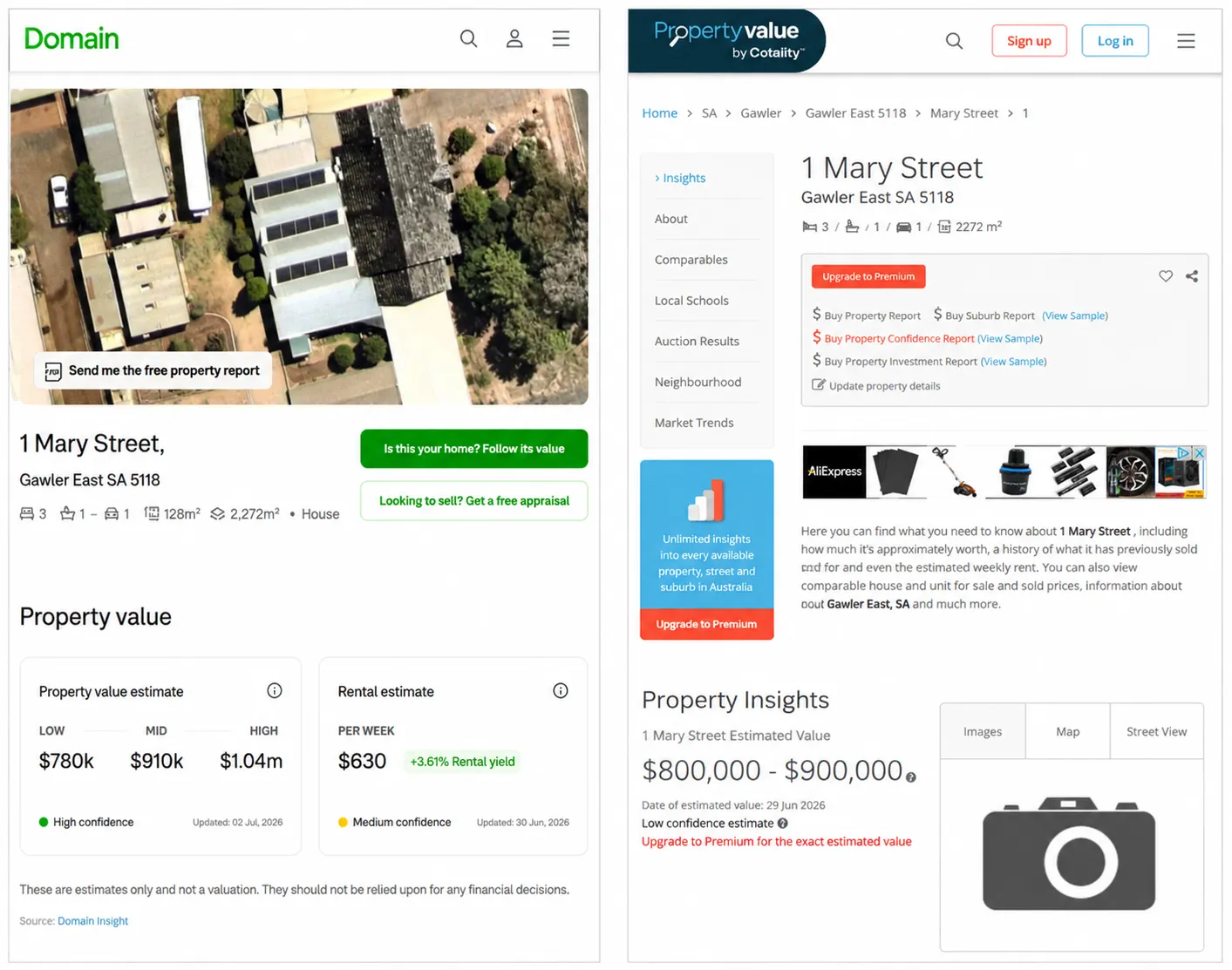
Even the "high confidence" figure carries a $260,000 range within itself — before you get to the fact that the two providers don't agree with each other either, despite being dated just three days apart. Neither is necessarily wrong by their own methodology; they're simply extrapolating from different historical data with no way to account for what's actually changed on the property, or what buyers are genuinely paying for comparable homes right now. That's the gap an evidence-based, comparable-sales appraisal is built to close.
Inflated automated estimates aren't the only way sellers get misled on price. Some agents use the same psychology deliberately — quoting an inflated appraisal figure to win a listing, then walking the price back down once the property is on the market. Our approach is the opposite of both.
Our approach doesn't depend on your own sale history at all. We compare land size, internal living area, bedroom and bathroom count, car spaces, construction type and build year against genuinely comparable homes that have sold recently — properties that most accurately represent yours today, regardless of when you personally last sold. We then look either side of that price point, not just at the middle, to give you a realistic range rather than a single number that may or may not hold up.
From there, we go further than the data can. We assess your home's presentation in person, and take into account additions that a spreadsheet can't see — solar panels, air conditioning, and similar improvements — because these genuinely move buyer appetite and belong in the final figure, not just the baseline.
A Property Appraisal Example — How We Build the Evidence-Based Price Range
To show how this framework actually works, here's an example drawn from an actual appraisal report, with the address and identifying details removed for privacy — this illustrates our method, not a specific current listing. Every appraisal is different: the comparables used, the weighting applied, and the final figure all depend entirely on the property in question. What follows is the actual reasoning from one real appraisal, kept exactly as it was calculated, to show the method rather than a number that applies to your home.
In the worked example below, we're showcasing a four-bedroom, two-bathroom home in Evanston Gardens, on a 450m² block with 177m² of internal living space, built in 2015.
Same-Suburb Comparables
Adjacent Suburbs
Active Competition
Weighing the Whole Picture
Step 1: Same-Suburb Comparables
We start with recent sales in the same suburb, matched as closely as possible on land size, floor area, bedrooms, bathrooms, car spaces and build year.
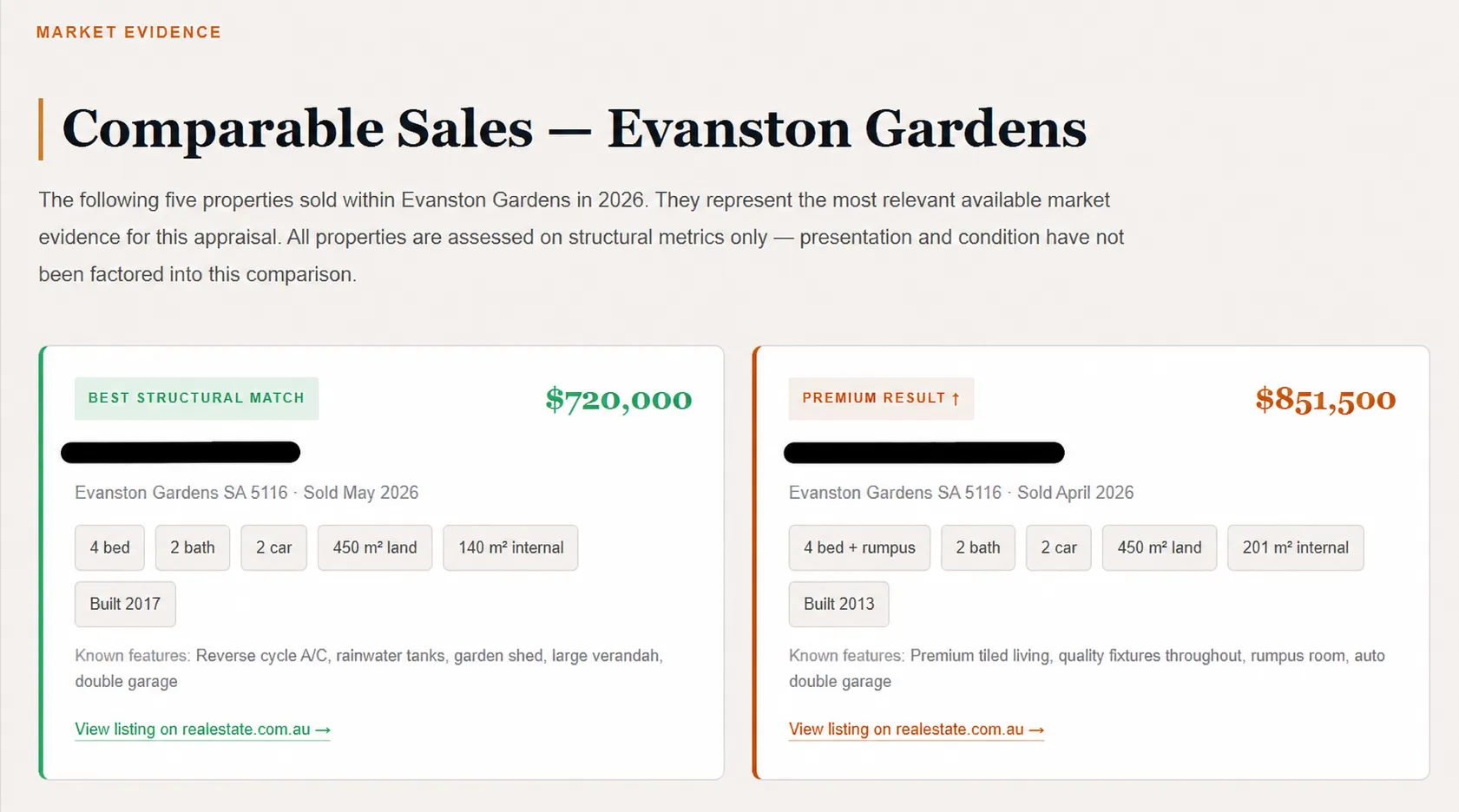
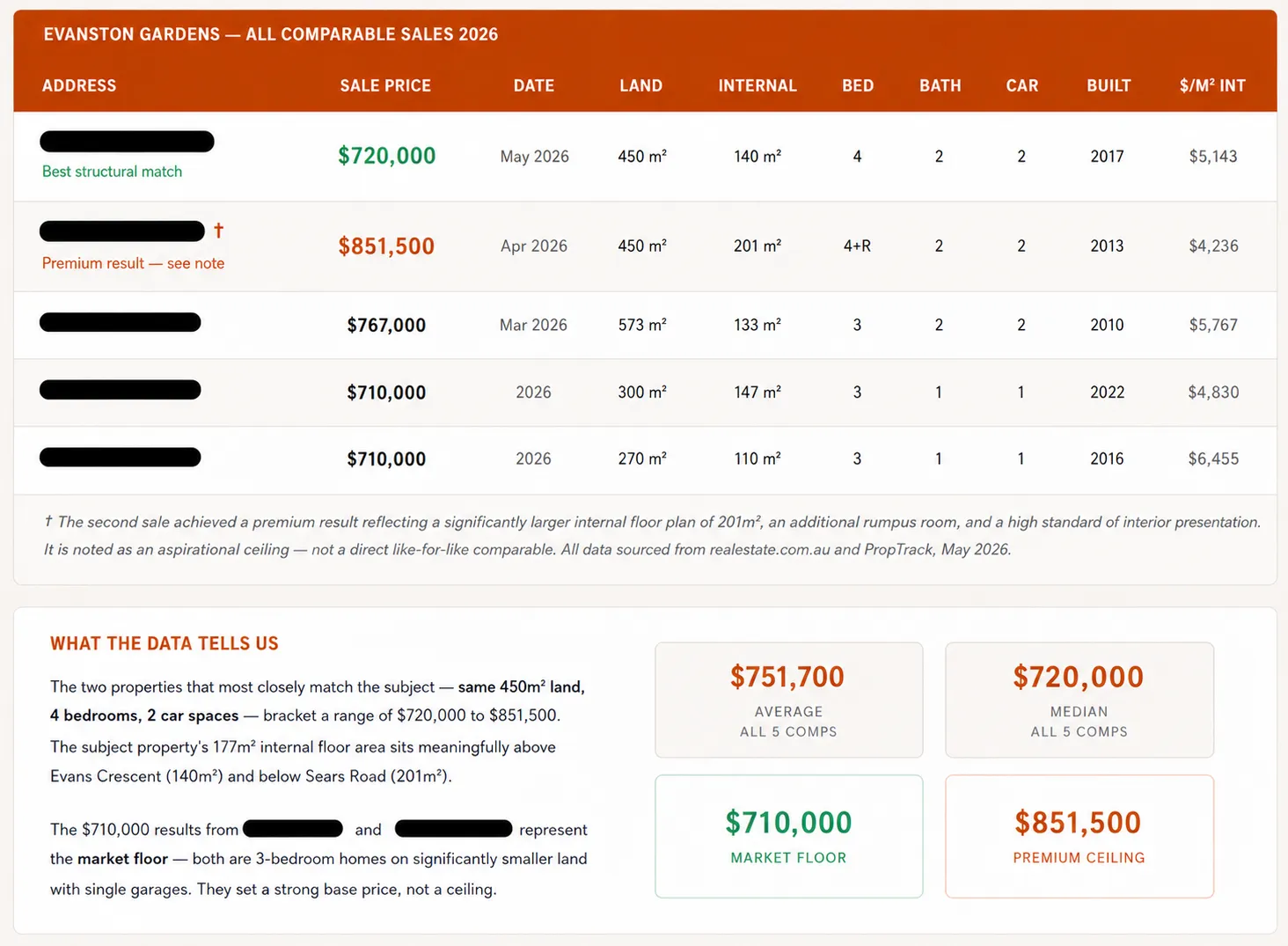
The closest structural match — same 450m² land, same bedroom and car configuration — sold for $720,000. The remaining results are smaller, three-bedroom homes on significantly less land with single garages; they represent the market floor for this type of property, not a ceiling. One result, on a larger 450m² block with a bigger floor plan and premium presentation, sold well above the rest — shown here as an honest reference point for what the top of the market can achieve, not a figure this property is expected to reach.
Step 2: Widening to Adjacent Suburbs
Same-suburb evidence alone isn't always enough. Where that's the case, we widen the search to immediately neighbouring suburbs — in this example, Evanston South, Hillier and Willaston — looking specifically for sales that structurally match the subject property, not simply for nearby suburbs in general.
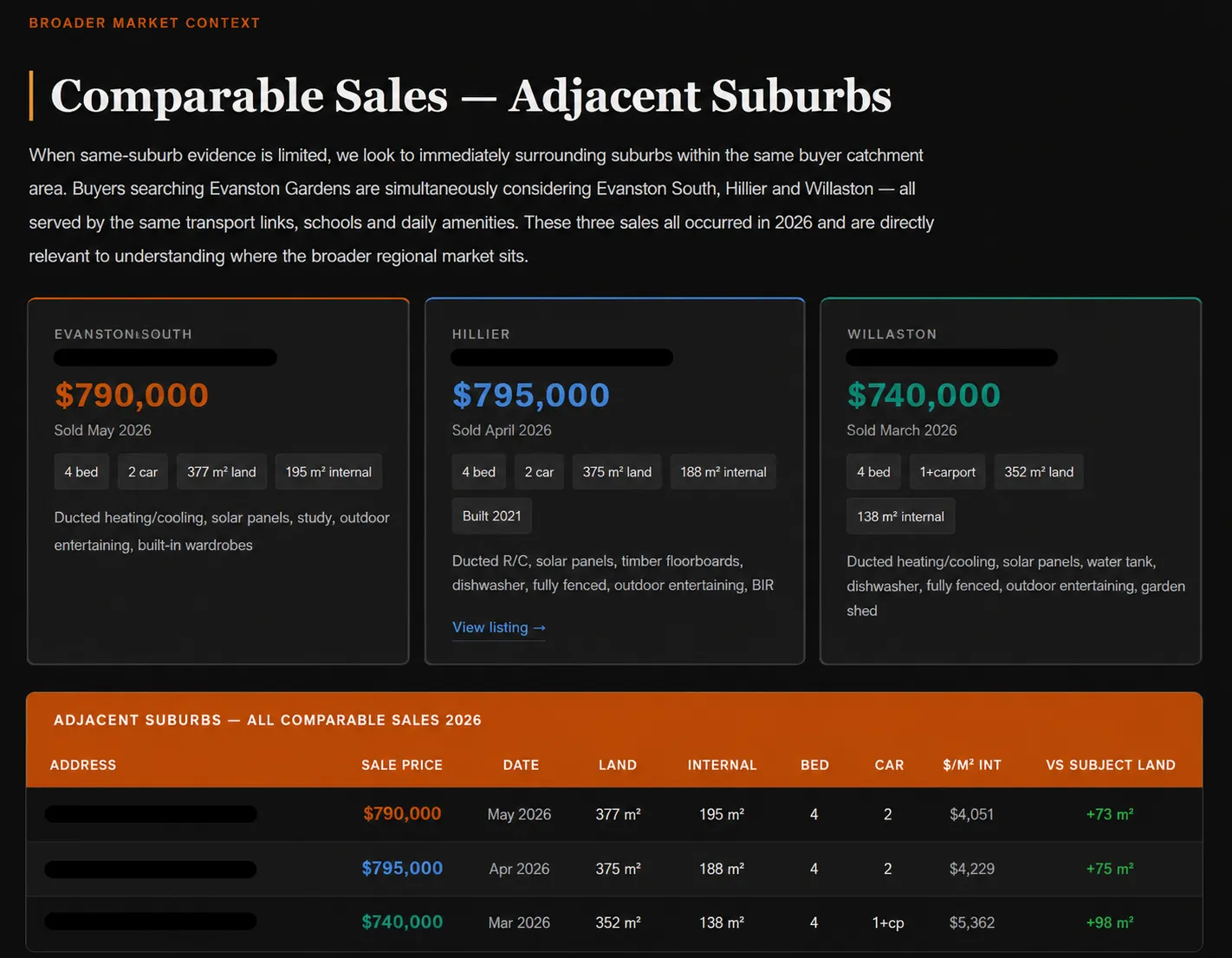
Both of these results were achieved on meaningfully less land than our example property. That's a genuine structural advantage worth factoring in — a larger, older-standard block isn't just bigger on paper, it's a scarcer feature these smaller, newer-release blocks simply can't offer.
Step 3: Checking the Active Competition
Once a property goes to market, it isn't just being judged against past sales — it's being compared directly against whatever else is currently listed nearby.
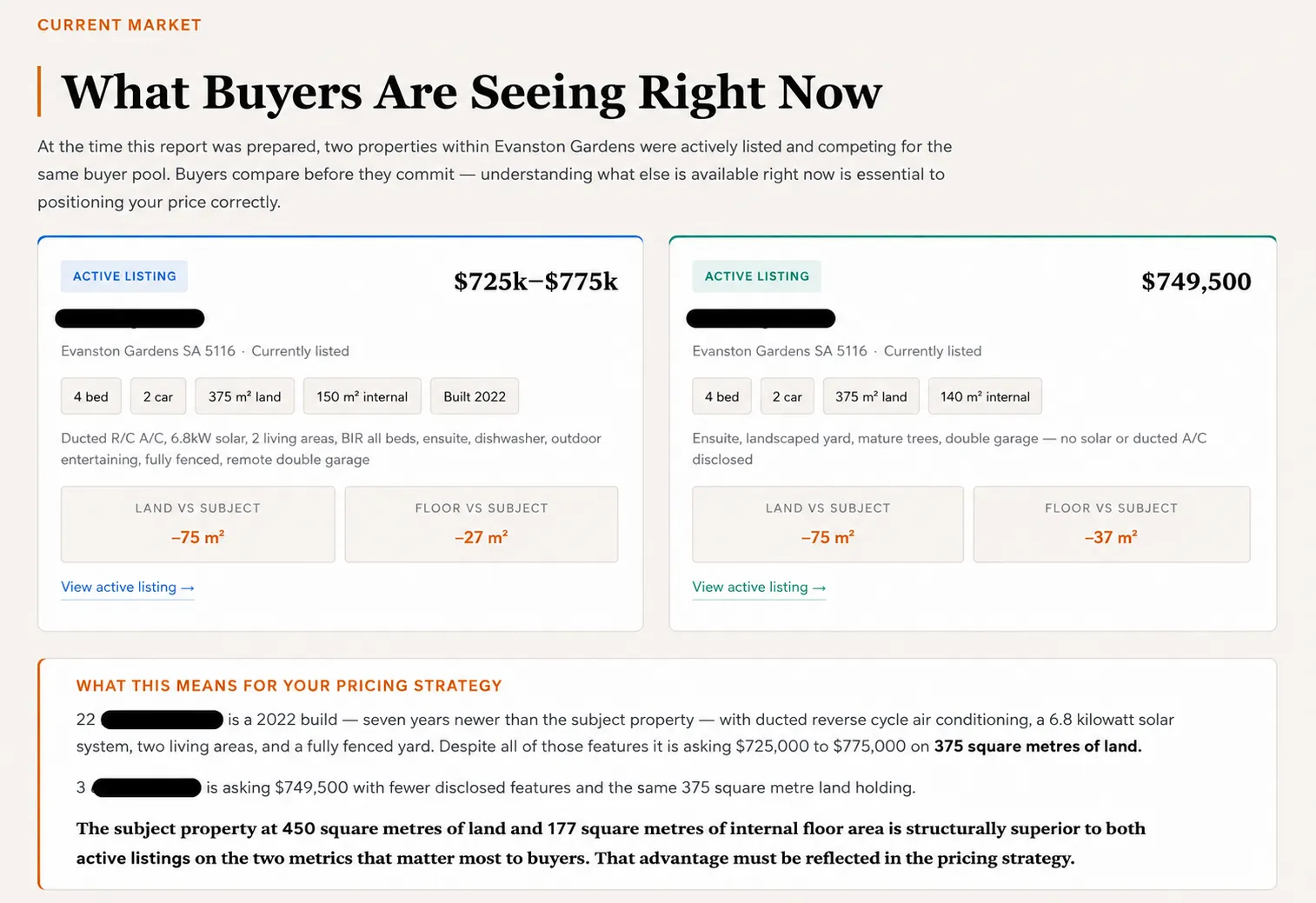
Both active listings are asking similar or higher prices than our example property's likely range — on meaningfully less land and less floor area. That's a genuine competitive advantage worth factoring directly into pricing strategy, not just noting in passing.
Step 4: Weighing the Whole Picture
Putting the evidence together, here's an honest look at where this kind of property sits — the case for a stronger result, and the factors that genuinely need to be weighed the other way.
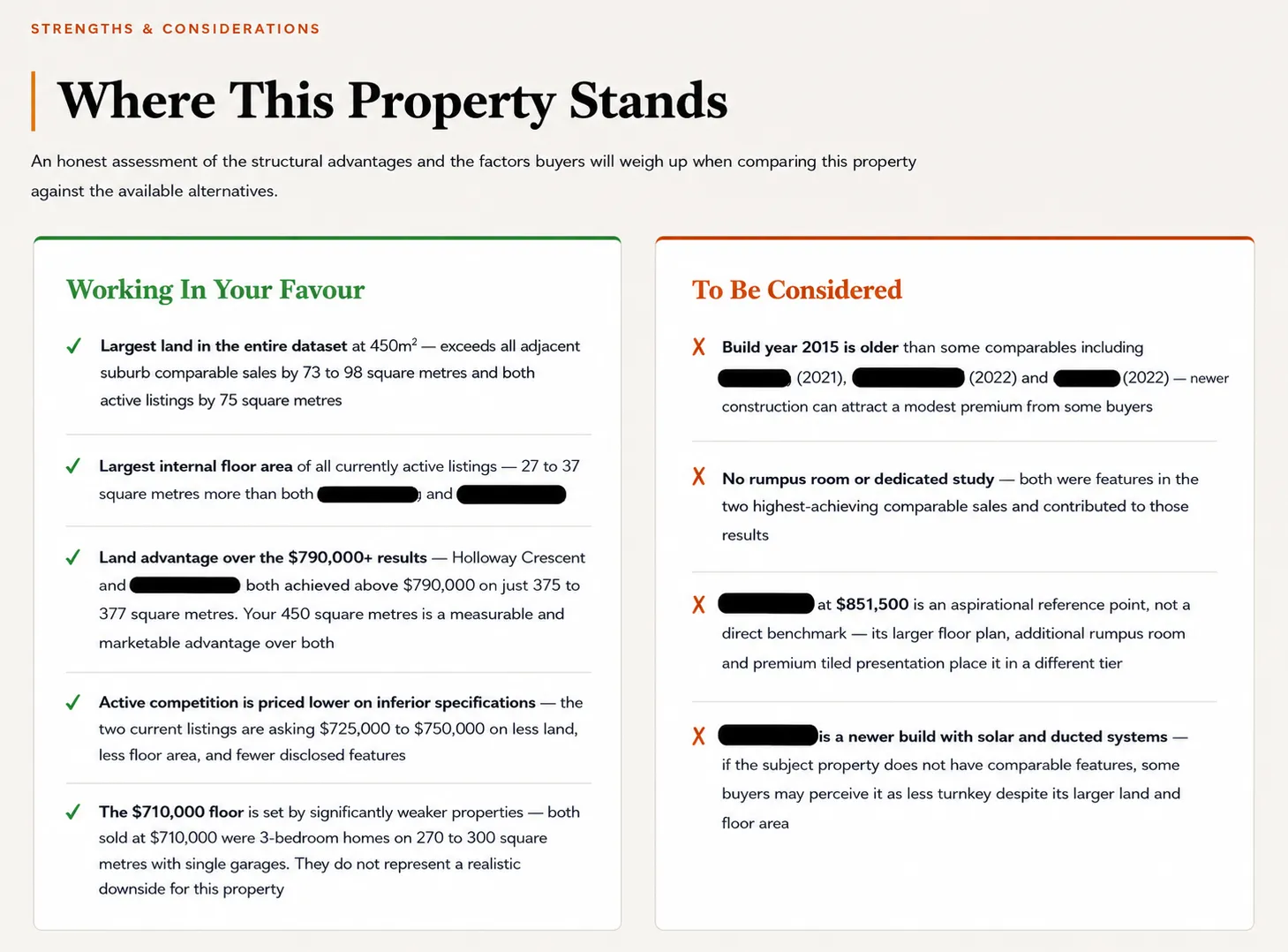
Working in favour
- Land size at the top of the comparable range — a structural advantage over every adjacent-suburb result and both active listings
- Floor area larger than every currently active listing in the same suburb
- The lower comparable results are set by smaller, weaker-specification properties — not a realistic ceiling for this profile
To be considered
- Build year is older than some newer comparables, which can attract a modest premium from buyers who value a newer build
- No rumpus room or additional living zone — a feature present in some of the highest-achieving local sales
- All comparables in this example share the same single-level construction; where a suburb has a genuine mix of single- and double-storey stock, that distinction gets weighted the same way land size and floor area are here
How the Numbers Come Together
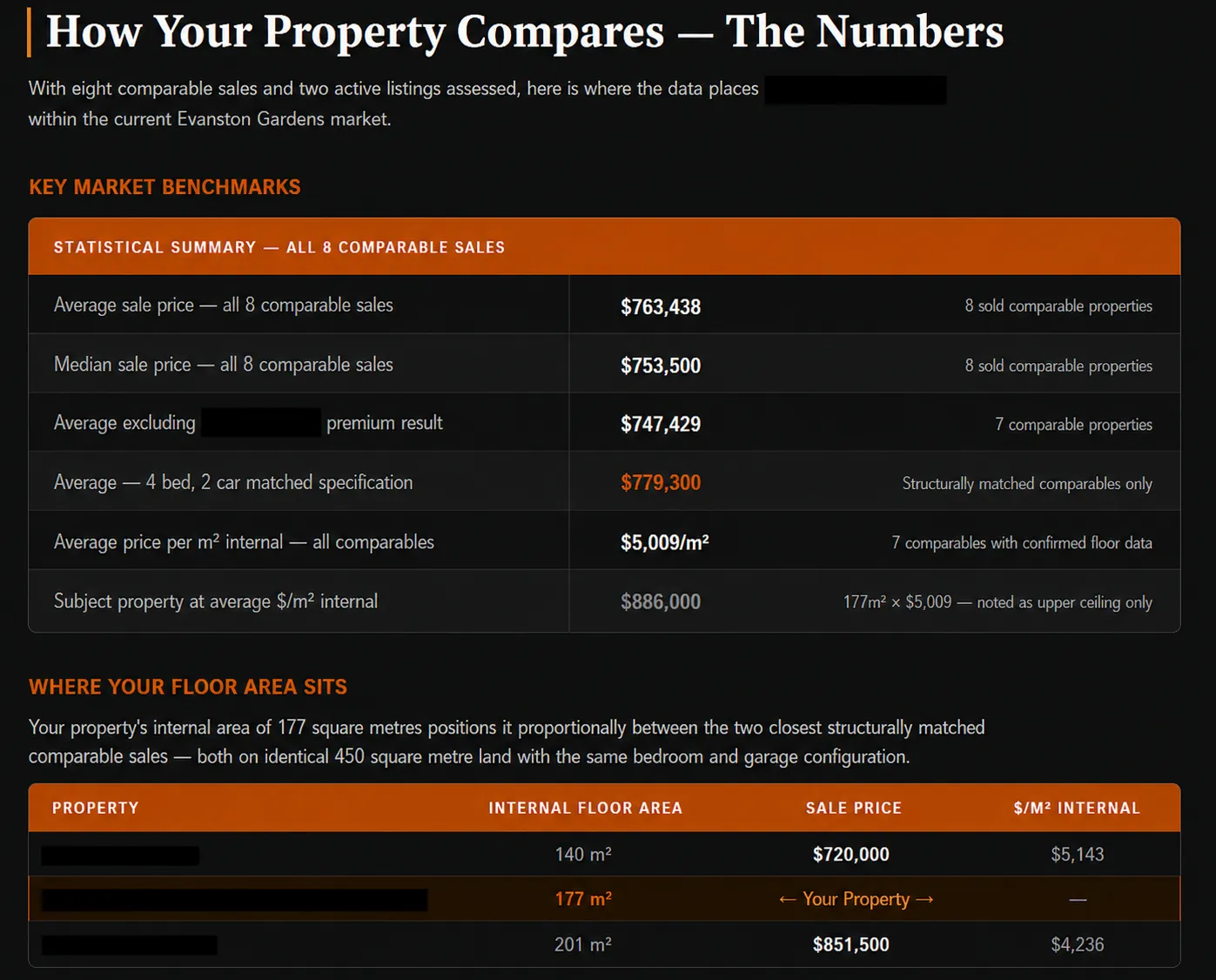
Beyond the individual comparable sales, we also cross-check using price per square metre of internal floor area, and interpolate where a property sits between two closely matched comparables by floor area. The two properties that most closely match this example on land size and configuration bracket a clear range — and where a comparable sale listing was still available online, we linked directly to it so the client could verify the evidence for themselves, focused on the properties closest in specification to the subject home.
A Note on Buyer Psychology
A buyer drawn to move-in condition and a contemporary finish might initially favour a newer, smaller-block property over an older home on genuinely larger land. That preference is real — fresh fixtures and the sense that nothing needs doing is a genuine drawcard for a section of any market.
Part of getting the price right is making sure every buyer understands what they'd be trading away by choosing the newer, smaller option — land that simply isn't being released at that size anymore, and what that means for long-term value. It's also worth naming the opposite temptation honestly: when a seller sees a high theoretical number — land size multiplied by the suburb's average rate per square metre, for instance — it's natural to want to believe that's what the home is worth. In this example, that calculation would suggest a figure well above $850,000. It isn't used on its own, because it assumes a level of finish and presentation the property doesn't actually have.
Being upfront about the numbers we're not relying on is as important as the ones we are.
The Estimate
Bringing the structural comparison, the adjacent-suburb evidence, the active competition, and the statistical cross-checks together, here's how that reasoning was translated into a recommended range for this specific example.
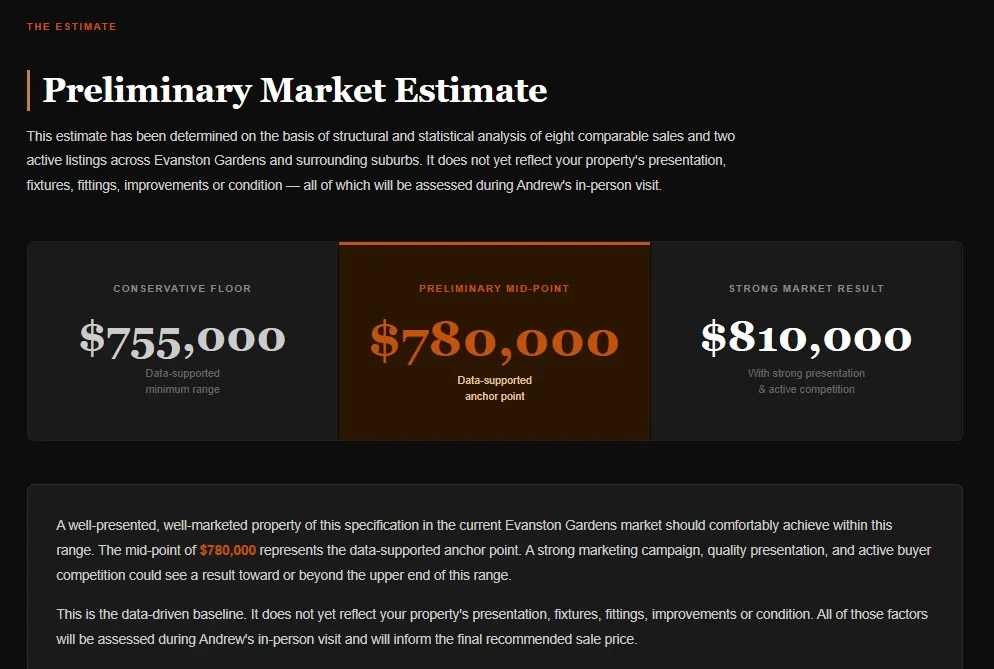
This is the data-driven baseline only. It doesn't yet reflect the property's presentation, fixtures, fittings, improvements or condition — all of which are assessed in person, and all of which can move the final recommended figure. Every appraisal we prepare follows this same structure; the specific comparables, weighting, and resulting range will always be tailored to the property in front of us.
From Evidence to Buyer Appeal
Understanding why a property's land size matters isn't just useful for setting the right price — it's directly useful for selling the property itself.
Once we know what a larger block genuinely offers a specific type of buyer, that becomes part of the story we tell — in the marketing campaign, in the brochure, and directly to buyers walking through on inspection day.
Take our Evanston Gardens example: newer estates in the same area are now releasing blocks closer to 300m², compared to the 450m² our example property sits on. That's not just a number — it's 50% more land than almost anything currently being built nearby. To a young family, that might mean room for a trampoline and a proper backyard without giving up the house itself. To someone planning ahead, it might mean space for a shed, a workshop, or simply the breathing room a smaller modern block can't offer.
We don't just calculate that advantage — we sell it.
Buyers respond to what a property genuinely offers them, not just a square metre figure on a listing. Turning the data into a reason to fall in love with the property is part of the campaign, not an afterthought.
This is the kind of evidence-based reasoning — and the kind of honest limitation — that goes into every appraisal we prepare.
An appraisal shouldn't leave you with more questions than answers. It should leave you understanding not only what your property may be worth, but why, how it compares with today's competition, and the decisions most likely to protect your final result. That's the purpose of this framework.
If this page helped you understand how we build an evidence-based price for your property, we'd genuinely appreciate a Google review. As an independent agency, we rely on recommendations from people who find our advice genuinely helpful. If you're short on time, even a simple star rating helps other homeowners discover practical, evidence-based property advice.
Leave a Google ReviewRequest Your Free, Evidence-Based Property Appraisal
Receive a personalised, evidence-based pricing report built from genuine comparable local sales — followed by an on-site assessment to refine your property's likely market value.
Request Your Free Property Appraisal →Prefer to talk it through first? Call Andrew directly on 0493 539 067, or get in touch here.
