
The 2026–27 Federal Budget introduced significant changes to negative gearing and capital gains tax, with the new arrangements scheduled to take effect from 1 July 2027. Existing investments held before the 12 May 2026 announcement are largely protected from the negative gearing changes, while the CGT reforms apply prospectively to gains accruing from 1 July 2027.
For property owners, buyers and investors across the Gawler district and surrounding areas, the national announcements provide important context — but the more useful question is what, if anything, has actually changed in the local market.
Gawler's sales data provides an interesting starting point. The district recorded 55 confirmed residential sales in May 2026, up 72% from April's 32 and well above the quieter winter pattern seen in the surrounding months. That surge coincided with the Budget announcement, but the local sales data alone cannot establish that the Budget caused the increase. June eased to 36 confirmed sales, still above April's baseline, before July eased further to 27 — now below where the year started.
That sequence makes May worth examining, but it also makes the timing important. Rather than assuming every change in local activity was caused by the Budget, this report looks at the confirmed Gawler sales data, the two months of cooling that followed May's surge, and the broader market conditions to assess what the evidence actually supports.
For the latest district-wide market position, see our Gawler House Prices page, updated monthly. For the most recent confirmed sales, see Houses Sold in Gawler — July 2026.
What Actually Changed in the 2026 Federal Budget?
The Budget announced two major reforms targeting residential property investment. Here is what each one means in plain English.
| Change | Who It Affects | When |
|---|---|---|
|
Restricted Negative gearing on established properties Rental losses can no longer be offset against salary or wage income. Losses are quarantined and carried forward against future rental income or capital gains only. | Investors purchasing existing residential properties after 7:30pm AEST, 12 May 2026 | From 1 July 2027 |
|
Exempt Negative gearing on new builds Full negative gearing treatment is retained. Investors in newly constructed properties are unaffected by this change. | Investors in newly constructed properties | No change |
|
All investors 50% CGT discount replaced The flat 50% CGT discount is replaced with cost-base indexation — gains are adjusted for inflation — plus a 30% minimum tax rate on real capital gains. Existing negative gearing on properties held before Budget night is grandfathered. The CGT changes apply to gains accruing from 1 July 2027 for all investors, regardless of purchase date. | All residential property investors — including those who purchased before Budget night | From 1 July 2027 |
These changes are now law, passed by Parliament on 25 June 2026. We still recommend speaking with your accountant for advice specific to your situation.
What Does the 2026 Budget Mean for Investors in Gawler and Surrounding Suburbs?
For investors who already own property in Gawler, Gawler East, Evanston and surrounding areas, the negative-gearing changes are not an immediate change to existing investments held before 7:30pm AEST on 12 May 2026. Those properties are covered by the grandfathering provisions, meaning the existing negative-gearing arrangements remain available while the property continues to be held.
The capital gains tax changes work differently. From 1 July 2027, the new CGT framework will apply to capital gains accruing from that date, while gains accrued before the change retain the existing treatment.
The interesting part for Gawler is what happened immediately after the Budget announcement. The district recorded 55 confirmed residential sales in May 2026, up 72% from April's 32. That was an unusually large increase for a period when the market would normally be moving into its quieter winter phase, and the timing makes the Budget announcement the clearest explanation for the change in activity.
The local data also provides a clue about where that response came from. The additional May activity was concentrated heavily in the lower-priced, older housing stock that makes up much of Gawler's traditional investor market. That doesn't allow us to identify exactly which sellers acted because of the Budget, but the timing, scale and composition of the May sales spike together provide strong evidence that investor reassessment was a significant contributor to the surge.
June and July then put the May spike into perspective. Confirmed sales eased to 36 in June — still above April's baseline — before easing further to 27 in July, now 16% below where the year started. That two-month pattern is consistent with a pull-forward of transactions — sellers who were already considering their position bringing decisions forward after the announcement — combined with a seasonal cooling that appears to be running deeper than usual, rather than the market suddenly generating a permanently larger volume of transactions.
For investors, that distinction matters. The May surge appears to have been a genuine Budget-related response, but the subsequent two months of easing show that the urgency was concentrated in a relatively short window, and that underlying activity has since settled below where it started the year. The question now is less whether the Budget affected Gawler — the evidence strongly suggests that it did — and more how much of the investor-owned housing stock has already responded, whether the current softer conditions persist, and whether further selling pressure develops as the 2027 changes approach.
Should you sell before 2027? That depends entirely on your individual circumstances — your purchase price, loan structure, income, tax position, long-term goals and rental yield. This is a conversation for your accountant or financial adviser, not your real estate agent. What we can provide is current local market evidence and an indication of what your property may realistically achieve. If you're considering how the changing market could affect your plans, an updated property appraisal can provide a useful starting point.
What Does the 2026 Budget Mean for Buyers in Gawler and Surrounding Suburbs?
Thinking about buying in Gawler or surrounding suburbs? We can tell you what's currently available and what represents genuine value in this market right now.
Call Andrew on 0493 539 067
For buyers — particularly first-home buyers and upgraders — these changes could open up a window of opportunity that hasn't existed for a few years.
If some investors do choose to exit established properties ahead of the CGT changes, more homes may come onto the Gawler and Gawler East market than we've seen during the tight-supply years of the early 2020s. More listings means more choice, and in some price brackets, potentially less competition from investment buyers who are now looking more carefully at new builds than established stock.
The May 2026 data suggests that window may already be opening. The 72% volume surge in May — 55 confirmed sales against April's 32 confirmed sales — indicates motivated buyers moved quickly following the budget announcement rather than waiting for spring. If you have been considering a purchase in Gawler East, Hewett or Evanston Gardens, the current conditions reward preparation over hesitation.
Owner-occupiers buying a family home in Hewett, Evanston or Angle Vale are not subject to these tax changes — you're buying a home to live in, not an investment vehicle, and these reforms simply don't apply to your purchase. Population growth in the Gawler corridor, ongoing infrastructure investment and the relative affordability compared to metropolitan Adelaide continue to underpin genuine demand in this market.
If you've been sitting on the sidelines waiting for conditions to shift, it's worth having a genuine conversation about what's available now.
What Does the 2026 Budget Mean for Vendors Selling in Gawler?
A policy shift does not mean a price collapse. What it may mean is a change in the mix of buyers active in the Gawler market.
Owner-occupiers — young families, upsizers, downsizers, people relocating from Adelaide — are highly motivated buyers. They're purchasing a home for lifestyle reasons, not a tax outcome, and that motivation tends to produce serious offers. For well-presented, correctly priced properties in Gawler East, Hewett, Evanston and Angle Vale, that buyer pool remains active and engaged.
If investor selling activity does increase, it's also worth remembering that those sellers need to go somewhere — and some of them become buyers in the same market, often for a home rather than an investment.
As with any market shift, presentation and pricing remain the two variables most within a seller's control. Getting those right matters as much now as it ever has. See how we approach this in our Gawler property pricing strategy — and find out how much you could save on commission when you sell with Gawler East Real Estate.
The Gawler Property Market in 2026: What We're Seeing Locally
National policy changes create headlines. Local knowledge creates decisions.
The Gawler corridor has seen strong underlying growth driven by factors that don't change overnight — its proximity to Elizabeth and northern Adelaide employment hubs, continued residential development in Angle Vale and surrounds, its community character, and a price point that remains accessible to families priced out of the inner suburbs. Those fundamentals haven't changed with the Budget. While national headlines focus on broader economic trends, local Gawler property prices continue to be influenced by supply levels, buyer demand and suburb-specific factors that no single piece of federal legislation can override overnight.
Broader market data reflects the shift in sentiment. SQM Research recorded Adelaide asking prices falling 1.7% in May 2026 — the steepest monthly decline of any capital city that month. Separately, property data provider Cotality has reported that buyers across capital cities are now negotiating discounts averaging close to 5% below initial asking prices, up from a decade average of 3.3%. Conditions in regional corridors like Gawler differ from capital city dynamics, but the broader direction is consistent: some urgency has left the market, and buyers are finding more room to negotiate than they were 12 months ago.
Gawler District Market Snapshot — May to August 2026
Our most recent Gawler property market rolling report covers 118 confirmed residential sales across the district between 4 May and 3 August 2026. Here are the headline figures.
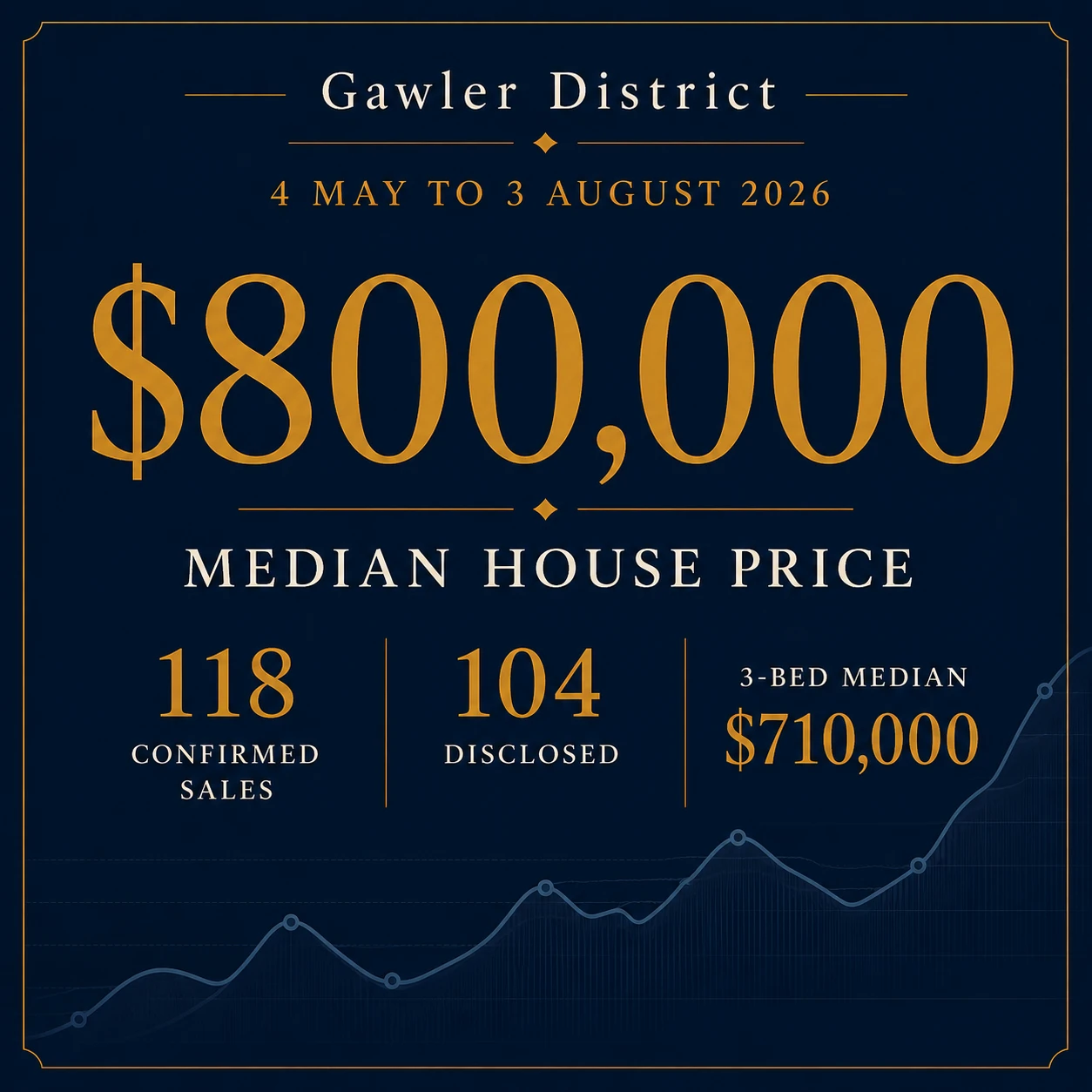
The headline median of $800,000 — up $60,000 from $740,000 in the prior period — reflects May's exceptional surge weighing heavily on this 90-day window rather than a clean, steady lift in values. The 3-bedroom median held flat at $710,000, unchanged from the prior period. Gawler East recorded 22 disclosed sales at a $782,500 median — the district's most statistically reliable suburb result by volume. Gawler Belt's $1,162,500 figure, from 9 sales, reflects a mix of larger residential allotments and rural acreage rather than typical in-town stock; a 2-sale result in Gawler itself was technically higher ($1,290,000) but too small a sample to read with confidence. For the full suburb-by-suburb breakdown, see the complete rolling report.
As this 90-day window moves forward past May in future updates, expect this median to shift again as that exceptional month rolls out of the calculation — not necessarily because the underlying market has changed. The monthly data beneath this window has moved fast: May brought a sharp surge in activity, followed by two consecutive months of cooling through June and July. The full story, and what it means, is below.
What the Data Is Now Telling Us About the Gawler and Surrounding Suburbs Market
When this analysis was first published, the Budget's potential influence on local activity was still an open question. The May 2026 sales data provided the first strong signal, and the subsequent June and July results have now given us a much clearer picture of what happened.
The Gawler district recorded 55 confirmed residential sales between 4 May and 3 June 2026 — a 72% increase on April's 32 confirmed sales, running directly counter to the district's established winter seasonal pattern. Of the 55 sales, 53 disclosed a sale price. The district median was $800,000, while the 3-bedroom median moved to $710,000 — a modest $10,000 lift on April's $700,000. That combination is important: transaction volume surged, but the typical 3-bedroom price benchmark barely moved with it.
The activity was also spread across the district rather than being concentrated in a single suburb or price band. Gawler East recorded 14 disclosed sales at a $763,500 median. Hewett recorded 6 disclosed sales at $1,008,000 — the first time Hewett had crossed the million-dollar suburb median in this report series. Evanston Gardens recorded 9 disclosed sales at $720,000. The most active price band remained $700,000–$749,999.
The composition of the May sales provides another important clue. A substantial share of the additional activity occurred in lower-priced, older housing stock that sits within Gawler's traditional investor market. That does not allow us to identify the motivation of every seller, but the timing of the Budget announcement, the size of the May increase and the type of properties transacting together provide strong evidence that investor reassessment was a significant contributor to the surge.
June and July then put the May result into perspective — though not as simply as a clean correction. Confirmed sales eased to 36 in June, still 13% above April's baseline, before easing further to 27 in July, now 16% below where the year started. The 3-bedroom median moved to $700,000 in June before rising to $767,000 in July, although that latest figure is based on only 9 disclosed sales. The sequence is consistent with a pull-forward of transactions in May combined with a seasonal cooling that has continued for two months running — sellers who were already considering their position appear to have brought some decisions forward following the Budget announcement, but the subsequent decline has gone further than a simple return to normal.
The May surge therefore remains one of the clearest signs of a Budget-related response in the Gawler data, but the two months since matter just as much. The evidence suggests the strongest reaction was concentrated in May, with activity continuing to soften afterward rather than settling at a new stable level. For the latest confirmed sales and suburb breakdown, see our Houses Sold in Gawler — July 2026 report.
How Many Homes Are Currently for Sale in Gawler and Surrounding Suburbs?
By late July 2026, approximately 230 properties were available across the Gawler district and surrounding areas when searching realestate.com.au using the 5118 postcode and surrounding suburbs, filtered to houses with three or more bedrooms. That is down from the 246-property peak recorded during May's surge and represents a second consecutive easing in active stock.
The movement in stock should not be attributed directly to the Budget. There are always multiple reasons why owners choose to sell, hold or withdraw a property. What the local data does show is that active stock has eased alongside a second consecutive month of falling sales — from 36 in June to 27 in July — a genuinely quieter market on both sides rather than one where fewer listings are simply being absorbed faster by a stable or growing buyer pool.
The combination is worth watching. If active stock and sales activity continue easing together, that would point toward genuine cooling in underlying demand rather than a short-term correction. If sales stabilise or recover while stock remains subdued, that would suggest the market is settling into a smaller but steady rhythm. The next few months will provide a clearer indication of whether the Budget-related pull-forward has fully worked through the market or whether broader softening is developing alongside it.
The Influence of Market Sentiment on the Gawler Property Market
Property markets are shaped by two forces that don't always move together: the underlying fundamentals of supply and demand, and the confidence of the people participating in the market. Right now, both are in motion.
National media coverage about price falls in Sydney and Melbourne — markets that operate at a very different scale and with a very different investor profile to the Gawler corridor — can influence how local buyers think and feel, even when the conditions on the ground here tell a different story. Some buyers who were ready to act become cautious when headlines suggest a broader downturn may be coming. That caution is understandable, but it is worth separating what is happening nationally from what is happening locally.
Sentiment can temporarily affect activity levels even when local fundamentals remain sound. A buyer who pauses for six months waiting for prices to fall further may find they have waited through a period of stability and missed a window that suited their circumstances. Equally, a seller who rushes to market purely in response to national news may not be making the decision that best fits their own timeline and financial position.
Property has historically been a long-term asset class for most Australians, and short-term fluctuations — whether driven by policy announcements, interest rate movements or media cycles — do not necessarily determine long-term outcomes. The most reliable way to assess what is actually happening in the Gawler property market in 2026 is to look at local data, local stock levels and local sale results, not the national average.
That is what we focus on at Gawler East Real Estate, and it is the basis on which we provide appraisals and market advice to our clients. If you are considering selling in the next 12–24 months, understanding where your property sits in the current Gawler real estate market is a useful starting point — and one we can help with at no obligation.
How We Advise Vendors Differently
Most agents focus on what has already sold. We focus on what buyers are looking at right now.
Alongside analysing recent sales evidence — including the confirmed data in our market reports — we regularly inspect competing properties currently listed across Gawler, Gawler East, Hewett, Evanston, Angle Vale and surrounding suburbs. When a new home enters the market, we want to see how it presents, what it offers and where it sits on value — because that is exactly what buyers are comparing your property against at the weekend open.
Recent sales are important, but buyers don't make decisions based on what sold three months ago. They make decisions based on the properties they are physically walking through this week. By understanding the current competition at ground level, we can position your property more effectively and provide pricing advice based on live Gawler property market conditions rather than historical data alone.
In a changing market, knowing where your property sits against today's listings can be just as important as knowing what sold yesterday. It means our vendors receive guidance informed by both past evidence and the homes buyers are actively considering right now.

Key Takeaways — Gawler and Surrounding Suburbs Property Market
- The 2026 Federal Budget's changes to negative gearing and CGT passed both houses of Parliament on 25 June 2026 and are now law, taking effect from 1 July 2027.
- Investors who owned or were under contract before 7:30pm AEST on 12 May 2026 are grandfathered on negative gearing for as long as they hold that property.
- The CGT changes apply to gains accruing from 1 July 2027 for all investors, regardless of when they purchased — making the next 12 months a period worth planning around.
- The May 2026 monthly report confirmed a 72% counter-seasonal surge in buyer activity — 55 confirmed sales against April's 32 confirmed sales — providing direct evidence that the budget announcement drove buyer urgency across the Gawler district.
- June and July's data have since shown that surge was followed by two consecutive months of cooling rather than a single clean correction — sales eased to 36 in June, still above the seasonal baseline, then eased further to 27 in July, settling below where the year started.
- The 3-bedroom median sat within a $700,000–$710,000 range across April, May and June, then moved to $767,000 in July from 9 disclosed sales — the first genuine movement in this benchmark across the whole series.
- As of early August 2026, a search of realestate.com.au using the 5118 postcode with surrounding suburbs selected, filtered to 3+ bedroom houses, shows approximately 230 properties available — down from around 243 in early July and from May's peak of 246, the second consecutive month of easing stock.
- Falling stock alongside falling sales points to a genuinely quieter market on both sides, not simply fewer listings being absorbed faster by a stable buyer pool.
- The Gawler district median house price was $740,000 for the period 4 February to 3 May 2026, across 90 confirmed sales. The 3-bedroom median rose to $710,000 and the 4-bedroom median strengthened to $845,000.
- The most current monthly median is $810,000, based on 27 confirmed sales between 4 July and 3 August 2026, with the 3-bedroom median at $767,000. A newer 90-day rolling report (4 May to 3 August 2026) covering 118 confirmed sales is also now available, with a rolling median of $800,000.
- Hewett has recorded a premium-priced median for three consecutive months — $1,008,000 in May, $1,055,350 in June, and $905,000 in July — a more reliable signal than any single month's figure given the small sample behind each one.
- Local Gawler property market conditions remain more important than national headlines when making property decisions in this corridor.
Frequently Asked Questions — 2026 Federal Budget and the Gawler Property Market
Will the 2026 Federal Budget cause property prices to fall in Gawler and surrounding suburbs?
The evidence so far points mainly to a volume effect, with the first signs of a price effect appearing in July. May 2026 recorded 55 confirmed sales against April's 32 — a 72% counter-seasonal surge — while June and July then eased for two consecutive months to 36 and 27 respectively, settling below April's baseline. The 3-bedroom median sat within a tight $700,000–$710,000 range across April, May and June before moving to $767,000 in July, though that figure rests on only 9 disclosed sales. The budget appears to have shifted buyer volume more clearly than it has shifted prices so far. The most recent 90-day rolling report, covering 118 confirmed sales from 4 May to 3 August 2026, recorded a median of $800,000. National headlines about price falls in Sydney and Melbourne reflect conditions in very different markets and should not be applied directly to the Gawler corridor.
How many homes are currently for sale in Gawler and surrounding suburbs?
As of early August 2026, a search of realestate.com.au using the 5118 postcode with surrounding suburbs selected, filtered to houses with three or more bedrooms, shows approximately 230 properties available — down from around 243 in early July and from May's peak of 246, the second consecutive month of easing stock. Stock levels change daily. For a current view of confirmed sales and buyer activity across the district, see our Gawler House Prices page, updated monthly.
Should investors sell before the proposed 2027 tax changes?
This depends entirely on individual circumstances — including purchase price, accumulated capital gains, loan structure, rental yield and long-term goals. Some investors may find that acting before 1 July 2027 makes financial sense; others may be comfortable holding. This is a decision for your accountant or financial adviser, not your real estate agent.
Are the negative gearing changes definitely going ahead?
Yes. The negative gearing and CGT reforms announced in the 2026–27 Federal Budget passed both houses of Parliament on 25 June 2026 and are now law, confirmed by the ATO. The changes take effect from 1 July 2027. Negative gearing will be restricted for established residential properties acquired after 7:30pm AEST on 12 May 2026, while properties held or under contract before that time remain grandfathered under the current rules for as long as they're held. Readers should still seek advice from their accountant on how these changes apply to their specific circumstances.
Did the 2026 federal budget actually increase property sales in Gawler?
Yes, for one month — and it has been cooling since. The Gawler district recorded 55 confirmed residential sales between 4 May and 3 June 2026, a 72% increase on April's 32 confirmed sales. This counter-seasonal surge in a month that historically softens is the clearest local evidence that the budget's investor incentive announcements drove buyer urgency across the district. The activity spread across multiple suburbs — Gawler East, Hewett, Evanston Gardens and Evanston Park all recorded strong results in the same period. June and July's data then showed two consecutive months of easing rather than a single correction: sales fell to 36 in June, still above April's baseline, then to 27 in July, now below it. The 3-bedroom median sat within a $700,000–$710,000 range for three months before moving to $767,000 in July, consistent with a genuine May pull-forward combined with a seasonal cooling that has run deeper than usual.
How do I find out what my Gawler property is worth right now?
The most accurate way is a free appraisal from a local agent with direct knowledge of recent comparable sales in your street — online estimates frequently miss suburb-specific factors and don't account for current competition or seasonal timing. For a full guide to how property values are actually determined, see How Much Is My House Worth?
If you'd like an updated appraisal of your Gawler property, contact Gawler East Real Estate for a no-obligation market assessment based on current confirmed sales data across the district.
Before you appoint an agent, it is worth understanding exactly what selling will cost you — see how much Gawler vendors save on commission with Gawler East Real Estate, and how our Gawler property pricing strategy protects your sale result from day one.
Call Andrew on 0493 539 067 or get in touch via our website.
This post is general information only and does not constitute financial or tax advice. Please consult a qualified accountant or financial adviser regarding your personal circumstances. Policy changes discussed were announced in the 2026–27 Federal Budget and passed into law on 25 June 2026, taking effect from 1 July 2027. Stock figures sourced from realestate.com.au at the time of writing (August 2026) and will change over time. Sales data sourced from realestate.com.au confirmed sold records, compiled by Gawler East Real Estate RLA 248695.