
Most sellers arrive at this question at a specific moment — when the decision to sell is becoming real and the numbers need to make sense before anything else can move forward.
It is a reasonable question and a more complex one than it first appears. The headline figure — agent commission — is only part of the picture. The costs that tend to surprise sellers are the ones that sit underneath it: the statutory legal requirements, the timing of when each cost falls, and the difference between what leaves your account during the campaign and what is deducted quietly at settlement.
This guide sets out the actual costs of selling a house in South Australia in 2026 — not as a worst-case warning, but as a clear framework for making confident decisions before you sign anything.
There are two interactive calculators on this page. The first estimates your net proceeds after all costs. The second shows what purchase price those proceeds could support for your next move. Both are tools for thinking clearly, not closing arguments for acting quickly.
On this page
Toggle- When Does Each Selling Cost Actually Leave Your Account?
- What Are the Total Selling Costs for a House in South Australia?
- How Much Is Real Estate Commission in South Australia?
- What Does Real Estate Marketing Actually Cost in South Australia?
- What Are the Legal Costs When Selling a House in South Australia?
- What Are PEXA Fees and Mortgage Discharge Costs?
- Does Property Presentation Affect What You Get for Your House?
- How Do I Calculate My Net Proceeds After Selling?
- How Much Can I Spend on My Next House?
- Selling Cost Questions Sellers Ask Before They Sign
- Before You Speak With Any Agent
- Understanding what selling will cost is the first step. Understanding what your house is worth in the current market is the second.
When Does Each Selling Cost Actually Leave Your Account?

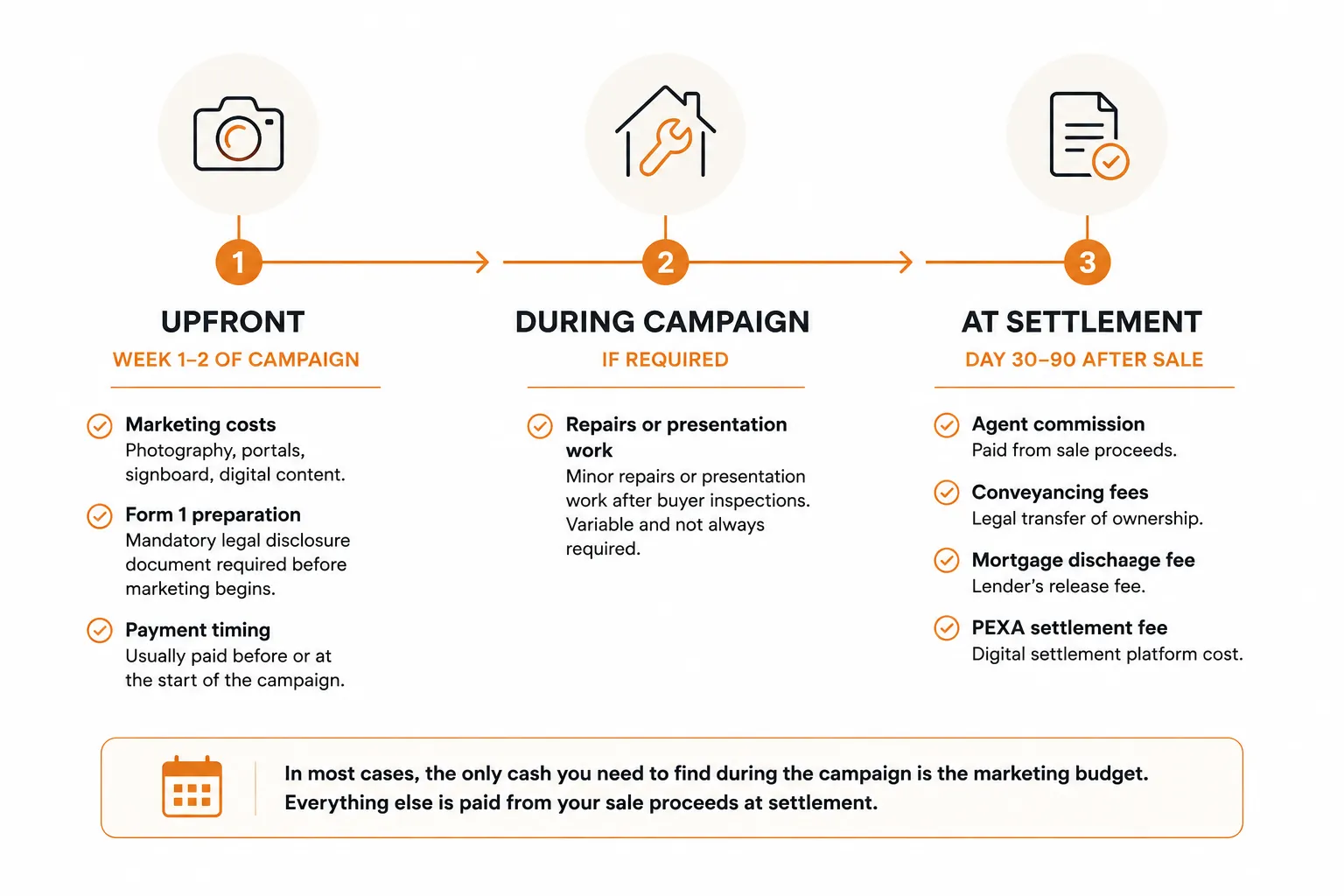
One of the most useful things to understand before selling is not how much each cost is — it is when it falls. The timing changes the cash flow picture significantly.
Upfront (Week 1–2)
- Marketing campaign (photography, portal listings, signboard)
- Form 1 preparation — mandatory legal disclosure document required before listing
During Campaign
- Minor repairs following buyer building inspections (if required)
- Any additional presentation or styling work
At Settlement (Day 30–90)
- Agent commission
- Conveyancing fees
- Mortgage discharge fees
- PEXA digital settlement costs
What Are the Total Selling Costs for a House in South Australia?
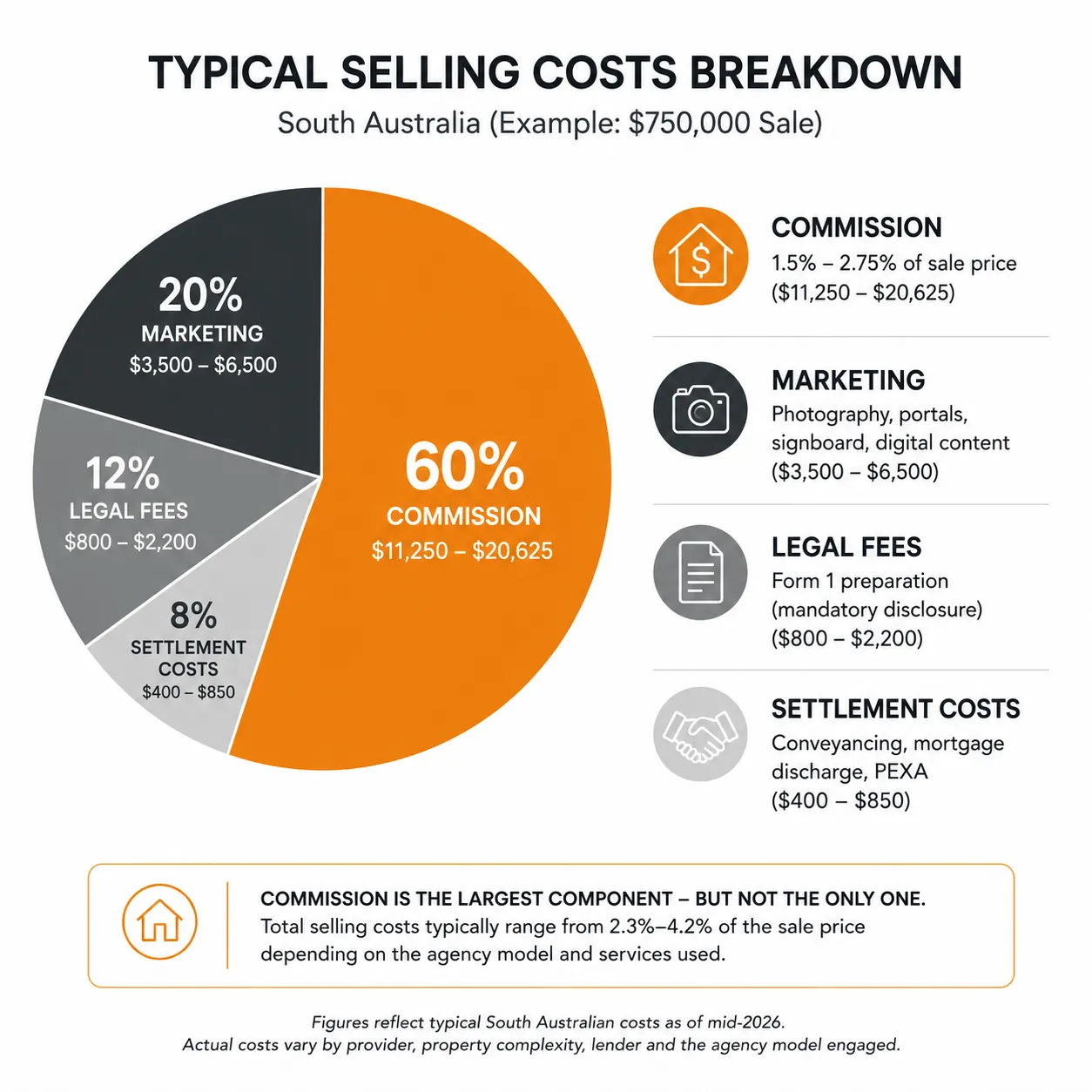
The table below sets out the full range of costs for a typical South Australian house sale, based on a $750,000 sale price — broadly representative of the current northern Adelaide corridor median.
| Cost Item | Estimated Range | Notes |
|---|---|---|
| Agent Commission (Inc GST) | $11,250 – $20,625 | 1.5% – 2.75% of sale price |
| Marketing Campaign | $3,500 – $6,500 | Photography, portals, signboard, digital |
| Form 1 Preparation | $800 – $2,200 | Mandatory disclosure; timing and method varies |
| Conveyancing (Settlement) | $880 – $1,300 | Required to complete the legal transfer |
| Mortgage Discharge & PEXA | $400 – $850 | Bank release fee + digital settlement platform |
| Total Estimated Costs | ~$17,000 – ~$31,500 | ~2.3%–4.2% of a $750,000 sale price |
How Much Is Real Estate Commission in South Australia?
In South Australia, real estate agent commission is not regulated. There is no legislated standard rate — the percentage an agent quotes is a starting point, not a fixed requirement.
Across the greater Adelaide area and surrounding regions, commission rates for residential sales currently range from approximately 1.5% to 2.75% inclusive of GST. The rate an agency quotes is shaped largely by its cost structure.
Franchise agencies carry overhead costs that independent agencies do not — brand levies, head office systems, and franchise fees that are ultimately recovered through the commission rate charged to vendors. An independent, principal-led agency operating with lower overheads can offer a lower rate without reducing the service that actually affects the outcome.
The more important calculation is not the commission percentage alone — it is the net figure you keep after the sale. An agent who charges 1.5% and achieves $740,000 puts more money in your pocket than one who charges 2.0% and achieves the same result. But an agent who charges 2.0% and achieves $760,000 through stronger negotiation puts more in your pocket than either.
Commission percentage tells you one variable. It does not tell you the result.
→ For a full explanation of how commission works, what it covers, and how to compare agents on outcome rather than rate: Read: Real Estate Agent Commission in Australia — What Sellers Should Know
What Does Real Estate Marketing Actually Cost in South Australia?
Marketing is the one selling cost paid upfront — and the one sellers most commonly underestimate or over-engineer.
This covers professional photography, a premium listing on realestate.com.au and Domain, a signboard, and digital or social promotion. Drone footage and video walkthroughs are available as add-ons — drone is most relevant for larger acreage or lifestyle properties where the land itself is a selling point, not as a standard item for the typical residential house sale.
The question worth asking is not "how do I spend less on marketing?" It is "what does the marketing budget actually produce?"
Marketing buys buyer attention. It does not create buyer competition — that is the agent's job once the buyers are in the room. A well-spent $4,000 campaign that generates twelve genuine inspection groups and five motivated buyers is worth considerably more than a $6,500 campaign that generates the same twelve people without a strategy for converting their interest.
It is also worth being direct about optional extras. Video walkthroughs and drone footage are available and can support brand presentation — but spending more on showcasing a property that buyers will inspect in person is not always the most effective use of a vendor's money. For most residential house sales, professional photography and a well-structured portal listing do the job. The marketing budget should be calibrated to what the property actually needs, not to what looks impressive on a proposal.
In a market where stock has risen and buyer volume has eased compared to early 2025, how a property is presented on realestate.com.au matters more than it did in a tighter market — but that is about pricing accuracy and listing quality, not about spending more on production.
What Are the Legal Costs When Selling a House in South Australia?
Legal costs in a South Australian property sale involve two separate steps that sellers frequently confuse. Understanding the distinction matters because they occur at different times and involve different providers.
What Is a Form 1 and How Much Does It Cost?
Before a property can be sold in South Australia, the vendor must serve a Form 1 — the Vendor's Statement. This document discloses zoning, council rates, easements, encumbrances, infrastructure charges, and other statutory information to the buyer before they are bound by the contract.
The Form 1 must be prepared before the campaign launches. It is a legal requirement, not an optional extra.
$800 – $2,200
The variation comes down to how it is prepared. Always ask, before signing an agency agreement, whether the Form 1 preparation fee is included in the proposal and how it is handled.
| Preparation Method | Typical Cost |
|---|---|
| Agent handles searches in-house, certifies directly | ~$800 |
| Fully outsourced to external legal provider | $1,800 – $2,200 |
What Does a Conveyancer Do and How Much Do They Cost?
Once the property is sold, a registered conveyancer is legally required to complete the transfer of ownership. This is a separate engagement from the Form 1 preparation and cannot be handled by the real estate agent.
Conveyancing at settlement covers the formal transfer of title, the adjustment of council rates and water charges between vendor and purchaser, and the coordination of settlement through PEXA.
$880 – $1,300
Even if Form 1 preparation is handled efficiently by the agency, an independent conveyancer is still required at the settlement stage. These are two different services with two different timing points.
What Are PEXA Fees and Mortgage Discharge Costs?
Since May 2026, PEXA — the national digital property settlement platform — operates under a jurisdiction-based fee model in South Australia. These costs are separate from conveyancing fees and are charged through the settlement process.
PEXA Platform Fees (SA, 2026)
- Transfer fee: approx. $141
- Industry Data charge: approx. $1.10 per document
Mortgage Discharge Fees
- Charged by your lender, not the agent
- Typically $250 – $550 per loan account
- Multiple loans = multiple discharge fees
Does Property Presentation Affect What You Get for Your House?
Buyers in the current market have more choice than they did twelve months ago. A house that presents as move-in ready — clean, well-maintained, without an immediate mental list of jobs — tends to attract stronger offers and faster decisions.
Two categories of presentation spend are worth understanding separately, because they deliver very different returns.
Professional Staging
$3,000 – $8,000Full-home staging — furniture, styling, accessories — is most effective in vacant properties where empty rooms undermine the sense of scale and liveability. For an occupied house with reasonable furnishings, the return on full staging is less predictable. Consider it carefully before committing.
The Basics First
Under $1,000A well-maintained garden, pressure-cleaned driveway, fresh mulch, and a clean front door communicate care — and buyers interpret the care visible outside as evidence of the care they cannot see inside. Spending $500–$800 on street presentation consistently outperforms much larger internal investments on return per dollar spent.
The principle is straightforward: presentation spend should target buyer perception at the moment of first impression and at the moment an offer is forming — not the highest-cost upgrade available.
How Do I Calculate My Net Proceeds After Selling?
The most useful number to know before selling is not the sale price — it is what you keep after every cost has been accounted for. Adjust the inputs below to reflect your situation. Default figures reflect typical South Australian conditions in 2026.
Figures are estimates only. Commission is calculated on the rate entered inclusive of GST. Form 1 includes typical government search disbursements. Final proceeds will vary depending on your mortgage payout figure and actual provider costs.
Most people don't lie awake wondering what their commission rate will be.
They wonder whether there will be enough left to buy their next house. Whether the numbers will support a move closer to family. Whether selling is actually financially possible right now — or whether it is better to wait.
That is why understanding your likely net proceeds matters more than knowing the commission percentage alone. A percentage is an abstraction. A net proceeds figure is a real number you can take to a mortgage broker, a financial planner, or a kitchen table conversation with your partner.
Use the calculator above before you speak to anyone.
How Much Can I Spend on My Next House?
Once you have an estimated net proceeds figure, the next question is usually what it means for the purchase that follows. Enter your proceeds, any additional savings, and a new mortgage amount to see the purchase price range you could realistically target — after South Australian stamp duty and transaction costs.
Figures are estimates only. Stamp duty is calculated on the estimated purchase price using the rate entered. Actual duty depends on purchase price, buyer type, and eligibility for concessions. Confirm with your conveyancer before making purchasing decisions.
Selling Cost Questions Sellers Ask Before They Sign
Most South Australian sellers should budget between 2.5% and 4.2% of their final sale price to cover all selling expenses. For a house selling at $750,000 this typically means $17,000 to $31,500 in total costs. The range reflects the difference between a competitive independent agency at 1.5% commission with efficient Form 1 preparation, and a franchise model at 2.75% with fully outsourced legal costs.
The three main cost categories are: agent commission (1.5%–2.75% inc GST), the marketing campaign ($3,500–$6,500), and statutory legal fees covering the Form 1 and settlement conveyancing ($1,680–$3,500 combined).
The costs sellers most commonly overlook are mortgage discharge fees ($250–$550 per loan account, charged by the lender at settlement) and the Form 1 preparation cost — a mandatory legal disclosure document required before listing, typically $800–$2,200 depending on how it is handled by the agency.
Neither is typically mentioned in an agent's initial cost summary. Both are predictable once you know to ask for them before signing anything.
Under a standard No Sale No Fee agency agreement in South Australia, commission is not payable if the property fails to sell or is withdrawn from the market. However, marketing and advertising costs already incurred — photography, portal listings, signboards — are generally still payable to the third-party providers who delivered them.
These costs are separate from the agent's commission and are typically outlined in the agency agreement before the campaign begins. Always confirm this in writing before you sign.
This depends on how the agency operates. Many agencies outsource the entire Form 1 preparation to an external legal provider, adding a professional fee on top of the government search costs — total typically $1,800–$2,200. Some agencies handle the search extraction in-house, with the vendor paying only the government search disbursements and certification — approximately $800.
Ask whether the Form 1 fee is included in the agency's proposal and exactly how the preparation is handled before you sign the agency agreement.
For a primary residence — your main home — selling costs are generally not tax deductible. For an investment property, selling costs including commission, marketing, and legal fees form part of the property's cost base. Adding these costs to the cost base reduces the net capital gain, which reduces the Capital Gains Tax payable on the sale.
A qualified accountant can advise on the specific treatment for your circumstances.
Stamp duty in South Australia is a buyer cost, not a seller cost. Sellers do not pay stamp duty on the property they are selling. It is payable by the purchaser on the contract price and is handled at settlement.
If you are purchasing a replacement property after selling, stamp duty on that purchase is factored into the buying power calculator above.
The costs on this page are not designed to be alarming. They are designed to be accurate. Most sellers who work through the full picture find the number is more manageable than the vague anxiety that surrounds the question before they looked at it directly.
What the numbers do is create a framework. When you know your estimated net proceeds, the conversation with any agent changes. You are no longer comparing commission percentages in the abstract — you are comparing what different approaches are likely to leave in your account after everything is settled.
Many sellers focus their energy on negotiating the commission rate. That negotiation has real value. But it has less value than the question of whether the agent's pricing strategy and negotiation approach will protect the sale price in the first place. A 0.25% saving on commission is $1,875 on a $750,000 sale. A property that sits on the market for six weeks because it launched at the wrong price — and eventually accepts an offer $15,000 below where it should have been — is a considerably more expensive outcome.
Practitioner Observation
One thing I notice after completing hundreds of appraisals across the northern Adelaide corridor:
The most common surprise isn't the commission. It's discovering how many sellers have never been shown their likely net proceeds before being asked to sign an agency agreement.
Most know roughly what their house might sell for. Very few know what they'll actually keep.
That conversation — the full picture, costs included — should happen before any agreement is signed. Not during. Not after.
Andrew McKiggan — Owner & Principal, Gawler East Real Estate RLA 248695
Continue reading
-
Commission is one cost. But the total amount you keep depends on how every cost is structured together. See a full side-by-side breakdown of commission, marketing, and legal fees — and what the difference looks like at settlement.
How commission and selling costs work together — full breakdown -
Knowing your costs is one side of the equation. The other is making sure the sale price holds once the campaign is live. This page explains how pricing strategy protects your result from day one — and what goes wrong when it doesn't.
The pricing strategy that protects the sale price once the campaign is live -
The most expensive mistake many sellers make has nothing to do with commission. It happens at the listing appointment, when an agent quotes a price designed to win the listing rather than reflect the market. This page explains what to look for before you sign anything.
How an inflated appraisal at the listing appointment can cost more than any commission saving
Before You Speak With Any Agent
By now you should have a much clearer picture of what selling a house in South Australia actually costs — not the vague range that gets mentioned at listing appointments, but the real structure: what each cost is, when it falls, and what you are likely to keep after everything has been settled.
Take these figures with you when you speak to other agents. Not as a negotiating weapon — as a framework for asking better questions.
- How do you structure your commission and what does it include?
- How is the Form 1 prepared and what will I be charged for it?
- When does each cost become payable — upfront, during the campaign, or at settlement?
- Can you show me my likely net proceeds — not just my likely sale price?
The goal is not to find someone who promises the most. It is to find someone who gives you genuine confidence that you understand the process before making one of the most significant financial decisions of your life.
An agent who answers those questions clearly, with evidence, before you have signed anything — that is the agent worth a longer conversation.
Understanding what selling will cost is the first step.
Understanding what your house is worth in the current market is the second.
A free property appraisal from Gawler East Real Estate gives you a price position built from current comparable sales — not from what you hope to achieve and not from what an agent thinks will win your listing.
Request a Free Property AppraisalOr call Andrew directly on 0493 539 067 · enquiries@gawlereastrealestate.au
Local Market Perspective
Real estate selling costs in South Australia follow a predictable structure — but the variables within that structure are not fixed. Commission rate, Form 1 preparation method, marketing budget, and the choice between outsourced and in-house legal preparation all shift the final cost to the vendor.
In the Gawler district and across the northern Adelaide corridor, the independent principal-led agency model means these costs can be managed more efficiently than a franchise structure typically allows. At Gawler East Real Estate, Form 1 preparation is handled in-house at approximately $800 — compared to the $1,800–$2,200 that external preparation typically costs. Commission starts at 1.5% inclusive of GST, with the full campaign managed directly by Andrew McKiggan from appraisal through to settlement.
The most useful number on this page is not the cost range — it is the net proceeds figure you calculate for your own property. That number is the one worth taking into any conversation with any agent.
Gawler East Real Estate — RLA 248695 — serving Gawler, Willaston, Hewett, Evanston, Angle Vale, Munno Para, and the broader northern Adelaide corridor. gawlereastrealestate.au

