

Most sellers approach the question of timing the wrong way around.
They search for the best month to sell, find articles pointing to spring, and decide to wait until September. Some of them are right. Many of them wait an extra four or five months — watching mortgage repayments, maintenance costs, and holding expenses accumulate — for an advantage that the data does not actually guarantee.
The question "when is the best time to sell?" sounds like one question. It is actually three different questions compressed into one — and neither the calendar nor the Property Clock answers all three:
The Three Questions Most Sellers Forget to Ask
- When do buyer volumes tend to peak nationally?
- What are conditions doing in this market, right now?
- What is the personal cost of waiting versus the expected benefit?
Most sellers only ask the first question. The second and third are where the real answer lives.
This guide works through all three — including the conditions that actually drive your sale result, the seasonal patterns worth understanding, and the signals that tell you more about your timing than the calendar does.
Best Time to Sell a House in Spring — The Truth About the Seasonal Advantage
The advice to sell in spring has a factual basis. Auction clearance rates and new listing volumes in most Australian capital cities are consistently higher between September and November than in any other quarter. Buyer activity rises after the winter lull. Gardens look their best. Open home traffic increases. In competitive markets, that combination can produce stronger competition for well-positioned properties.
But "more buyers" does not automatically mean "better result." It also means more competing listings. Spring is not just when buyers emerge — it is when every other seller decides to list, too.
A property entering a spring market without a well-calibrated price position, strong listing presentation, and an agent actively managing buyer interest does not benefit from the seasonal lift. It competes harder for the same pool of buyers that a hundred other vendors are also chasing.
Spring works best for sellers in markets with constrained supply — where the seasonal increase in buyer demand is not matched by an equal increase in competing stock. In markets already carrying elevated listing volumes, the spring advantage is diluted.

Best Season to Sell a House in Australia: What Each Period Actually Delivers
Not all seasons are equal — and the differences matter more in some markets than others. Here is an honest assessment of what each selling window typically delivers across Australian residential markets.
Highest buyer activity nationally. Also highest competing stock. The visual lift of a well-maintained garden matters when buyers are comparing multiple properties at open homes.
Best for strong street appeal. Riskiest when you need to stand out in a crowded field.Consistently underestimated. Buyers serious about purchasing before winter move with more urgency and less browsing behaviour. Competition from other vendors is materially lower.
Best for committed buyers and lower competing stock. Often the strongest window for well-priced properties.Slowest period for new listings and typically the lowest buyer volumes. Winter buyers tend to be more committed — but the pool is genuinely smaller. Not suited to campaigns relying on high open home traffic.
Best for well-priced properties with minimal competition. Avoid if you need high inspection numbers.January–February sees buyer and agent activity at low points. Properties listed in January are frequently overlooked until late February. Exception: coastal and holiday markets where summer is peak season.
Avoid January launches in metro and suburban markets. Coastal markets are the exception.What Drives a Strong Sale Result More Than Timing
The strongest sale results across Australian residential markets tend to cluster not around a specific month but around a specific set of conditions — conditions that can occur in any season.
Active competing buyers for the same property — not just interest, but two or more motivated parties who both want it.
A price that reflects where buyers are currently searching — built from comparable sales, not from what the vendor hopes to achieve.
A listing that surfaces in the search results those buyers are using — the right price band, the right portal presentation on realestate.com.au.
An agent who creates and manages pressure between interested parties — not one who waits for offers to arrive and then passes them on.
When those four conditions are present, the calendar date has a secondary influence. When they are absent, selling in peak spring does not compensate.
The property that enters a spring market with an overconfident price and an agent who waits for offers to arrive is outperformed by the property that enters a quieter autumn market correctly positioned and actively managed. Timing the market is less important than entering the market correctly.

Should You Wait for the Market Peak? Understanding the Property Clock
Many Australians have encountered the Property Clock — a framework used by analysts and valuers, most recognisably in the quarterly reports published by firms like Herron Todd White, that maps residential property markets through a recurring cycle of stages.
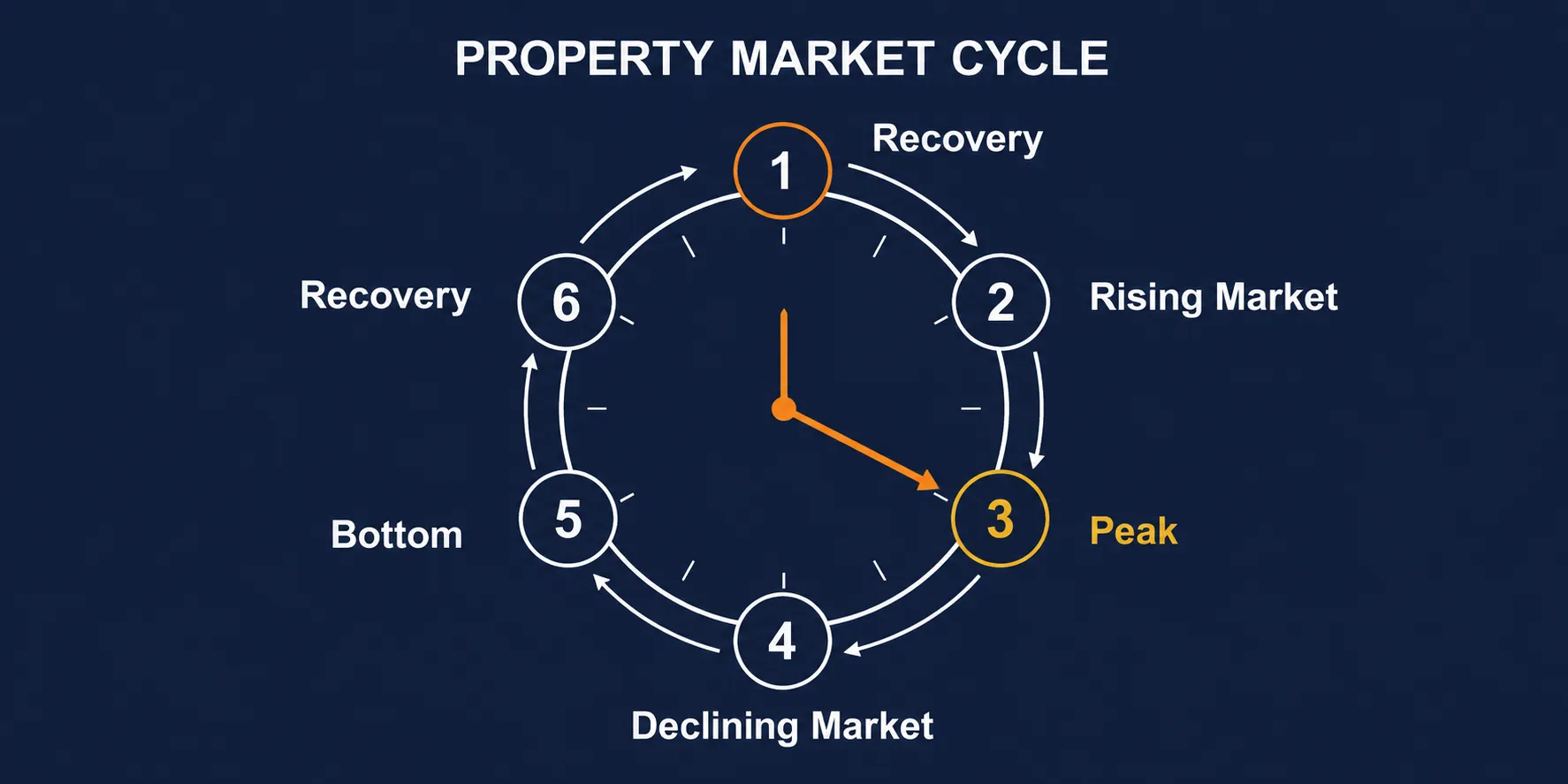
State-based versions of the clock track capital cities and regional centres separately, reflecting that Sydney, Melbourne, Adelaide, and Brisbane rarely move in lockstep. At that level of understanding, it is a genuinely useful tool — one that helps buyers, sellers, and investors orient themselves within a longer market narrative.
The problem is not the Property Clock itself. The problem is what sellers assume it means for their individual decision.
A homeowner who sees their city positioned at "approaching peak" on the latest Property Clock does not have a selling instruction. They have a piece of broad context about where analysts believe the market may be in its cycle. Those are meaningfully different things — and conflating them is where the Property Clock leads sellers astray.
Your property does not compete against the national market, or the state market, or even the suburb median. It competes against today's buyers, today's competing listings, today's interest rates, and today's comparable sales in your price bracket. The cycle provides the backdrop. Those four things determine the result.
| The Property Clock Helps Explain | It Doesn't Tell You |
|---|---|
| Where the broader market may be in its cycle | What your property is worth today |
| Long-term directional trend | Whether your asking price is correct |
| General buyer confidence at a city or regional level | How much competing stock exists in your price bracket |
| Economic cycle and its effect on sentiment | Whether waiting three months genuinely improves your outcome |
There is also a practical problem with trying to sell at the peak: nobody rings a bell when it arrives. Property cycles are identified in hindsight. The seller who waits for peak conditions confirmed by analysts is reading last quarter's data while this quarter's buyers are already adjusting to whatever has changed since. By the time the cycle position is published, the market has moved.
The Climate vs Weather Distinction
Climate matters — it shapes what you can expect. But weather decides whether you take an umbrella today. You do not cancel a well-planned campaign because the climate is uncertain, and you do not assume a favourable climate means the campaign runs itself.
Days on Market — The Hidden Variable Every Seller Should Understand
How long a property has been listed is visible to every buyer on realestate.com.au. Days on market accumulates publicly, and buyers read it — often before they read the listing description or look at the price.
A property that has sat for 45 days without selling is not seen as patient. It is seen as a property that the market has already assessed and passed on.

Proprietary Concept
The Freshness Window
The first 14 to 21 days of a campaign are when buyer attention is at its highest, portal algorithms surface the listing most prominently, and genuine competition for the property is most likely to emerge. Once that window closes, recovering campaign momentum requires either a price adjustment or a deliberate re-launch. Neither is costless. The mechanics behind The Freshness Window — and how price position either protects or destroys it — are explained in full in the Property Pricing Strategy guide.
Days on market is one of the strongest signals in a property campaign. Every pricing and strategy decision before launch should be made in the context of protecting it.
Andrew's Observation
The sellers who regret their timing rarely regret selling in July instead of October. They regret launching without the right price position. They regret accepting an optimistic appraisal because it matched what they hoped to hear. They regret the 60-day campaign that ended with a price reduction they could have avoided if the launch price had been set correctly in the first place.
The single most expensive timing mistake is not selling in the wrong season. It is entering the market before the price position has been built from evidence.
The question vendors almost never ask — but should — is this: given what comparable properties are currently achieving, what is the realistic cost of the price reduction I will need if the initial launch price does not attract offers? That is not a pessimistic question. It is the question that separates a well-planned campaign from one that costs money quietly.
— Andrew McKiggan, Gawler East Real Estate RLA 248695
When to Sell a House: The Conditions That Matter More Than the Calendar
If you are weighing up when to sell, these conditions are more predictive of your result than the month on the calendar. Understanding them changes the question from "what is the best season?" to "what does my market look like right now?"
Borrowing capacity determines buyer budgets. In a period of rate cuts or rate stability, buyer confidence tends to expand and price ceilings rise. In a rising rate environment, buyers become cautious and reassess what they can afford — which compresses offers regardless of the season.
The number of competing listings in your suburb and price range directly affects how much attention your property attracts. Selling when supply is constrained means your property gets more attention from the same pool of buyers. Selling into elevated stock means you are competing harder for every inspection.
A property that presents better in warm weather — outdoor entertaining area, pool, established gardens — has a genuine visual advantage in spring and early summer. A property with strong indoor living and cosy presentation can sell as strongly in winter if priced and presented well. The property's characteristics should inform the timing.
Every month of delay costs money. Mortgage repayments, council rates, insurance, maintenance, and strata fees where applicable are real costs that accumulate during any waiting period. If the projected benefit of a more favourable season is $10,000 and the monthly holding cost is $3,500, the mathematics of waiting three months is marginal at best.

How to Time Your House Sale: A Four-Question Framework
Before deciding to wait or to list, work through these four questions. They are more reliable than the season, more specific than the Property Clock, and more honest than an agent who defaults to "spring is the best time."
Not what they are listed for — what they are selling for, and how long they are taking. This tells you whether the market is moving in your favour or against it. A formal comparable sales analysis — the same methodology used in a professional appraisal — is explained in the Property Appraisal guide.
If new listings are accumulating and open home attendance is softening, waiting for spring may deliver more competition rather than more buyers. Check what is currently listed — not just what has sold.
Calculate the real cost of each additional month — not just the mortgage, but all ongoing expenses. Stack that against a realistic estimate of the benefit from waiting. The number is often smaller than sellers expect.
The best month to sell is the month in which the property is correctly prepared, correctly priced, and represented by an agent with a clear strategy. Listing before those conditions are met — regardless of the season — is the most common and most avoidable timing mistake.
If those four questions point toward listing now, the season becomes largely irrelevant. If one or more points toward preparation, the time is better spent on that than on waiting for September.
Common Timing Mistakes That Cost Sellers Money

Every open home that does not generate a written offer weakens the campaign. Buyers share information. A property seen at a first open home with boxes in the hallway and an unattended garden enters the market carrying an impression it may not recover from. The Freshness Window does not restart when you tidy up — it has already closed.
Spring attracts buyers, but it also attracts vendors — and buyers in a crowded spring market compare aggressively. A property priced 8% above where comparable sales are settling does not benefit from seasonal demand. It accumulates days on market and eventually negotiates from a weaker position than a correctly priced autumn listing would have achieved.
The right buyer for an overpriced property is a buyer willing to pay the vendor's price in a market that is not supporting it. The longer a property sits without offers, the less likely that buyer arrives — and the more likely the only offers that do arrive reflect accumulated market scepticism rather than genuine competition.
A property sold in late October settles in late December or early January — a period when conveyancers, lenders, and buyers are often stretched thin. Allowing for settlement timing and its implications for the vendor's own plans is a practical consideration that is rarely built into the timing decision at the listing stage.
What to Ask Your Agent Before You Set a Launch Date

When you ask an agent when you should list, you are asking for more than a calendar recommendation. You are asking them to demonstrate that they understand your market, your price bracket, and the current conditions well enough to give advice worth acting on.
These five questions tell you quickly whether they can:
What are the three most comparable properties to mine that have sold in the past 90 days, and what did they achieve?
How many active buyers are you currently working with in my price range?
What is the current average days on market for properties like mine in this suburb?
How many competing listings are expected to enter the market in my price range in the next 60 days?
If the campaign has not received a satisfactory offer after four weeks, what is your recommended response?
An agent who can answer those questions with evidence — not generalisation — is an agent whose timing advice is worth weighting heavily. An agent who defaults to "spring is the best time" without reference to your specific market, your specific property, and current conditions is giving you the advice that requires the least knowledge to give.
If you are at the stage of comparing agents before committing, the Real Estate Agent Comparison guide covers what to look for beyond the questions above — including how to assess recent results, fee structures, and campaign approach.
Local Market Perspective — Gawler and the Northern Adelaide Corridor

Andrew McKiggan is the principal and sole licensed agent of Gawler East Real Estate (RLA 248695), an independent residential agency based at 1 Lewis Ave, Gawler East SA 5118. Andrew sells residential property across the Gawler district and northern Adelaide corridor at 1.5% commission or lower.
The seasonal timing patterns described on this page apply nationally — but in the Gawler district they play out differently than in inner Adelaide suburbs. The buyer pool here is driven primarily by affordability and access. Buyers relocating from more expensive suburbs to the south are active year-round — their decision to buy is triggered by budget and life stage, not by the calendar. Spring does not produce the same disproportionate lift in this market that it does in lifestyle-driven markets closer to the city.
What matters far more in this district than the season is the competing stock picture in your price bracket. When supply is constrained — fewer listings competing for the same buyer pool — correctly priced properties attract strong early interest regardless of the month. When supply is elevated, even a spring campaign can feel flat.
The most current picture of what comparable properties are achieving in this market right now — including days on market trends and recent sale prices by suburb — is available at the Gawler House Prices page, updated monthly.
If you are weighing up whether now is the right time to sell in Gawler or the surrounding suburbs, speak with one of the real estate agents Gawler vendors trust for an honest, evidence-based timing assessment — not a calendar recommendation.
The sellers who get timing right are not the ones who waited for October. They are not the ones who studied the Property Clock until it told them what they wanted to hear.
They are the ones who understood what comparable properties were achieving, entered the market correctly priced, and worked with an agent who managed buyer interest actively from the first open home.
If you are weighing up whether now is the right time to sell, the most useful starting point is not the season — it is a clear understanding of what your property is worth in the current market and what conditions you will be selling into. That is what a good appraisal provides: not a number to feel good about, but a price position built from current evidence that tells you whether this is a good moment to act.
If you are ready to speak with one of the real estate agents Gawler vendors trust for honest advice and a low commission outcome, contact Andrew directly to discuss your property.