

When selling a property, most owners assume the greatest challenge is finding a buyer. In practice, one of the most significant risks appears well before a property reaches the market — at the moment you choose an agent and agree on an initial price.
That moment matters more than most sellers realise. The figure an agent presents at a listing appointment doesn't just reflect their assessment of your property. In some cases, it reflects what they believe you want to hear. And because most of us instinctively want to believe the higher number — it represents our years of mortgage payments, our financial future, our plans for what comes next — that instinct can be used against us.
This page explains the two practices at the centre of that risk: buying the listing and conditioning. Understanding how they work is the most effective protection against them.
How Listings Are Sometimes Won Before Properties Are Sold
In competitive property markets, sellers often receive noticeably different price opinions from different agents. In some cases, one appraisal sits well above what recent, comparable sales would suggest.
This can occur because pricing guidance plays a role not only in positioning a property for the market, but in securing the listing itself. When two figures are presented — one conservative and one more optimistic — most people instinctively lean toward the higher number. The figure feels like a possibility, even when the supporting evidence is limited or absent entirely.
"A higher appraisal can feel persuasive — not because it's proven, but because it aligns with the outcome sellers hope for."
Once an agency agreement is signed, the relationship changes. The agent now controls the listing for the agreed exclusivity period, and attention naturally shifts from winning the business to managing the campaign. The optimistic figure that won the listing quietly becomes the starting point for a different conversation.
Understanding how appraisal figures are built — and what evidence they should be based on — is the foundation of any well-informed listing decision. Our property appraisal guide explains what a well-constructed appraisal contains and how to assess whether the figure you receive reflects current market evidence.
The Conditioning Process Explained
After a property launches, buyer behaviour begins to provide feedback. If enquiry is lower than expected or open homes are quiet, pricing conversations evolve.
Conditioning refers to the gradual adjustment of a seller's expectations after a property has been positioned above what buyers are prepared to pay. This adjustment typically occurs incrementally — framed around market feedback, buyer hesitation, or comparable properties achieving lower results.
A good appraisal should do more than provide a number.
It should explain why that number is supported by the evidence, what it means for your campaign, and help you make confident decisions before you sign anything.
Conditioning often becomes necessary when an appraisal wasn't built from evidence in the first place. The market hasn't changed — the original interpretation of the market was simply wrong.
"Conditioning isn't a single conversation — it's a slow recalibration of expectations after the market has already spoken."
By the time this process is underway, the original optimistic appraisal may no longer be referenced at all. Instead, discussions focus on what needs to change to generate interest — a price adjustment, a new marketing approach, a different method of sale. The optimistic appraisal has served its purpose. What follows is the cost of it.
The full relationship between appraisal accuracy, pricing decisions, and campaign outcomes is explored in our property pricing strategy guide — including how price position either protects or destroys the critical opening weeks of a campaign.
The Freshness Window — Why the First 21 Days Matter
Buyer competition tends to be strongest during the opening weeks of a campaign. In most Australian property markets, the highest-intent buyers inspect a property within the first 14 to 21 days of it appearing on the major portals. This period is what we call The Freshness Window — the point at which competition, urgency, and negotiating leverage are at their strongest.
Portal algorithms surface new listings most prominently in the first weeks after launch. Buyers with pre-approved finance are actively monitoring and move quickly. If a property launches above where those buyers are searching, this window closes without the competition that produces strong results ever forming.
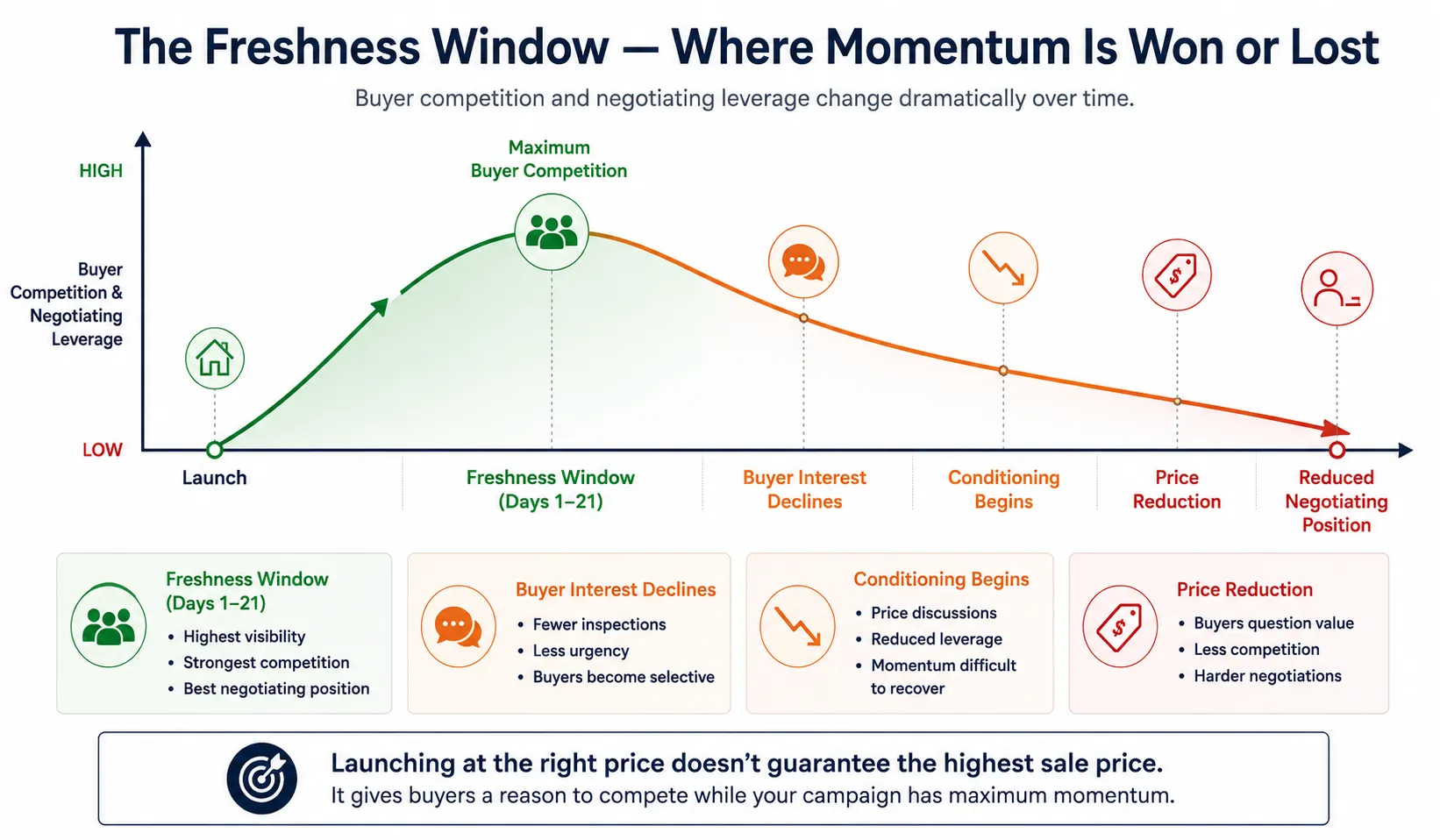
"Once the first 21 days pass without traction, the campaign often shifts from maximising interest to managing expectations."
Even if the price is adjusted later, the competition that should have formed during those opening weeks rarely returns. Once that momentum is lost, it is difficult to recreate. The buyers who would have moved quickly in week one have already moved on — to other properties, other suburbs, other agents. What remains is a smaller pool with more time and less urgency.
The mechanics behind The Freshness Window — why those opening weeks determine so much of the campaign outcome, and how price position either protects or destroys them — are explained in full in our property pricing strategy guide.
What Conditioning Can Cost — In Real Terms
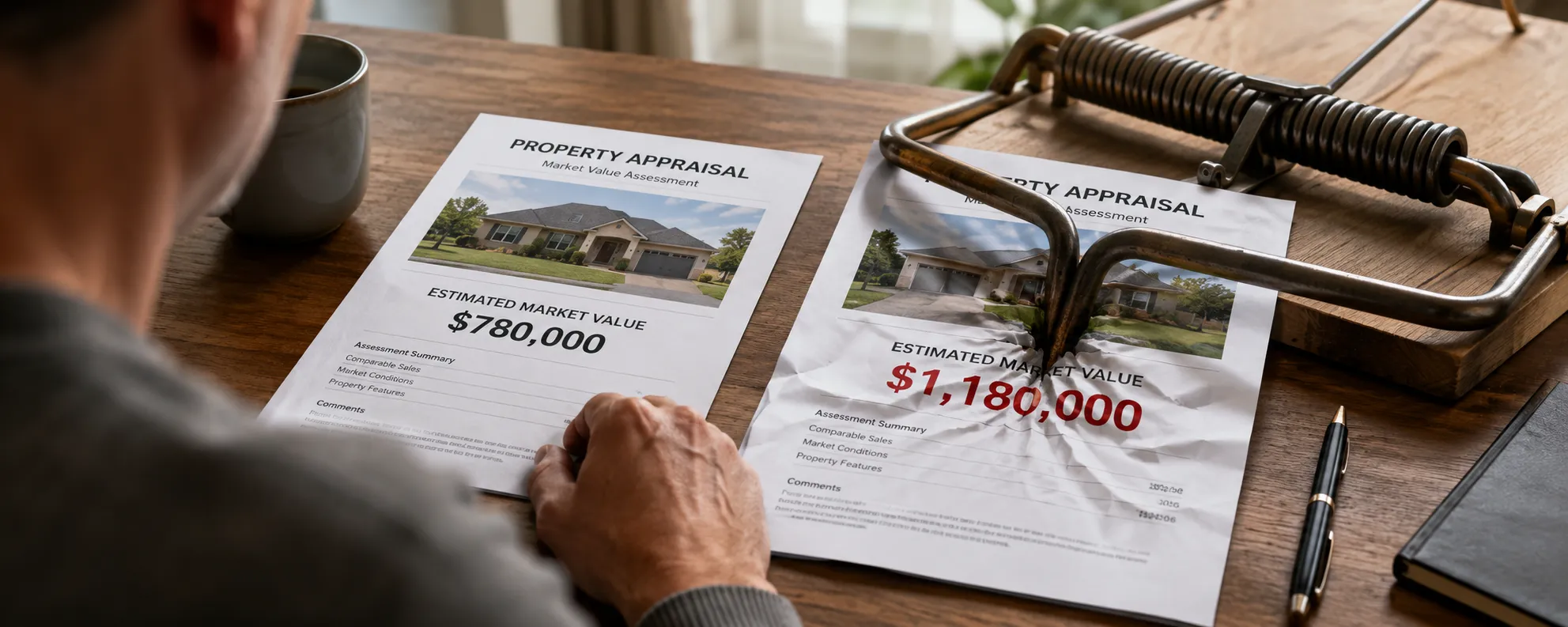
The impact of conditioning is often underestimated because it rarely appears as a single, obvious loss. Instead, it accumulates quietly throughout the campaign — through reduced competition, weakened negotiating leverage, and a campaign that has already spent its most valuable asset: time.
Example scenario:
A property is appraised at $850,000, despite recent comparable sales suggesting buyer interest is strongest closer to $800,000–$820,000. The property launches at the higher figure. During the first two weeks:
- Enquiry is limited
- High-intent buyers move on to better-positioned properties
- No competing offers emerge
After several weeks, the price is adjusted to align with where the market was all along. At this point the seller hasn't lost $30,000 on paper — but they have lost:
- Early buyer competition
- Urgency in negotiations
- The ability to push buyers upward through competing interest
In practical terms, this shows up as:
- Fewer offers
- Stronger buyer conditions
- Less flexibility to hold firm on price
"Conditioning doesn't reduce value directly. It reduces the seller's ability to defend it."
For a full picture of what selling costs — including the holding costs that accumulate during a stalled campaign — the selling costs guide covers every expense from appraisal to settlement.
The "Stale Listing" Effect
As days on market accumulate, buyer perception shifts. Rather than asking "What do I need to pay to secure this property?" attention moves to "Why hasn't it sold?" That change in framing is significant — and it happens faster than most sellers expect.
Days on market is visible to every buyer on realestate.com.au. A property that has been listed for 45 days without selling is not seen as patient. It is seen as a property the market has already assessed and passed on. And buyers respond accordingly — not by making low offers, but by not engaging at all.
"Time on market doesn't just measure exposure — it reshapes how buyers interpret value."
The assumption most sellers make about overpricing is that it still produces negotiations — just slower ones. In practice, it often produces none at all.
One of the biggest misconceptions about overpricing is that buyers will simply negotiate. In reality, most don't. They quietly remove the property from consideration and move on to the next listing that feels better aligned with the market.
The buyers who recognise a property is sitting well above where the market is likely to support it rarely argue about the price. Most simply walk away. And in the words of Darryl Kerrigan from The Castle...
"Tell 'em they're dreamin'."
The seller often never realises those buyers were even there. By week four or five, the only people still looking are the ones who know time is on their side. The negotiation doesn't get harder — it simply never starts.
— Andrew McKiggan, Principal, Gawler East Real Estate RLA 248695
Auctions as a Market Reset
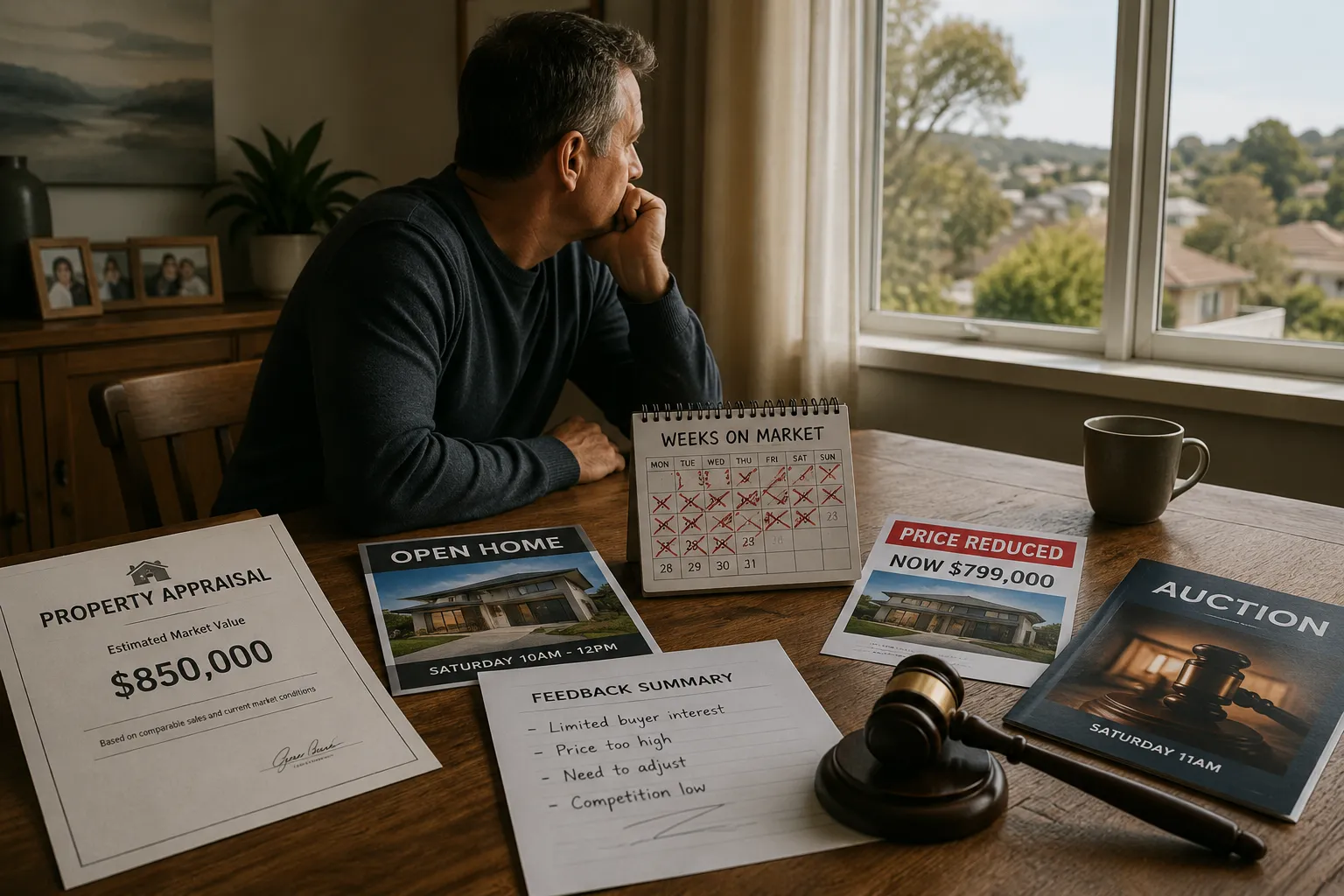
In some situations, auctions are introduced after a campaign has struggled to generate sufficient buyer competition. While auctions can be effective when used as the primary strategy from launch, they are sometimes employed mid-campaign as a way to demonstrate market resistance more clearly — and to complete the conditioning process that began at the listing stage.
On auction day, buyer behaviour provides immediate and public feedback. A property passed in at auction doesn't just confirm that the price was too high. It confirms it in front of every registered bidder, every agent watching the results, and every buyer who sees the outcome on the portals. The seller who once held out hope for the original appraisal figure now has the market's verdict in writing.
"Auctions can clarify market value quickly — but they can't restore lost momentum."
In Gawler, based on an analysis of 89 recent local sales, 72% of properties sell via private treaty — not auction. Before committing to a campaign method, our guide to auction vs private treaty in Gawler explains which method is likely to deliver the strongest result for your property type and the current market conditions.
The commission structure you agree to at the listing stage also influences how campaigns are managed and what methods are recommended. Understanding what commission actually funds — and what it should — is covered in our guide to real estate agent fees in South Australia.
Industry Scrutiny and Public Awareness
Concerns around over-quoting and expectation management are not new, and they are not limited to individual agents or isolated markets. In March 2023, an ABC Four Corners investigation examined pricing practices across the Australian real estate industry — speaking with sellers, former agents, and industry insiders about how optimistic appraisals are used to win listings and how conditioning follows.
The segment discussing over-quoting and conditioning begins at approximately 28 minutes and 20 seconds into the program.
External Reference
ABC Four Corners investigation into real estate pricing practices and listing tactics: View the ABC Story Here
Frequently Asked Questions About Property Appraisals and Listing Strategy
Why do some property appraisals seem higher than the market evidence?
In some cases, an optimistic appraisal is used as a way of securing a listing rather than reflecting likely sale outcomes. This approach is often referred to as "buying the listing" and relies on a natural tendency for sellers to favour the most positive scenario.
The risk is not the higher figure itself, but what can follow if early buyer competition does not materialise. When a property launches above where buyers are searching, The Freshness Window closes without the competition that protects the final result ever forming. Understanding this helps homeowners ask the right question at the listing appointment — not "what is the highest price?" but "what does the evidence actually support?"
What does "conditioning" mean in real estate?
Conditioning refers to the gradual adjustment of a seller's expectations after a property has been positioned above what buyers are prepared to pay. It typically occurs over time and is framed around buyer feedback, enquiry levels, and comparable sales achieving lower results.
Rather than a single conversation, conditioning is a sequence of small recalibrations that often begins after The Freshness Window has already closed — meaning the best opportunity to generate competition has already passed. Recognising the signs of conditioning early gives homeowners the best chance of responding before their negotiating position weakens further.
Why are the first 21 days of a property campaign so important?
Buyer competition tends to be strongest in the opening weeks of a campaign — particularly in the first 14 to 21 days after a property appears on the major portals. This period is what we call The Freshness Window: the point at which portal algorithms surface listings most prominently and finance-ready buyers are most likely to act.
If a property is overpriced at launch, many high-intent buyers move on without inspecting. Once that window closes, the competition that produces strong results rarely returns in the same form. For homeowners, this means the launch price isn't just a starting point — it's a decision that shapes the entire campaign.
Can an overpriced listing recover later in the campaign?
A property can still sell after a price adjustment, but the dynamics change. With fewer competing buyers, negotiations tend to become more conditional, and sellers often have less leverage than they did at the start of the campaign.
What is usually lost isn't the property's value. It's the seller's ability to defend that value through buyer competition. A correctly priced property from launch gives buyers a reason to act quickly. A price-reduced listing gives them a reason to wait and see. For homeowners, understanding this distinction changes how they evaluate an agent's pricing advice before signing anything.
What's the difference between an appraisal and a valuation in Australia?
In Australia, an appraisal is a real estate agent's opinion of likely sale price, based on current market conditions and comparable sales. A valuation is a formal assessment completed by a qualified valuer, typically required for lending, legal, or taxation purposes.
They serve different purposes and are prepared by different professionals. For a detailed explanation of what a well-constructed appraisal should contain and how it is built from evidence, see our property appraisal guide — because understanding the difference helps homeowners make more confident decisions before they choose an agent.
