
Last Updated on March 11, 2026 by Andrew Mckiggan
The Gawler property market operates as a “Dual-Speed Economy,” functioning distinctly from standard Adelaide suburbs:
- The Historic Core (Church Hill): Characterized by heritage protection and low turnover. This sector offers stability and capital preservation for long-term holders.
- The Growth Corridors (Gawler East, Evanston): Defined by modern housing stock and higher transaction volumes. These areas are currently driven by relative affordability and improved transport infrastructure. (See the latest sold prices for these growth corridors here)
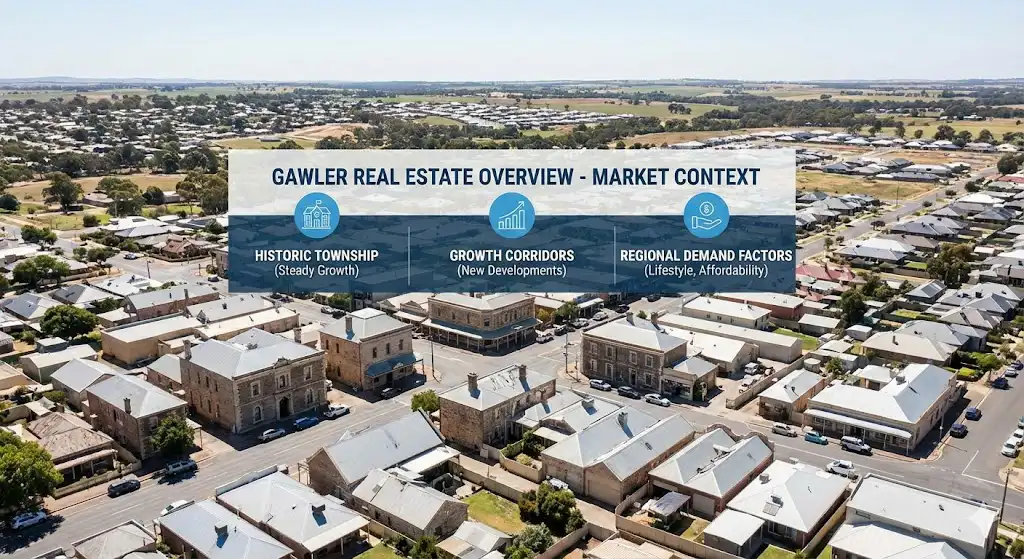
Market Structure, Growth Dynamics, and Regional Context
This page provides a high-level, factual overview of the residential property market in Gawler, South Australia.
It is intended for orientation and background understanding only and does not provide pricing advice, investment recommendations, or forecasts.
Gawler functions as the primary residential and service hub for the Lower North region. Located approximately 42 kilometres north of the Adelaide CBD, it operates as a geographic and economic transition zone between metropolitan Adelaide and the Barossa Valley.
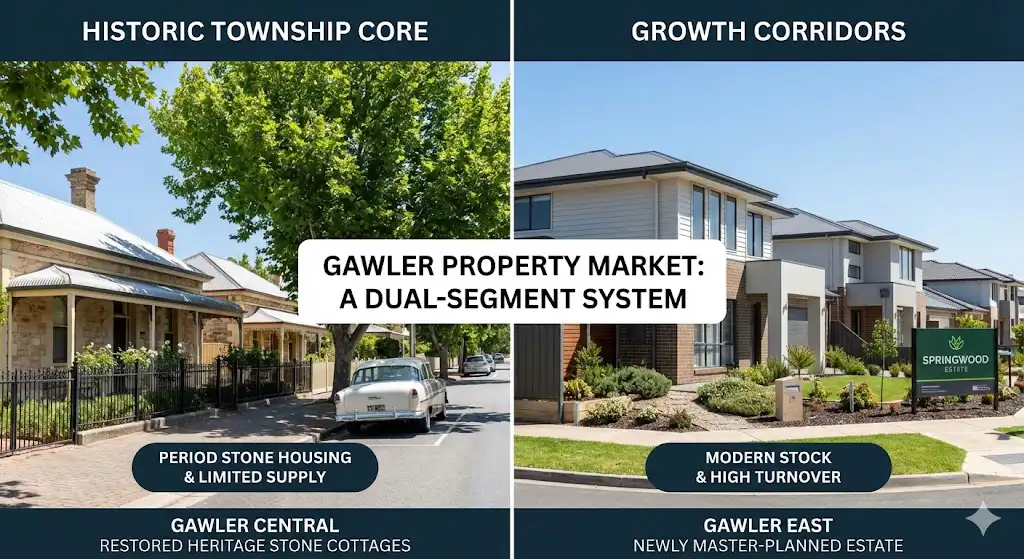
Gawler Property Market at a Glance
From a structural perspective, the Gawler housing market does not operate as a single, uniform system. Instead, as local expert Andrew McKiggan notes, it behaves as two distinct segments with unique drivers:
| Zone Type | Key Precincts | Housing Stock | Market Driver |
|---|---|---|---|
| Historic Township Core | Church Hill, Gawler Central | Stone Cottages, Villas, Heritage Homes | Scarcity & Lifestyle (Low Turnover) |
| Growth Corridors | Gawler East, Evanston Gardens | Modern Master-Planned Estates | Affordability & Connectivity (High Activity) |
1. The Historic Township Core
Central precincts such as Church Hill and Gawler Central are characterised by:
- Heritage overlays: Planning controls that preserve established streetscapes
- Period housing stock: A high proportion of stone cottages, villas, and early-era dwellings
- Low turnover: Tightly held properties with lower transaction volumes than outer areas
Price movement in this segment has historically been incremental rather than volatile, reflecting limited supply and long-term owner occupancy rather than speculative turnover.
2. The Growth Corridors
Surrounding areas — including Gawler East, Evanston Gardens, and southern extensions toward Evanston — form the market’s peri-urban growth layer. These areas typically feature:
- Master-planned estates: Predominantly modern housing stock on engineered allotments
- Higher activity levels: Greater rates of construction, resale, and rental turnover
- Affordability-driven demand: Buyer activity influenced by price ceilings relative to metropolitan Adelaide
Because these two segments respond differently to broader housing cycles, aggregate metrics such as a single “Gawler median price” can obscure meaningful local variation.
Recent Structural Shifts in the Gawler Market (Post-2020)
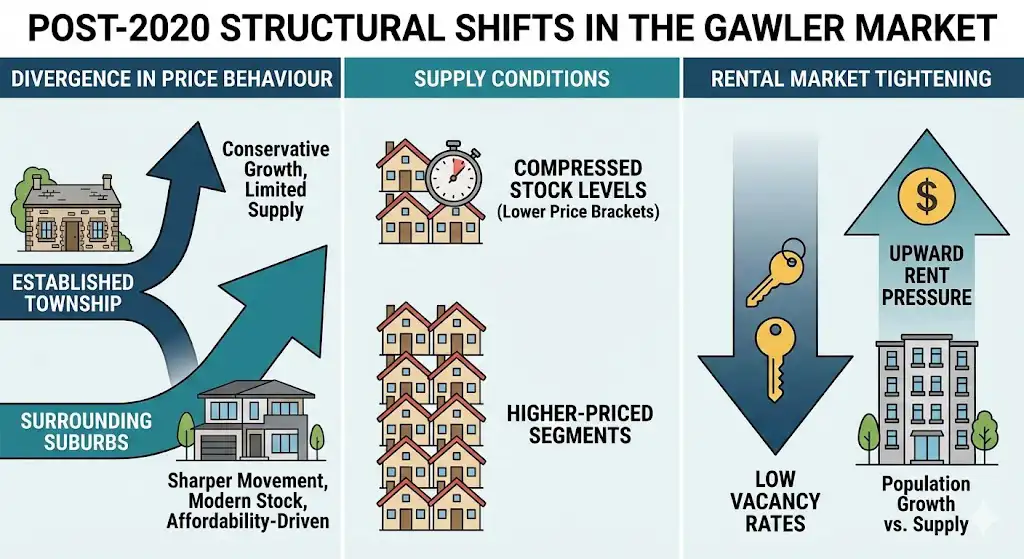
Since 2020, Gawler has increasingly shifted from a steady regional market toward a higher-demand peri-urban growth area, reflecting broader South Australian housing trends.
Divergence in Price Behaviour
Established township areas have generally shown measured, lower-volatility growth, while some surrounding suburbs have experienced periods of sharper price movement. This divergence is commonly associated with:
- The availability of newer housing stock in expanding estates
- Buyer displacement from inner-ring Adelaide due to affordability constraints
- Limited land availability closer to the historic town centre
Supply Conditions
Across several recent market cycles, Gawler has recorded compressed stock levels, particularly within lower price brackets. Properties positioned within entry-level ranges have often experienced shorter days-on-market relative to higher-priced lifestyle segments.
Is it Hard to Find a Rental in Gawler?
Rental vacancy rates across the Gawler region have remained consistently below long-term averages, contributing to upward pressure on rents. While this reflects broader statewide conditions, local real estate data indicates population growth is occurring faster than the delivery of completed rental housing in some precincts.
Residential Development and Housing Supply
Gawler’s housing pipeline includes established estates, active construction zones, and long-term growth areas at different stages of planning and delivery.
Established and Active Developments
Springwood (Gawler East)
A large master-planned community. In recent stages, development focus has included neighbourhood retail delivery and the staged remediation of the former quarry precinct to enable future hillside allotments.
Orleana Waters (Evanston Gardens)
A family-oriented estate incorporating wetlands and reserve space, positioned for access to the Northern Expressway and the Tambelin rail corridor.
Woodvale (Gawler South)
An estate emphasising larger allotments and open-space integration, marketed on proximity to both the historic township and evolving road infrastructure.
Regional Expansion: Roseworthy and the Gawler Belt
Beyond the immediate town boundary, areas such as Roseworthy and the Gawler Belt continue to mature. These locations typically offer:
- Larger allotments than metropolitan Adelaide
- Semi-rural lifestyle positioning
- Direct competition with Gawler for buyers seeking space with service access
Future Growth Horizons (2026 and Beyond)
According to Andrew McKiggan, the region’s long-term supply will be defined by two major strategic zones:
Concordia – Northern Growth Zone
Located north-east of Gawler, Concordia represents the region’s primary long-term growth area.
- Scale: Rezoned to ultimately accommodate up to 12,000 dwellings
- Current focus: Coordination of major infrastructure frameworks — including roads, utilities, and staging — prior to widespread residential delivery
Rezoning indicates long-term intent rather than immediate housing availability.
Kudla and the Northern Growth Area
To the south-west, Kudla forms part of a broader northern expansion strategy.
- Housing capacity: Planning frameworks allow for approximately 16,000 future homes over staged delivery horizons
- Open space planning: Strategic planning includes provision for a continuous green corridor between Kudla and Gawler, intended to preserve environmental amenity alongside urban growth
How Fast is the Commute from Gawler to Adelaide?
Buyer demand in Gawler is closely tied to transport and service accessibility. Current infrastructure improvements have significantly reduced travel times
- Rail Commute: Electrification of the Gawler rail line has materially improved commuter reliability
- Road Commute: The Northern Expressway and Gawler East Link Road allow for a non-stop run to Adelaide’s outer ring, reducing travel times significantly.
- Services: New retail hubs in Evanston and Gawler East have decentralised daily services, easing pressure on Murray Street
Structural Drivers of Property Demand
Several long-term factors shape housing demand in the region:
- Relative affordability compared to middle-ring Adelaide
- Gateway positioning between metropolitan Adelaide and the Barossa
- Demographic mix of young families and downsizers from regional areas
These drivers influence where demand concentrates, but not necessarily how prices behave in any given year.
Frequently Asked Questions – Gawler Property Market Context
How is the Gawler property market different from most Adelaide suburbs?
The Gawler property market functions as a regional hub rather than a single, uniform metropolitan suburb. It combines a historic township core with multiple peri-urban growth areas, each with different housing stock, buyer demand, and turnover patterns. As a result, market conditions can vary significantly between locations within the broader Gawler area.
Why do price trends differ between Gawler’s town centre and newer estates?
Price trends differ because housing supply and buyer demand are structured differently across these areas. Central Gawler locations typically have limited, tightly held housing stock, which contributes to steadier price movement. Newer estates generally have higher transaction volumes and a greater share of first-home buyers, which can result in more pronounced price changes during active market cycles.
Does additional land supply automatically lower property prices in Gawler?
No. Additional land supply does not automatically reduce property prices. While rezoning can increase future housing capacity, pricing outcomes depend on how quickly land is developed, how infrastructure is delivered, and whether population growth absorbs the new supply as it becomes available.
Who controls planning and zoning decisions affecting future housing in Gawler?
Planning and zoning decisions are primarily set at a state level through PlanSA. These frameworks determine where residential development is permitted, while actual housing delivery depends on infrastructure funding, civil works, and staged land releases over time.
Why can median house prices be misleading when assessing Gawler?
Median house prices combine all dwelling types and locations into a single figure. In a market like Gawler — where heritage homes, modern estates, townhouses, and semi-rural properties coexist — median data can mask significant variation between suburbs and housing types. Medians are best interpreted alongside volume and stock composition rather than viewed in isolation.
What types of buyers are most active in the Gawler property market?
Buyer activity in Gawler commonly includes first-home buyers, family upgraders, investors, and downsizers. Participation levels within each group vary depending on lending conditions, relative affordability compared to Adelaide, and the availability of suitable housing stock in different parts of the region.
How does transport infrastructure influence housing demand in Gawler?
Transport infrastructure influences housing demand by improving access to employment and services. Upgrades such as rail electrification and major road connections reduce travel times, which can expand the pool of buyers willing to live in the Gawler area.
Are future growth areas like Concordia and Kudla already fully developed?
No. While areas such as Concordia and Kudla have been rezoned for future residential use, development is staged over many years. Rezoning indicates long-term intent but does not mean housing is immediately available or under construction across the entire area.
Is this page intended to provide buying, selling, or investment advice?
No. This page is provided for general market context and educational purposes only. It explains how the Gawler property market is structured and how planning and infrastructure factors interact with housing supply. It does not provide financial, legal, or investment advice.
Further Reading and Official Sources
This page is intended as a contextual reference only. For authoritative data and statutory information, consult:
- PlanSA — zoning maps and code amendments
- Town of Gawler Council — development applications and infrastructure updates
- Major real estate portals for verified sales and rental statistics
📍 Researching the area?
For suburb boundaries, amenities, and general location context, see our Gawler SA location overview.
🏡 Ready to buy or sell?
For professional appraisals and sales representation, visit our dedicated Gawler Real Estate Services page.
Need specific advice on your Gawler property?
Market conditions in Gawler change rapidly between the historic center and the outer estates. For a personalized appraisal based on 2026 data, contact Andrew McKiggan directly at Gawler East Real Estate.

