
Last Updated on April 21, 2026 by Andrew Mckiggan

If you’ve ever wondered why two agents can value the same home very differently, you’re not alone. Many sellers assume there should be a single, correct price for a property, so conflicting appraisals can feel confusing or even unsettling.
In reality, a home’s value is not a fixed number. It is a range of probability, shaped by market evidence, buyer behaviour, timing, and risk. Two agents can inspect the same property, review similar sales, and still arrive at different price opinions because they are pricing different assumptions about how the market will respond.
⚠️ Key context: Understanding these differences early can help sellers avoid pricing decisions that quietly reduce momentum, negotiating leverage, and final sale outcomes.
Appraisal vs Valuation: An Important Distinction for Sellers
In Australia, it’s important to distinguish between two terms that are often used interchangeably, but serve very different purposes in practice.
- Property appraisal (or price opinion):
Provided by a real estate agent to guide selling strategy, buyer targeting, and market positioning. - Formal valuation:
Conducted by a licensed valuer, typically for lending, legal, or taxation purposes, using a more rigid and retrospective methodology.
An appraisal is not a certification of value or a guarantee of outcome. It reflects how a property is expected to perform in the open market at a given point in time, taking into account current competition, buyer behaviour, and selling conditions. This is one reason two agents can reasonably arrive at different figures for the same home.
For sellers who want a deeper explanation of how appraisals differ from formal valuations in Australia, including why each is used and when one may be more appropriate than the other, this distinction is explored in more detail here:
👉 https://gawlereastrealestate.au/property-appraisal-vs-valuation-in-australia-9-key-differences-that-matter/
🔎 Why this matters: Appraisals are forward-looking and strategic; valuations are retrospective and procedural.
Data vs Real-Time Market Behaviour
Most appraisals begin with a Comparative Market Analysis (CMA), which reviews recent comparable sales. However, this data is inherently retrospective — it reflects what buyers paid weeks or months ago.
Where price opinions often diverge is in how agents interpret current market behaviour, such as:
- Active listings competing for the same buyer pool
- Days on market trends
- Quality of enquiry, not just volume
- Recent shifts in buyer sentiment or finance conditions
An agent actively negotiating with buyers may adjust expectations faster than one relying primarily on settled sales data. That difference in perspective can materially affect pricing guidance, particularly in changing markets.
🔎 Watch for: Appraisals that rely heavily on older sales without addressing current competition or buyer behaviour.
Strategy Bias: When Pricing Is Influenced at the Listing Stage
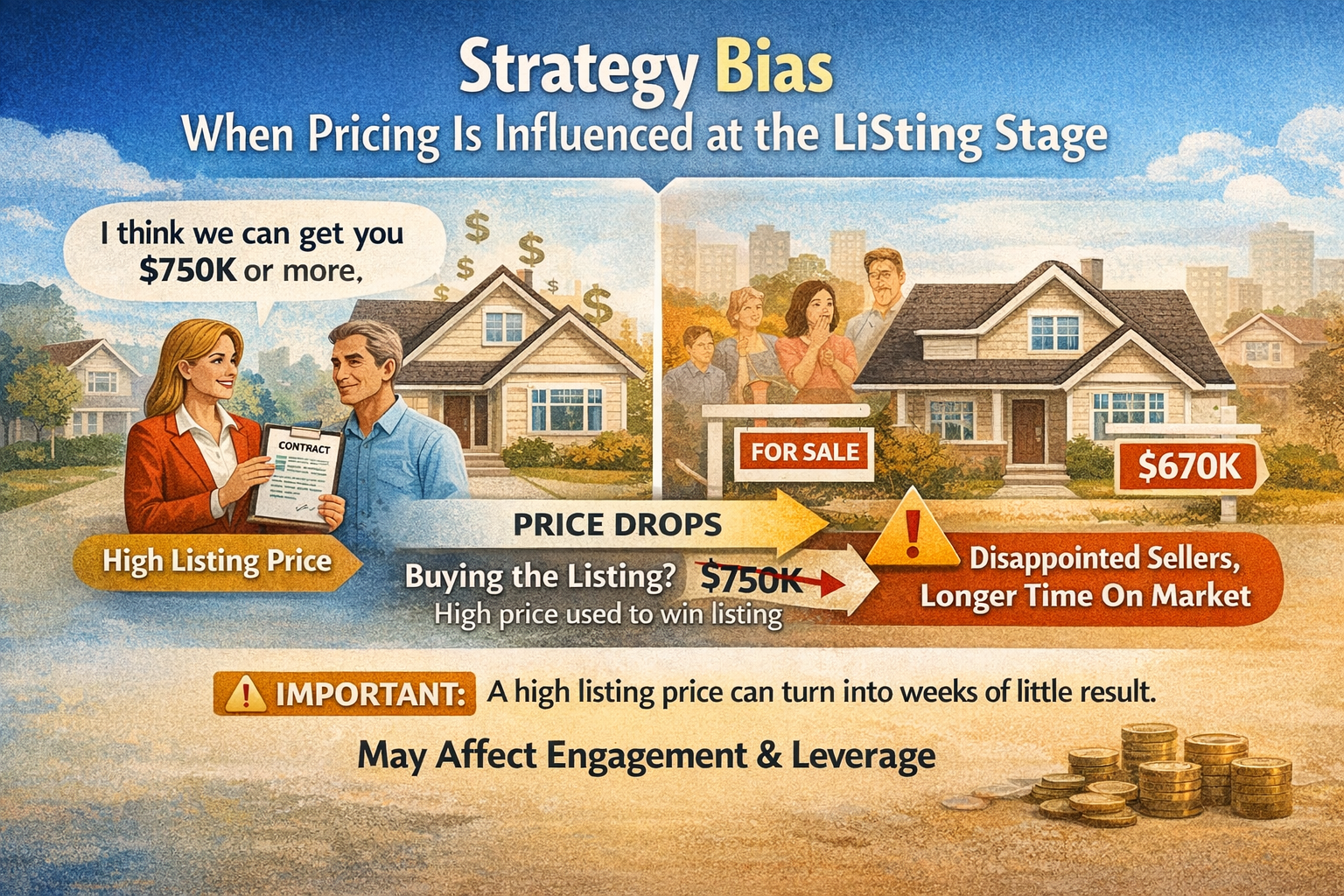
In some situations, pricing opinions are influenced not only by market evidence, but also by listing strategy. Within the industry, this is sometimes referred to as
the practice sometimes referred to as “buying the listing”.
🔎 Related reading: 👉 the practice sometimes referred to as “buying the listing”
This occurs when a higher initial figure is used to secure the appointment, followed by gradual price adjustments once the campaign is underway. While not universal, this approach can affect early buyer engagement, perceived value, and negotiating leverage.
⚠️ Important: When sellers are unaware of how this process works, later price changes can feel unexpected — even though the outcome was largely shaped before the property reached the market.
Understanding “Recovery Skill” in Pricing Decisions
A major reason agents arrive at different price opinions is how they assess and plan for risk. More experienced agents don’t just provide a number — they consider what happens if the market doesn’t respond as expected.
A higher valuation is only as strong as the strategy behind it. If a price is set at the upper end of expectations, the agent should be able to explain how buyer resistance will be handled, how feedback will be interpreted, and what steps will be taken if early interest is weaker than anticipated.
Without this context, a valuation is simply an opinion rather than a defensible plan.
🔎 Related reading:
👉 what experienced agents focus on if a property doesn’t sell early
Some experienced agents will discuss a low, likely, and high range to acknowledge market uncertainty. When an appraisal focuses only on the best-case outcome, it may understate the market’s natural volatility.
How Experience Changes the Way Risk Is Priced
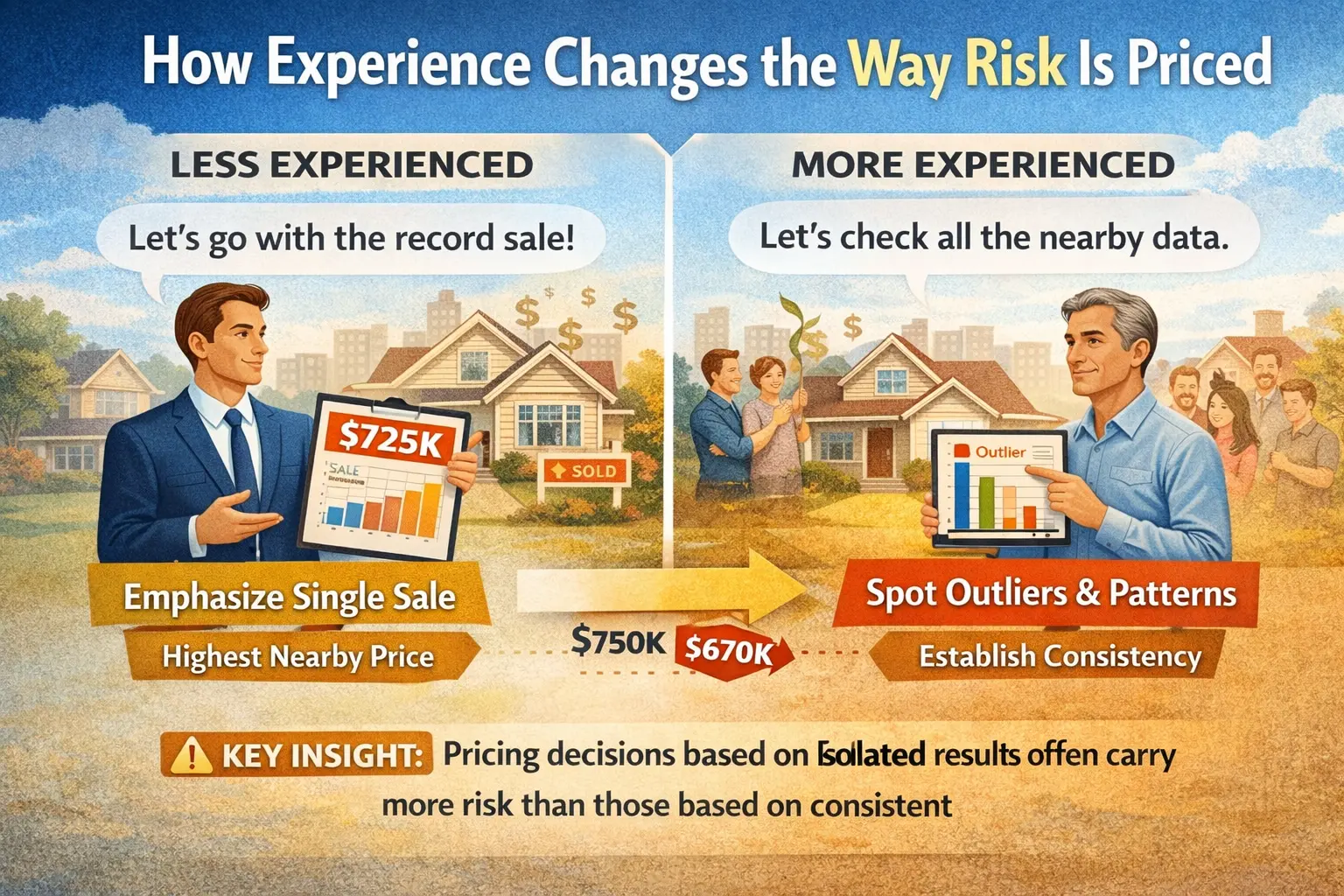
Agents who have worked through different market cycles — including slower or correcting periods — tend to interpret sales evidence differently from those whose experience is limited to strong or rising markets.
Less experienced approaches may place greater emphasis on the highest nearby sale, even when that result was influenced by unique buyer circumstances. More experienced approaches tend to look for patterns rather than peaks, recognising that a single record-breaking sale doesn’t always establish a new price floor for surrounding properties.
⚠️ Key insight: Pricing decisions based on isolated results often carry more risk than those based on consistent buyer behaviour.
What Sellers Should Listen for in an Appraisal Conversation
When reviewing different price opinions, many sellers find it more useful to focus on the quality of the explanation, rather than the highest number quoted.
Clear, experience-based appraisals often address questions such as:
- Which specific active listings are we competing against right now — not just what has already sold?
- If we don’t see meaningful buyer engagement within the first two weeks, what does that usually indicate about price alignment?
- How would pricing be adjusted if buyer feedback suggests resistance, and when would that occur?
🔎 Related context:
👉 when appraisal assumptions don’t align with buyer behaviour
The ability to answer these questions calmly and clearly often indicates that pricing is part of a broader process, not just a headline figure.
The Bottom Line
Two agents can value the same home very differently because they are not just assessing the property itself. They are pricing:
- Buyer behaviour
- Timing
- Competition
- Risk
- Strategy
An appraisal is not a promise of outcome — it is a hypothesis about how the market may respond. For many sellers, the most reliable guidance comes from agents who explain uncertainty, outline contingencies, and clearly describe what happens if conditions change.
✅ Final takeaway: Clarity and risk awareness often protect both sale price and peace of mind better than optimism alone.
Pricing & Appraisal Questions Sellers Often Ask
Why do different agents give different price opinions for the same property?
Different price opinions usually reflect differences in risk assessment, buyer expectations, and selling strategy, not just the property itself. Some agents price based on optimistic scenarios or standout past sales, while others focus on current competition, buyer behaviour, and how pricing will affect early enquiry. The consequence for sellers is that choosing an appraisal without understanding the underlying assumptions can lead to weaker momentum or reduced negotiating leverage once the property is live. In practice, the explanation behind the number matters more than the number itself.
Why is pricing strategy difficult to correct after a property goes live?
Pricing decisions made before launch shape how buyers perceive value, how much competition is created, and how strong a seller’s negotiating position is in the early stages. When a property enters the market above buyer expectations, enquiry often slows quickly, which reduces urgency and makes later price adjustments less effective. Even if the price is corrected, buyers may already view the property as “stale,” leading to longer time on market and weaker offers. For most sellers, the initial pricing strategy has a greater impact on the final result than any changes made later.
Is a higher appraisal always better for the seller?
A higher appraisal can feel reassuring, but it only benefits the seller if it is supported by buyer demand and a clear strategy to defend it. Without sufficient early interest, higher pricing can reduce competition and weaken negotiating leverage, often resulting in price reductions or extended time on market. In contrast, a price aligned with buyer expectations can create urgency and competitive pressure, which may lead to stronger final outcomes. The key trade-off is between optimism and probability — and understanding which one an appraisal is based on.
How does agent experience affect pricing decisions and risk?
Agents who have worked through different market conditions tend to interpret sales evidence more cautiously, recognising when standout results are outliers rather than reliable benchmarks. Less experienced approaches may place greater weight on the highest nearby sale without accounting for unique buyer circumstances or changing demand. The consequence for sellers is that pricing based on isolated results often carries higher risk, while pricing based on consistent buyer behaviour is more resilient if conditions shift. Experience influences not just the price suggested, but how well that price can be defended during negotiations.
What should sellers focus on when comparing appraisals from different agents?
Rather than focusing solely on the highest figure, sellers are often better served by comparing how each agent explains buyer behaviour, competition, and contingency planning. Strong appraisals clearly outline what happens if early enquiry is weak, how feedback will be interpreted, and when adjustments would occur if needed. Appraisals that avoid downside discussion may feel confident but can expose sellers to greater risk later in the campaign. The quality of the explanation usually predicts the quality of the outcome more accurately than the headline price.
A final note for sellers
If you’re comparing appraisals or trying to understand why pricing opinions differ, having a clear, evidence-based conversation early can remove a lot of uncertainty.
If you’d like a second perspective on how pricing, buyer behaviour, and risk interact in your situation, you’re welcome to get in touch to discuss it in plain terms.
📞 0493 539 067
✉️ enquires@gawlereastrealestate.au