
Last Updated on April 23, 2026 by Andrew Mckiggan

📌 What this page covers
This guide explains whether home improvements actually add value to a house before selling — and how sellers can assess which upgrades are likely to deliver a return versus those that mainly improve liveability.
For homeowners preparing to sell, renovation decisions often involve significant financial risk. This article helps sellers understand return on investment (ROI), over-capitalisation risk, buyer psychology, and current cost realities, rather than relying on outdated renovation rules.
Home improvements are only one part of preparing a property for sale. For a broader overview of local trades, services, and maintenance options, visit our Gawler Home Services hub.
Key point: This is a factual, experience-based reference for 2026 — not a recommendation to renovate at any cost.
Why this question matters in the current market
Many sellers assume that every dollar spent improving a home increases its sale price by the same amount.
In practice, this is rarely the case.
In South Australia — including Gawler and surrounding suburbs — price growth has stabilised and affordability ceilings are more defined. As a result, the gap between improvement cost and added value has widened, making over-capitalisation one of the biggest financial risks for sellers.
⚠️ Important: Renovating without a clear return strategy can reduce net sale proceeds rather than increase them.
The short answer
No — not all home improvements add value before selling.
Some upgrades increase buyer demand and perceived value. Others improve comfort for the current owner but do not materially change what buyers are willing to pay.
The difference usually comes down to:
- Visibility during inspections
- Buyer expectations for the price bracket
- Market conditions at the time of sale
- Whether the improvement removes a buyer objection
How buyers actually assess “value”
Buyers rarely price homes by adding up renovation invoices.
Instead, they compare:
- Condition relative to similar listings
- How much immediate work is required
- Whether the home feels move-in ready
- Emotional comfort and perceived risk
💡 Buyer reality: An improvement adds value only if it reduces friction in the buyer’s decision-making process.
The law of diminishing returns in home improvements
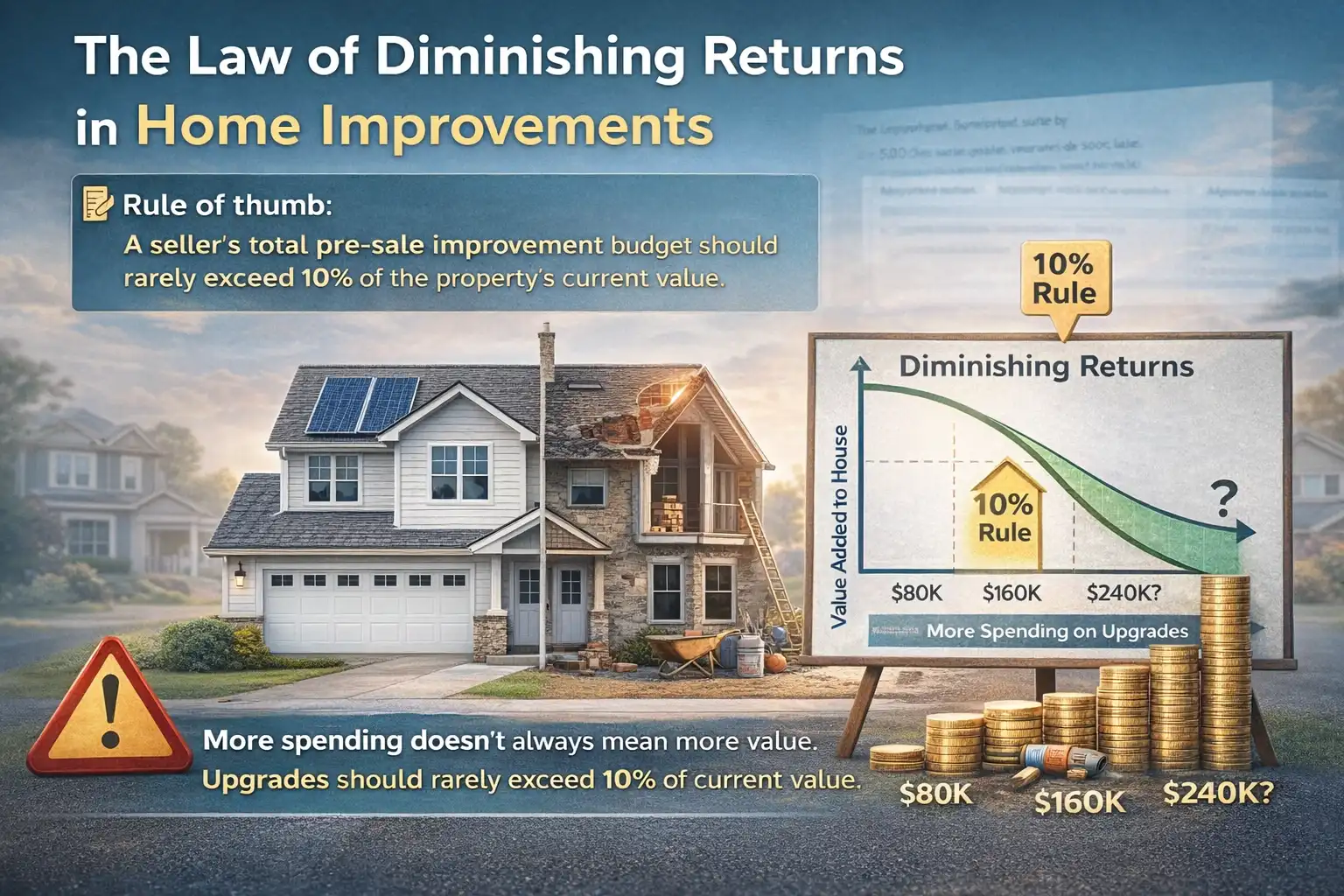
In property, more spending does not automatically mean more value.
Once a home reaches the standard expected for its price bracket and location, additional upgrades often deliver diminishing returns — particularly where surrounding homes or buyer demographics do not support a higher price.
📂 Real-Life Case Study: The $25,000 Mistake
The 10% rule (practical safeguard)
📏 Rule of thumb: A seller’s total pre-sale improvement budget should rarely exceed 10% of the property’s current value.
For example, if a house is worth $800,000, spending $150,000 on upgrades is a high-risk strategy unless the market clearly supports a higher bracket.
You generally cannot “renovate” a home into a higher demographic if the location does not support it.
The ROI matrix: pre-sale improvement decision guide
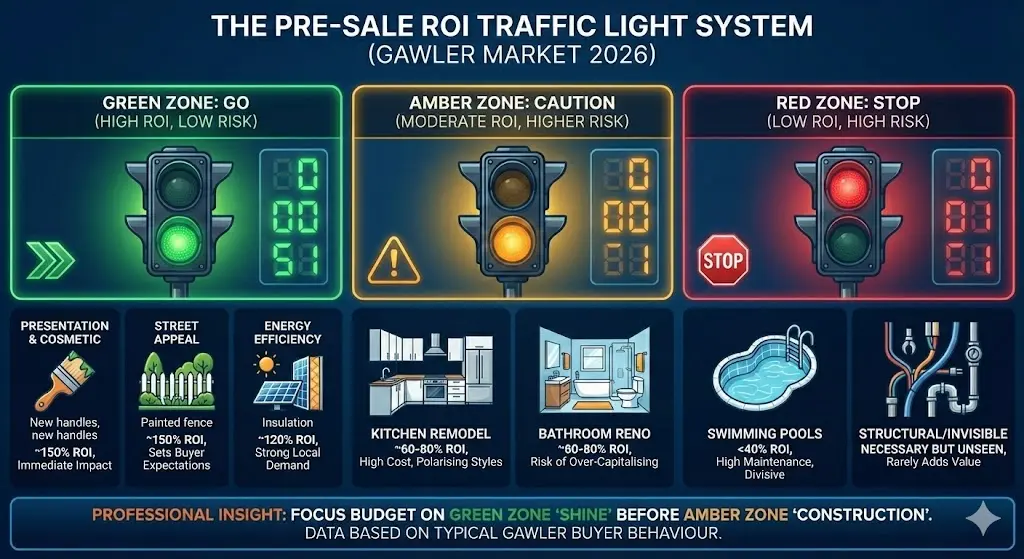
Before starting any work, it helps to classify improvements by likely return.
| Improvement Type | Typical ROI Range | Strategic View |
|---|---|---|
| Street appeal & landscaping | 150% – 200% | GO – sets buyer expectations early |
| Cosmetic refresh (paint, lighting) | 100% – 150% | GO – low cost, high impact |
| Energy efficiency (solar, insulation) | 80% – 120% | GO – strong demand in SA |
| Major kitchen or bathroom remodel | 50% – 80% | CAUTION – high cost, higher risk |
| Swimming pools | < 40% | STOP – polarising for buyers |
⚖️ Reminder: ROI figures are indicative only. Actual outcomes depend on price point, location, and timing.
Home improvements that often add value before selling
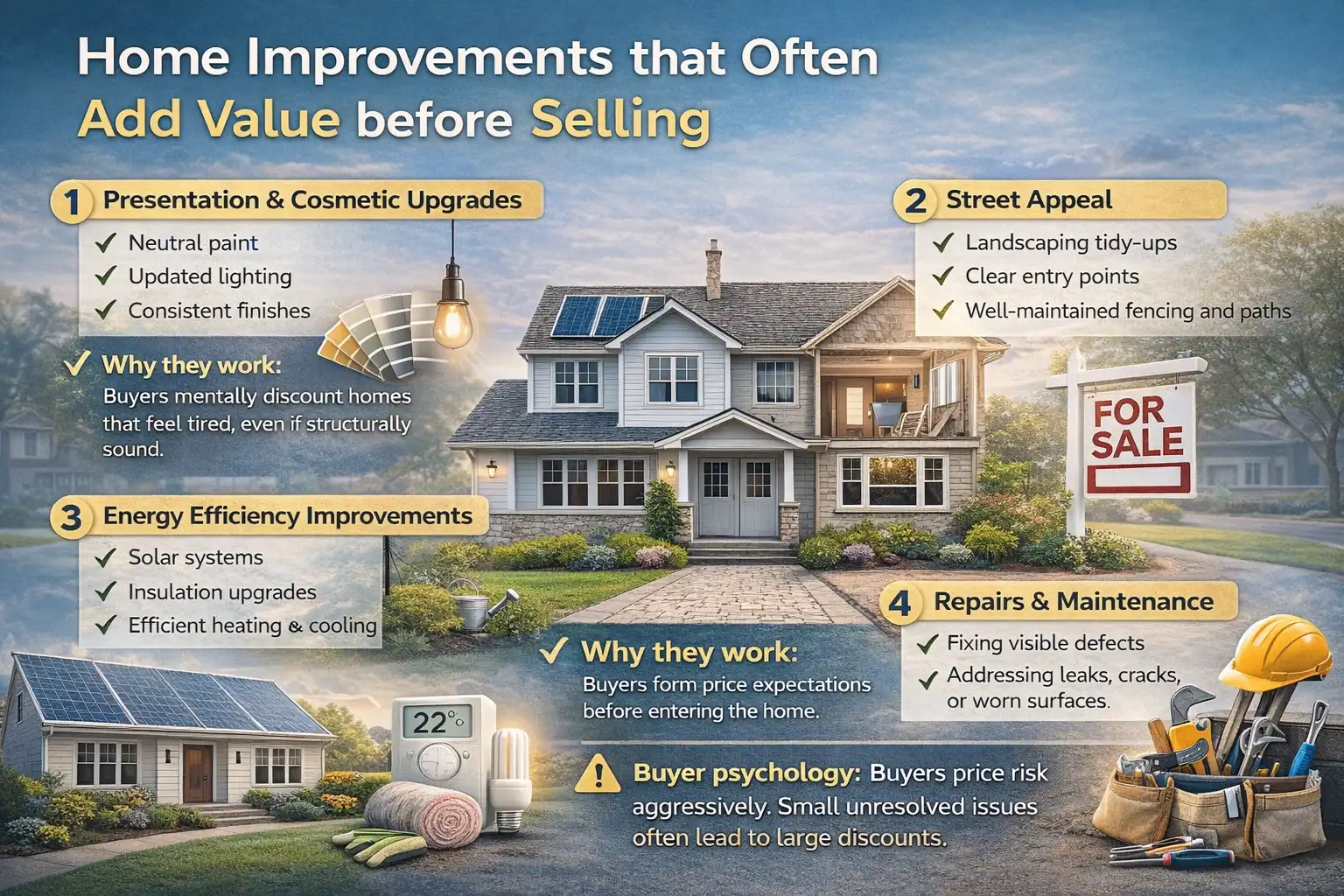
1. Presentation and cosmetic upgrades
- Neutral paint
- Updated lighting
- Consistent finishes
✅ Why they work: Buyers mentally discount homes that feel tired, even if structurally sound.
2. Street appeal
- Landscaping tidy-ups
- Clear entry points
- Well-maintained fencing and paths
✅ Why they work: Buyers form price expectations before entering the home.
3. Energy efficiency improvements
- Solar systems
- Insulation upgrades
- Efficient heating and cooling
✅ Why they work: Ongoing energy costs are front-of-mind for South Australian buyers.
4. Repairs and maintenance
- Fixing visible defects
- Addressing leaks, cracks, or worn surfaces
⚠️ Buyer psychology: Buyers price risk aggressively. Small unresolved issues often lead to large discounts.
Home improvements that often do not add value
- Highly personalised renovations
- Over-capitalised luxury finishes
- Invisible upgrades (plumbing, wiring, structural)
- Poor-quality DIY or non-compliant work
🚫 Key risk: Buyers compare homes, not invoices — and they discount uncertainty heavily.
The impact of trade shortages and rising build costs
In recent years, much of South Australia has experienced a sustained shortage of qualified trades, alongside rising material, compliance, insurance, and labour costs.
This has significantly changed the economics of pre-sale renovations.
Historically, homeowners often assumed labour costs would broadly match material costs. In today’s market, this rule no longer applies. Labour can now exceed material costs by a substantial margin — particularly for small, one-off residential jobs.
⚠️ Reality check: Many sellers are now surprised by renovation quotes that are far higher than expected, even for relatively straightforward work.
This has increased the financial risk of undertaking last-minute renovations before selling, especially where timelines are tight or multiple trades are required.
Why “shine” now outperforms construction
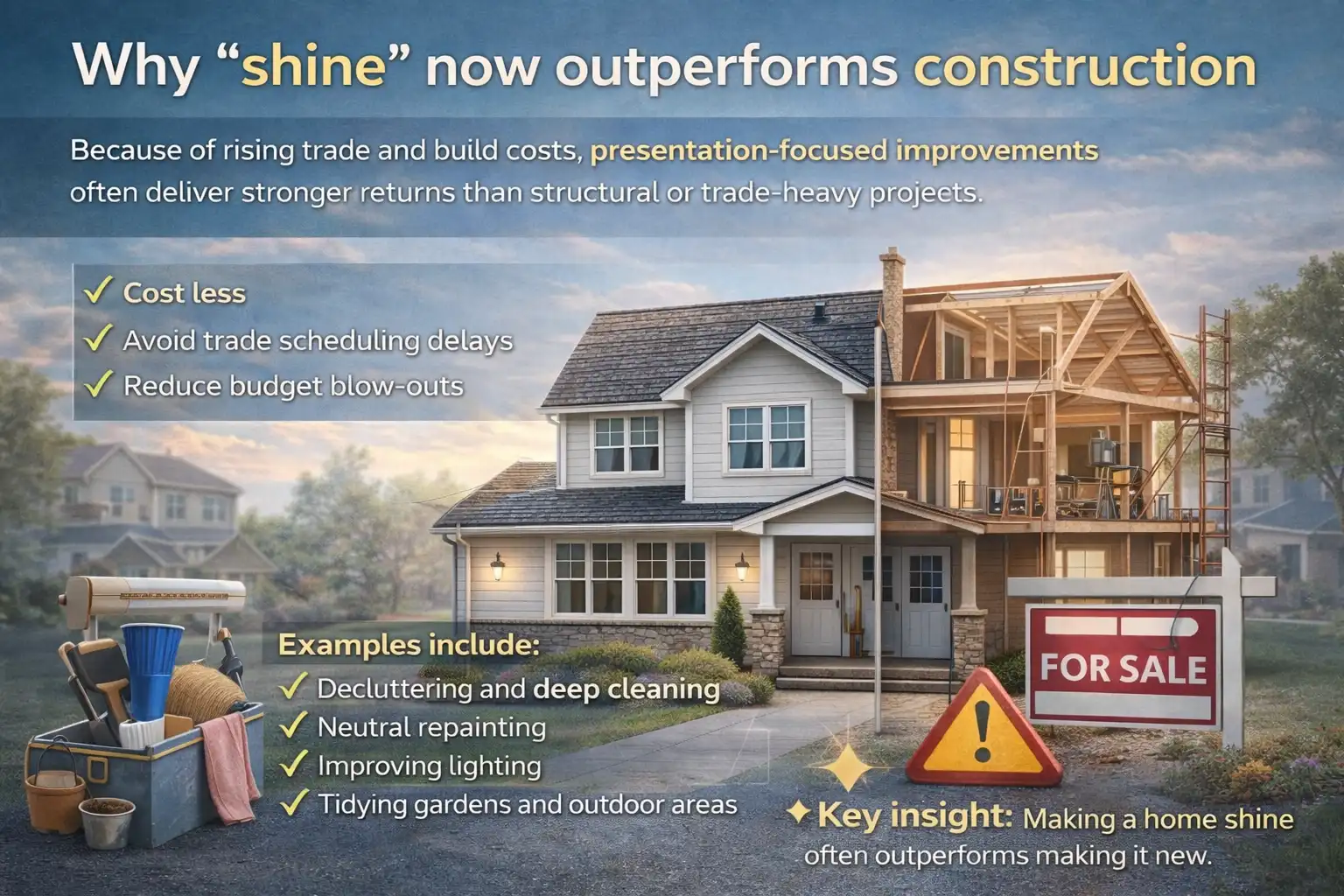
Because of rising trade and build costs, presentation-focused improvements often deliver stronger returns than structural or trade-heavy projects.
These improvements:
- Cost less
- Avoid trade scheduling delays
- Reduce budget blow-outs
- Deliver immediate visual impact at inspections
Examples include:
- Decluttering and deep cleaning
- Neutral repainting
- Improving lighting
- Tidying gardens and outdoor areas
✨ Key insight: Making a home shine often outperforms making it new.
Important clarification on DIY work
Owner-led improvements can add value when focused on presentation only.
However:
- Structural
- Electrical
- Plumbing
- Compliance-related work
…should always be carried out by licensed professionals.
🚨 Warning: Non-compliant or poor-quality work can reduce buyer confidence and create legal or negotiation risks.
The best outcomes usually come from professional compliance where required, combined with careful owner-led presentation work elsewhere.
A simple checklist before renovating
Before committing to an improvement, ask:
- Does this solve a clear buyer objection?
- Is the finish consistent with the rest of the home?
- Is the likely return at least 1:1?
- Is this what buyers want right now in this area?
✔️ If the answer is “no” to more than one, the improvement is unlikely to add value before selling.
How this fits into broader selling decisions
Home improvements are just one factor alongside:
- Pricing strategy
- Marketing approach
- Timing
- Location and buyer demographics
In many cases, polishing what already exists produces better outcomes than major transformation.
🤔 Stuck on a “Fix it” or “Leave it” decision?
Don’t guess and waste money. Snap a photo of the room you’re worried about and send it to me. I’ll give you a quick, honest “Yes/No” verdict on whether it’s worth renovating for sale.
(No sales pitch, just straight advice).
📲 WhatsApp Andrew Your PhotoHome Improvements and Property Value: Common Questions Before Selling
Do all home improvements add value to a house before selling?
No, not all home improvements add value before selling. Some upgrades improve liveability for the current owner but do not translate into higher sale prices. In many cases, buyers expect certain features as standard and are unwilling to pay extra for them. Improvements that exceed what buyers expect for the home’s price range or location often deliver diminishing returns, meaning the cost of the work is higher than the value added at sale.
What types of home improvements are most likely to increase a home’s value?
Home improvements that focus on presentation, functionality, and buyer confidence are most likely to increase value. These include cosmetic upgrades such as neutral repainting, improved lighting, tidy landscaping, and fixing visible defects. These changes reduce buyer objections, improve first impressions, and make a home feel “move-in ready,” which often results in stronger buyer competition rather than just a higher asking price.
Why can expensive renovations reduce profit instead of increasing it?
Expensive renovations can reduce profit when they push the property beyond the price expectations of the local market. Buyers compare homes within a price bracket, not based on how much the seller spent. If nearby homes do not support a higher value, the renovation cost cannot be recovered. This is known as over-capitalisation and is most common with major kitchen rebuilds, luxury bathrooms, and extensions in areas where buyer budgets are capped.
What is the 10% rule for pre-sale home improvements?
The 10% rule is a practical safeguard used to avoid over-capitalisation. It suggests that a seller’s total pre-sale improvement budget should generally not exceed 10% of the property’s current market value. For example, on an $800,000 home, spending more than $80,000 on improvements significantly increases financial risk unless the market clearly supports a higher price bracket.
Do DIY home improvements add value compared to hiring trades?
DIY improvements can add value when they focus on presentation and are completed to a good standard. Tasks such as painting, decluttering, basic landscaping, and minor cosmetic fixes often deliver strong returns because they cost less and have immediate visual impact. However, structural, electrical, or plumbing work should always be handled by licensed trades, as poor workmanship can reduce buyer confidence and lead to price discounts.
Why does presentation often matter more than structural upgrades when selling?
Presentation matters because buyers respond emotionally before they assess technical details. Clean, bright, and well-presented homes feel easier to live in and require less mental effort from buyers. Structural upgrades that are not visible are often assumed to be standard and do not trigger higher offers. Buyers are more likely to compete on a home that feels finished than one that feels like a project.
How do rising trade costs affect renovation decisions before selling?
Rising trade costs mean that labour now often exceeds material costs, which changes the return on investment for many projects. In South Australia, trade shortages and increased pricing have made major renovations riskier for sellers. As a result, lower-cost improvements that avoid trade delays—such as cleaning, painting, and garden tidy-ups—often outperform construction-heavy projects in terms of value added.
Should sellers fix all maintenance issues before listing their home?
Visible maintenance issues should generally be addressed before selling, as buyers price risk aggressively. Even small problems such as leaks, cracks, or damaged finishes can lead buyers to assume larger hidden issues. While not every upgrade adds value, unresolved defects often reduce offers by far more than the actual cost of repair.
How do home improvements influence buyer behaviour rather than just price?
Home improvements influence buyer behaviour by reducing hesitation and increasing competition. A well-presented home attracts more buyers, keeps them engaged longer during inspections, and encourages stronger emotional attachment. This often leads to better sale conditions, faster selling times, and competitive offers, even if the improvements do not directly increase the advertised price.
Final note
Home improvements should be treated as financial decisions, not emotional ones.
No upgrade guarantees a higher sale price. Strategic, well-timed improvements that reduce buyer friction usually outperform expensive renovations aimed at chasing a higher bracket.
🧠 Bottom line: The goal is to remove reasons for a buyer to hesitate — while keeping your equity in your own pocket.
