
Last Updated on April 21, 2026 by Andrew Mckiggan
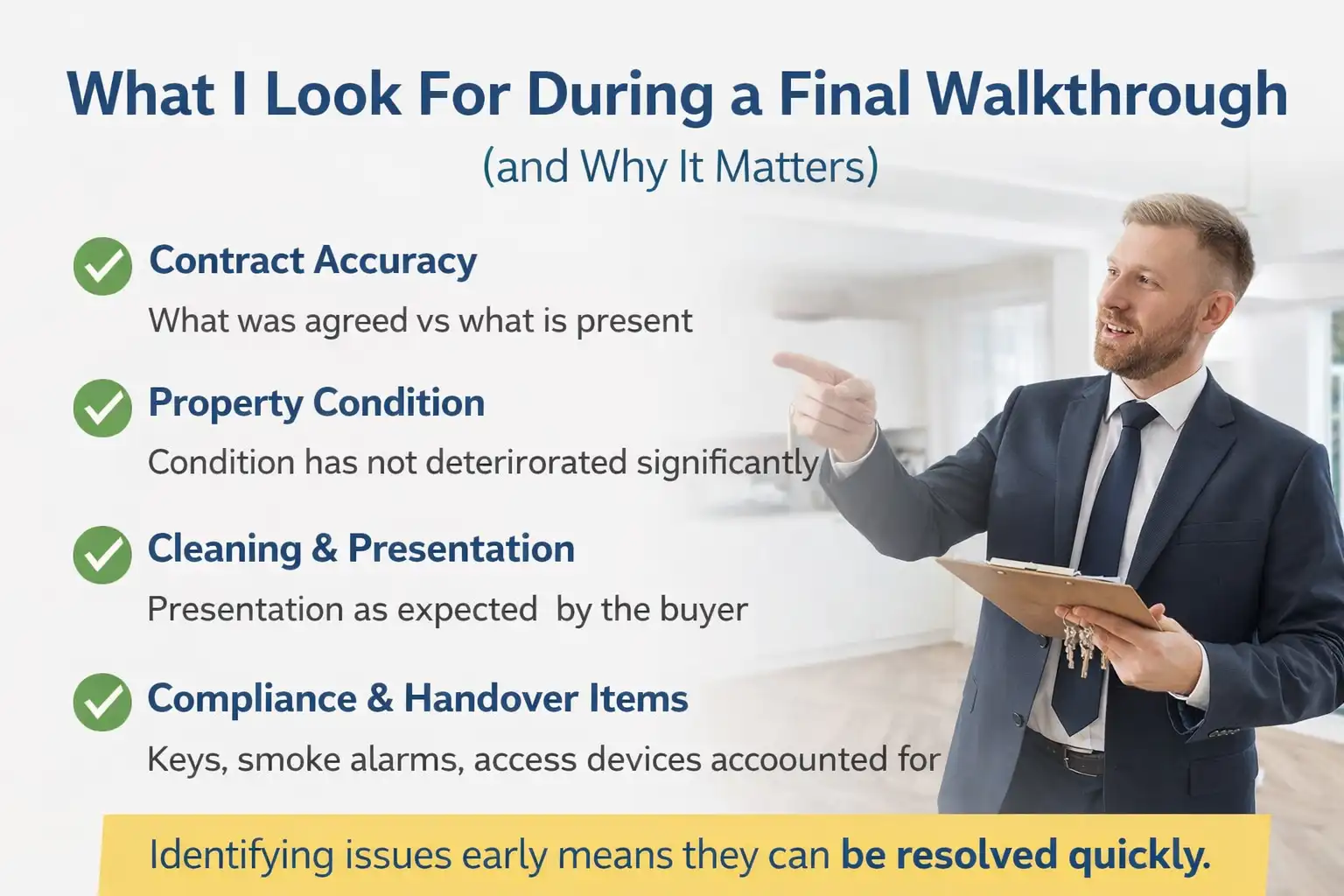
In Australia, the final walkthrough — often referred to as a pre-settlement inspection — is one of the most misunderstood stages of a residential property transaction.
By the time it occurs, the contract is unconditional and settlement is approaching. Many sellers assume this means everything is effectively locked in. In reality, the final walkthrough sits at a critical point where contractual obligations, property condition, and handover details are confirmed before ownership legally transfers.
From my experience as a real estate agent operating within Australian conveyancing frameworks, final walkthroughs rarely uncover dramatic surprises. What they do uncover are smaller inconsistencies that, if left unaddressed, can introduce unnecessary friction late in the process — when flexibility is limited.
Where the Final Walkthrough Sits in the Australian Transaction Flow
In a typical Australian residential transaction, the sequence generally follows:
- Offer accepted
- Contract of sale executed
- Cooling-off period (where applicable)
- Contract conditions satisfied (finance, inspections, etc.)
- Contract becomes unconditional
- Final walkthrough / pre-settlement inspection
- Settlement
- Legal transfer of ownership
Timing Matters
The walkthrough occurs after the buyer is legally committed, but before settlement makes the transaction irreversible.
That timing exists for a reason: it allows discrepancies to be identified and resolved while practical options still exist.
The Legal Definition in Australia: What a Final Walkthrough Is — and Is Not
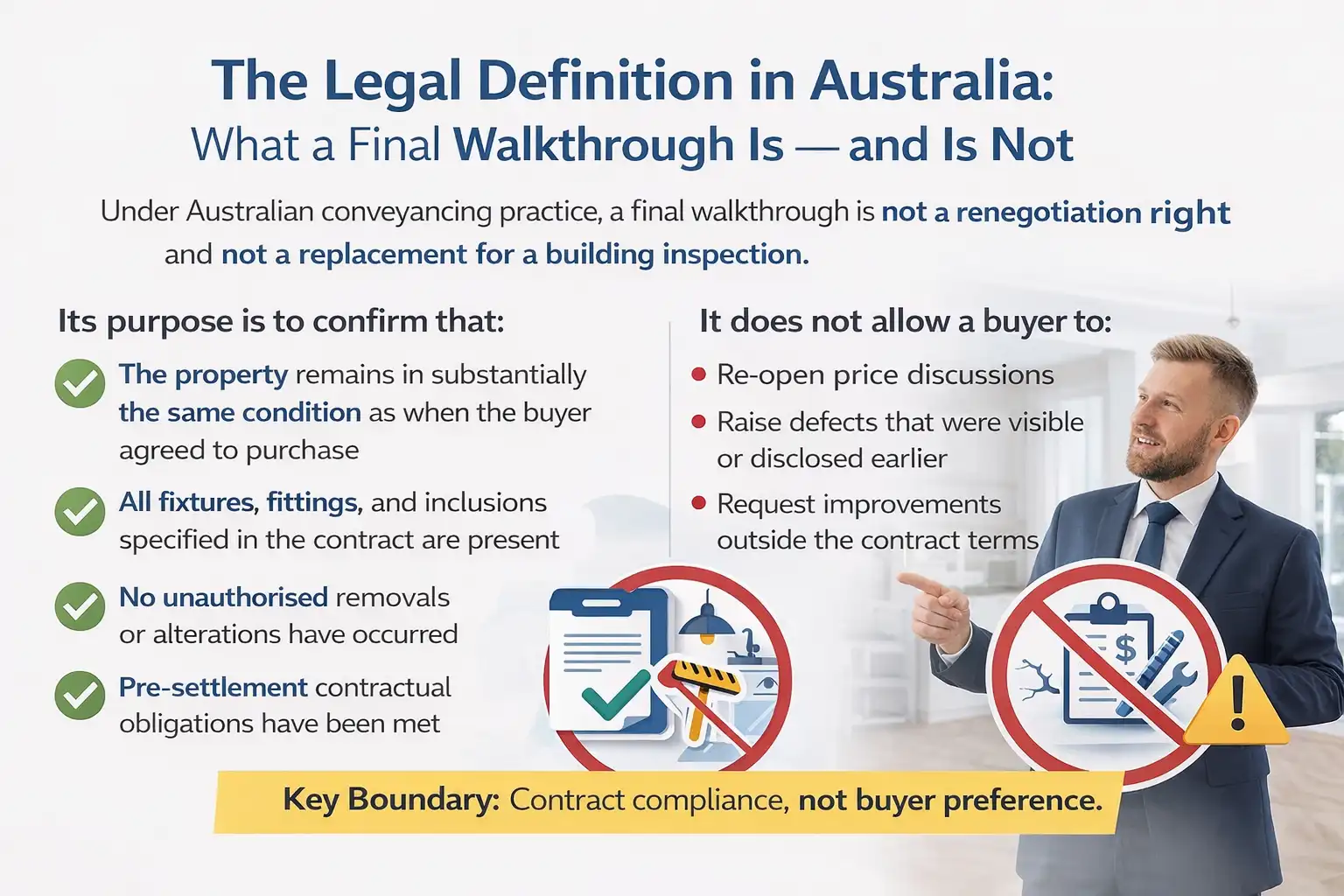
Under Australian conveyancing practice, a final walkthrough is not a renegotiation right and not a replacement for a building inspection.
Its purpose is to confirm that:
- The property remains in substantially the same condition as when the buyer agreed to purchase
- All fixtures, fittings, and inclusions specified in the contract are present
- No unauthorised removals or alterations have occurred
- Pre-settlement contractual obligations have been met
It does not allow a buyer to:
- Re-open price discussions
- Raise defects that were visible or disclosed earlier
- Request improvements outside the contract terms
In Australia, walkthrough-related disputes are assessed against the contract of sale, not personal expectations. In South Australia, for example, this approach is reflected in guidance issued by Consumer and Business Services, which treats walkthrough issues as matters of contract compliance, not buyer preference.
Key Boundary
A final walkthrough confirms delivery of what was agreed, not whether a buyer wishes something had been different.
What I Assess During a Final Walkthrough (and Why Each Item Matters)
This is the part of the process most sellers don’t see — but it’s where risk is either managed or allowed to carry forward.
Contract Accuracy: What Was Agreed vs What Is Present
The walkthrough always begins with a direct comparison between the contract and the property as it stands.
I review:
- Fixtures and fittings
- Appliances listed as inclusions
- Items explicitly excluded
- Any written variations agreed to after contract execution
In Australian transactions, most late-stage disputes don’t arise from intent — they arise from assumptions.
Common Assumption Trap
If something is visible during inspections, buyers often assume it’s included unless clearly excluded.
The walkthrough is the last clean point to correct that assumption.
Property Condition Since the Buyer’s Last Inspection
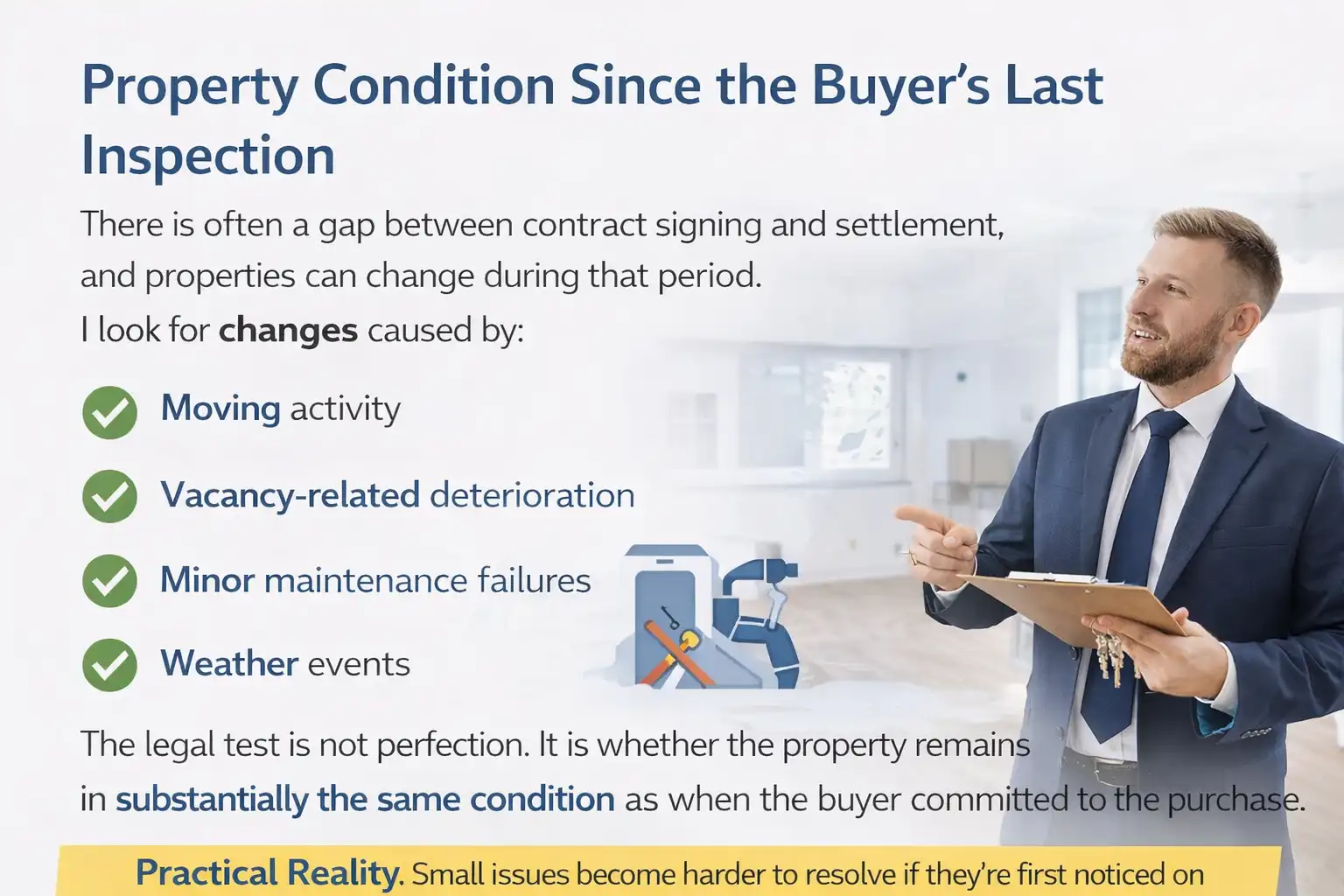
There is often a gap between contract signing and settlement, and properties can change during that period.
I look for changes caused by:
- Moving activity
- Vacancy-related deterioration
- Minor maintenance failures
- Weather events
The legal test is not perfection.
It is whether the property remains in substantially the same condition as when the buyer committed to the purchase.
Practical Reality
Small issues become harder to resolve if they’re first noticed on settlement day.
Cleaning and Presentation Expectations
While Australian contracts rarely define cleaning standards line-by-line, presentation still plays a role in buyer expectations.
Buyers assess cleanliness relative to:
- How the property was presented during inspections
- The condition at offer stage
- What was implied during the campaign
Late-stage dissatisfaction here is usually an expectation mismatch rather than a contractual breach.
Compliance and Handover Items
This is where avoidable settlement delays most often appear.
I confirm that:
- Smoke alarms are installed and operational (as required under relevant state legislation)
- All keys, remotes, and access devices are accounted for
- Manuals, warranties, and access codes are available where applicable
- Any safety or compliance items referenced in the contract are in place
Individually these items seem minor.
Collectively, they often determine whether settlement proceeds smoothly.
Many Delays Are Administrative
Settlement issues are frequently caused by unresolved handover details rather than legal disputes.
Optional reference checklist
As part of my own pre-settlement process, I use a structured walkthrough checklist to ensure nothing important is overlooked before handover.
I’ve made a general version of this checklist available below. While it reflects how I approach final walkthroughs professionally, it can be used by any seller or buyer as a reference to help ensure a property is left in appropriate handover condition prior to settlement.
Download the Final Walkthrough Reference Checklist (Australia)
Unapproved Structures and Improvements: A Common Australian Grey Area
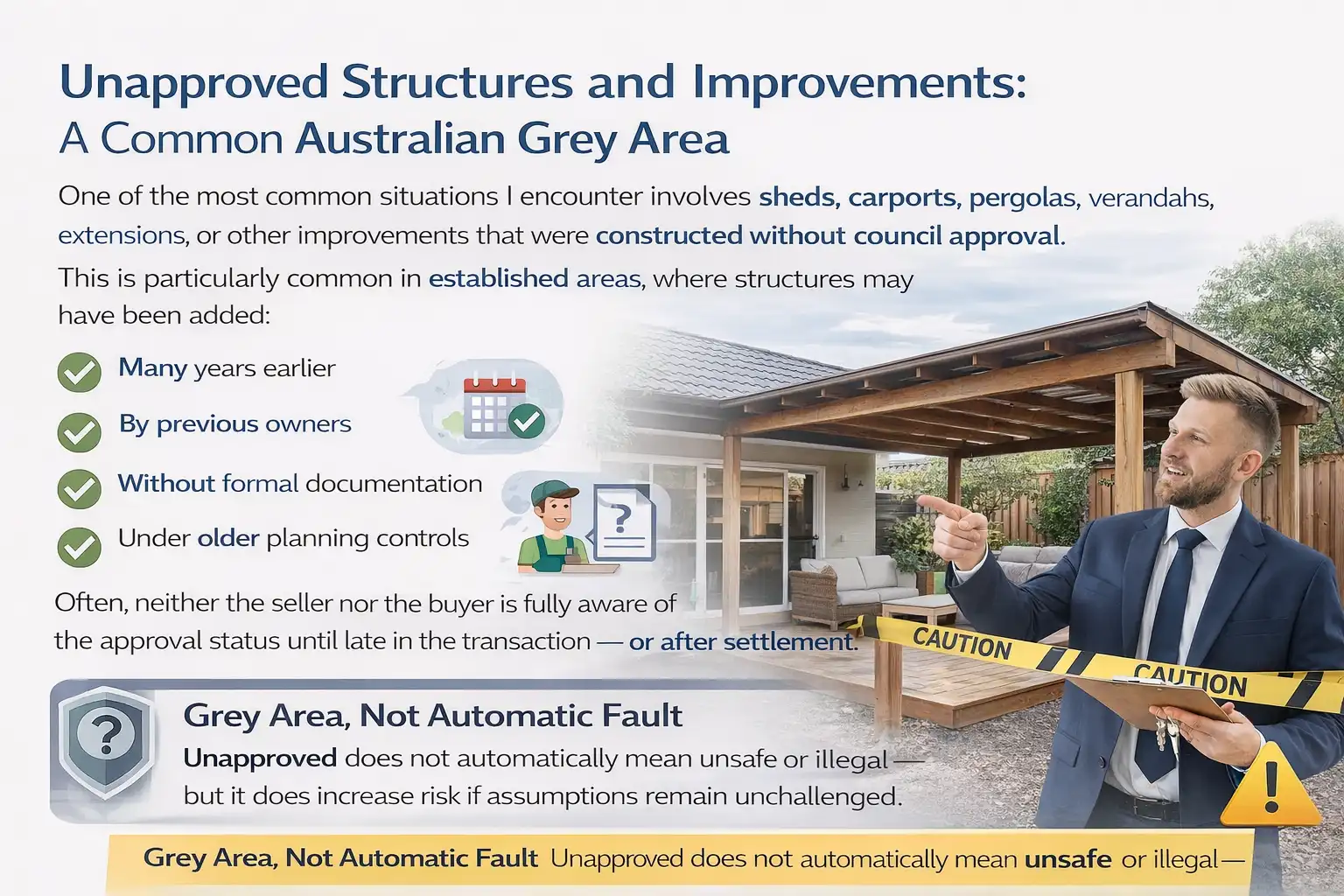
One of the most common situations I encounter involves sheds, carports, pergolas, verandahs, extensions, or other improvements that were constructed without council approval.
This is particularly common in established areas, where structures may have been added:
- Many years earlier
- By previous owners
- Without formal documentation
- Under older planning controls
Often, neither the seller nor the buyer is fully aware of the approval status until late in the transaction — or after settlement.
Grey Area, Not Automatic Fault
Unapproved does not automatically mean unsafe or illegal, but it does introduce risk if assumptions remain unchallenged.
How Approval Issues Are Treated in Australia
A final walkthrough is not a planning compliance audit.
Real estate agents are not council certifiers or building surveyors.
However, approval issues surface because:
- Buyers visually assume compliance
- Conveyancers, lenders, or insurers raise questions close to settlement
- There is a mismatch between what exists and what has been disclosed
At that point, the issue becomes one of disclosure and expectation, not construction quality.
What Happens If This Isn’t Raised Before Settlement
If settlement proceeds and an unapproved structure is later identified:
- A buyer may argue reliance on campaign representations
- A seller may state the structure pre-dated their ownership or was not known to be unapproved
- An agent’s duty of care may be questioned
Australian law does not require agents to certify approvals, but it does require that agents not misrepresent or knowingly allow misleading impressions to persist.
Where Problems Usually Start
Disputes most often arise from silence and assumption — not from issues that were clearly disclosed.
A Practical Example of Why Timing Matters
In one Australian transaction, an item visible during inspections had been removed prior to settlement. It wasn’t clearly excluded in the contract, and both parties held different assumptions.
Because the issue was identified during the pre-settlement walkthrough, it was resolved immediately — without delaying settlement or escalating into a dispute.
Had the same issue emerged after settlement, resolution would have been slower, more rigid, and more costly.
Why This Step Often Protects Sellers Most
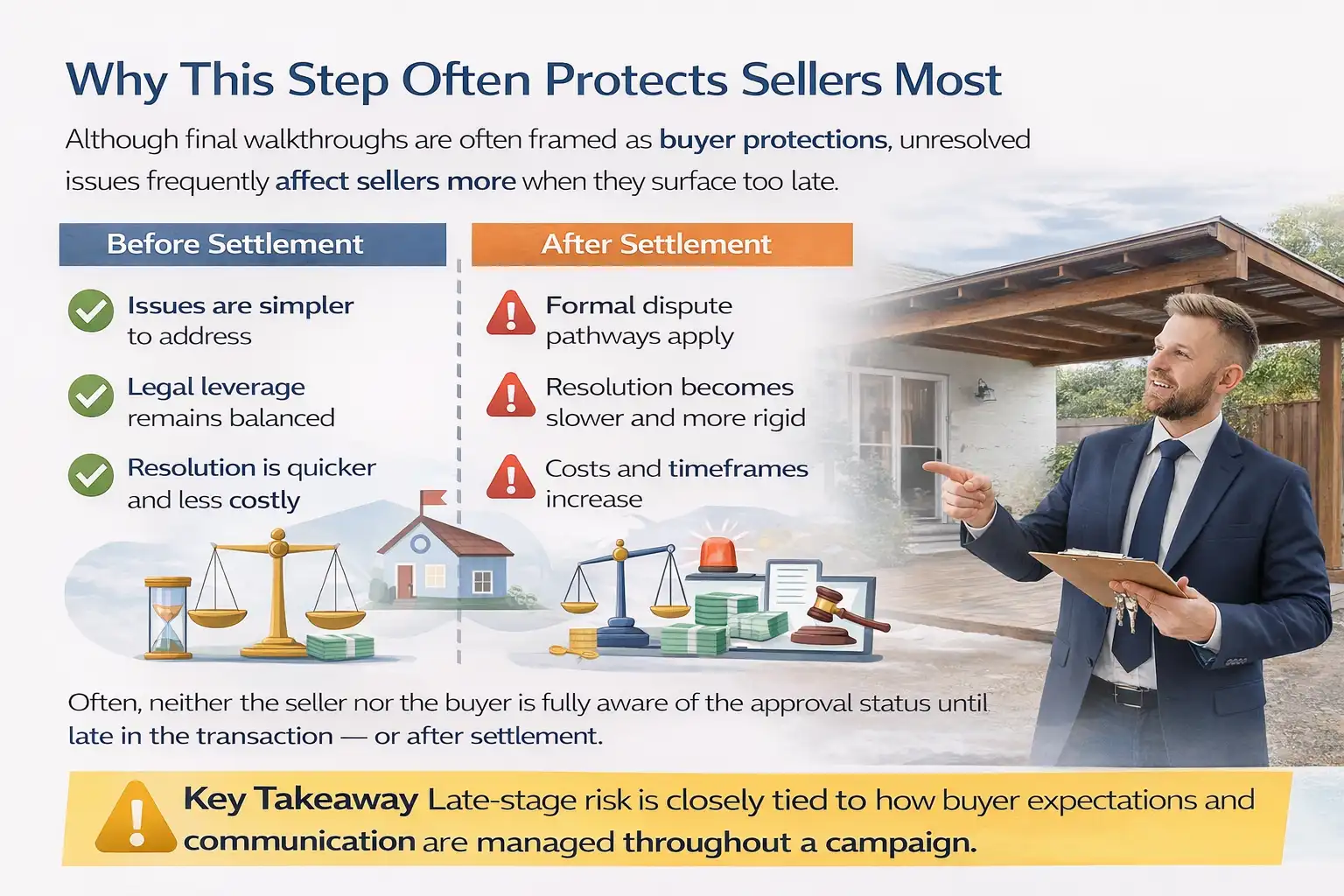
Although final walkthroughs are often framed as buyer protections, unresolved issues frequently affect sellers more when they surface too late.
Before settlement
- Issues are simpler to address
- Legal leverage remains balanced
- Resolution is quicker and less costly
After settlement
- Formal dispute pathways apply
- Resolution becomes slower and more rigid
- Costs and timeframes increase
This type of late-stage risk is closely tied to how buyer expectations and communication are managed throughout a campaign — something I’ve explored separately when looking at the way buyer handling influences competition and negotiation outcomes.
How This Fits Within an Agent’s Broader Role
Managing a pre-settlement walkthrough is only one part of the broader transaction-management role an agent plays. It sits alongside contract oversight, buyer communication, and settlement coordination — all of which influence how smoothly a sale progresses once it moves beyond the marketing phase.
Issues identified at walkthrough stage rarely exist in isolation. They tend to interact with how buyer expectations have been set and managed throughout the campaign, particularly when multiple parties are involved or timing becomes sensitive. I’ve covered this dynamic in more detail when looking at the way buyer expectations are managed during a campaign and how that affects negotiation dynamics, as it often determines whether late-stage issues are resolved calmly or escalate unnecessarily.
At the same time, walkthrough outcomes are often shaped by earlier strategic decisions. Pricing approach, disclosure clarity, and how risks are framed from the outset all influence how resilient a transaction is when pressure points arise. For sellers wanting a clearer picture of how these responsibilities connect in practice — beyond inspections and advertising — this overview explains what a real estate agent actually does across compliance, negotiation, and transaction control throughout the sale process.
Final Walkthrough FAQs (Australia)
Why does a final walkthrough matter if the contract is already unconditional?
Even though a contract is unconditional, settlement has not yet occurred, which means ownership has not legally transferred. The final walkthrough exists to confirm that the property will be delivered in accordance with the contract before that transfer becomes irreversible. Issues identified at this stage can usually be resolved informally and efficiently. If the same issues are discovered after settlement, resolution often becomes slower, more rigid, and more costly, particularly for sellers. This is why the walkthrough functions as a risk-management step rather than a formality.
What can and can’t be raised during a final walkthrough in Australia?
A final walkthrough is not a renegotiation opportunity and does not replace earlier inspections. It can be used to confirm that the property remains in substantially the same condition, that agreed fixtures and inclusions are present, and that no unauthorised removals or alterations have occurred. It cannot be used to reopen price discussions, raise defects that were visible or disclosed earlier, or request improvements outside the contract terms. Walkthrough disputes are assessed against the contract, not buyer expectations.
Why do unresolved walkthrough issues often create more risk for sellers than buyers?
Before settlement, most issues can be resolved cooperatively while legal leverage remains balanced. After settlement, the same issue is more likely to fall into formal dispute pathways governed by contract interpretation rather than practical resolution. This shift often increases timeframes, costs, and stress for sellers. In practice, addressing issues before settlement frequently protects sellers from post-sale complications rather than disadvantaging buyers.
How do unapproved structures become a problem if they aren’t raised before settlement?
Unapproved structures such as sheds, pergolas, or extensions are common, particularly in established areas, and are not automatically unsafe or illegal. Problems arise when assumptions about approval status go unchallenged. If approval questions surface after settlement, responsibility can become contested between buyer, seller, and agent. Raised before settlement, these issues can usually be clarified through disclosure or due diligence. Raised after settlement, resolution is often slower and more complex, which is why timing matters.
How do earlier decisions and communication affect walkthrough outcomes?
Walkthrough issues rarely exist in isolation. How significant they feel, and how easily they are resolved, is often influenced by earlier decisions around pricing, disclosure, and buyer communication. When expectations have been managed realistically throughout a campaign, late-stage issues are more likely to be handled calmly. Where assumptions have been allowed to form without clarification, the same issue can escalate unnecessarily. This is why walkthrough outcomes are often shaped long before the inspection itself occurs.
Final Thought
In Australia, a final walkthrough isn’t about reopening negotiations or finding faults.
It exists to confirm that the property will be delivered in accordance with the contract before settlement makes the transaction irreversible.
Handled properly, it’s one of the quiet safeguards that prevents issues most sellers never want to manage after the fact.
Clarifying Note
This article provides general information about final walkthroughs in Australian residential property transactions. It does not constitute legal, planning, or building compliance advice. Buyers and sellers should rely on their own conveyancer, solicitor, and relevant authorities for advice specific to their circumstances.