
Last Updated on January 22, 2026 by Andrew Mckiggan

🔹 Quick Answer (Australia)
In Australia, real estate agents cannot disclose the details of one buyer’s offer to another buyer unless the buyer who made the offer has given explicit consent.
Agents may confirm that multiple offers exist, but prices, terms, conditions, and buyer identities must remain confidential. While the core principles are consistent nationwide, real estate law is regulated at the state and territory level, and enforcement is handled by different government authorities across Australia.
Why This Question Arises So Often
In competitive property markets, buyers often want to know how their offer compares to others, while sellers want confidence that offers are being handled properly and in accordance with the law.
This creates a natural point of tension in negotiations and leads to a common question:
what information is a real estate agent actually permitted to share about other offers?
Understanding the professional standards behind offer handling helps explain why agents are restricted in what they can disclose.
Core Principle: Confidentiality of Offers

Across Australia, the handling of offers is governed by a shared professional requirement: confidentiality.
An offer contains sensitive financial and contractual information belonging to the person who made it. Real estate agents are required to protect that information and must not disclose it to third parties without permission — even where disclosure might encourage stronger competition.
This principle applies regardless of:
- Market conditions
- The number of competing buyers
- Whether the property is sold by private treaty or auction
🔹 What Agents Can and Cannot Say About Other Offers
Agents can:
- Confirm that other offers have been received
- Advise that the seller is considering multiple buyers
Agents cannot disclose without consent:
- The price or price range of another offer
- Contract terms or conditions
- Settlement periods
- The identity of another buyer
These boundaries exist to preserve fairness, accuracy, and trust in the sales process.
🔹 Why Buyers Often Feel Pressure in Multiple-Offer Situations
In Australian property transactions, real estate agents are engaged by the seller and are responsible for presenting offers in the seller’s interests. At the same time, agents are required to handle buyer information confidentially and avoid misleading or deceptive conduct.
This creates a practical tension in multiple-offer situations:
agents may indicate that competition exists, but they must not disclose specific offer details without consent.
Understanding this balance helps explain why agents often communicate in general terms rather than providing exact figures or conditions.
Legislative and Regulatory Framework (High-Level)
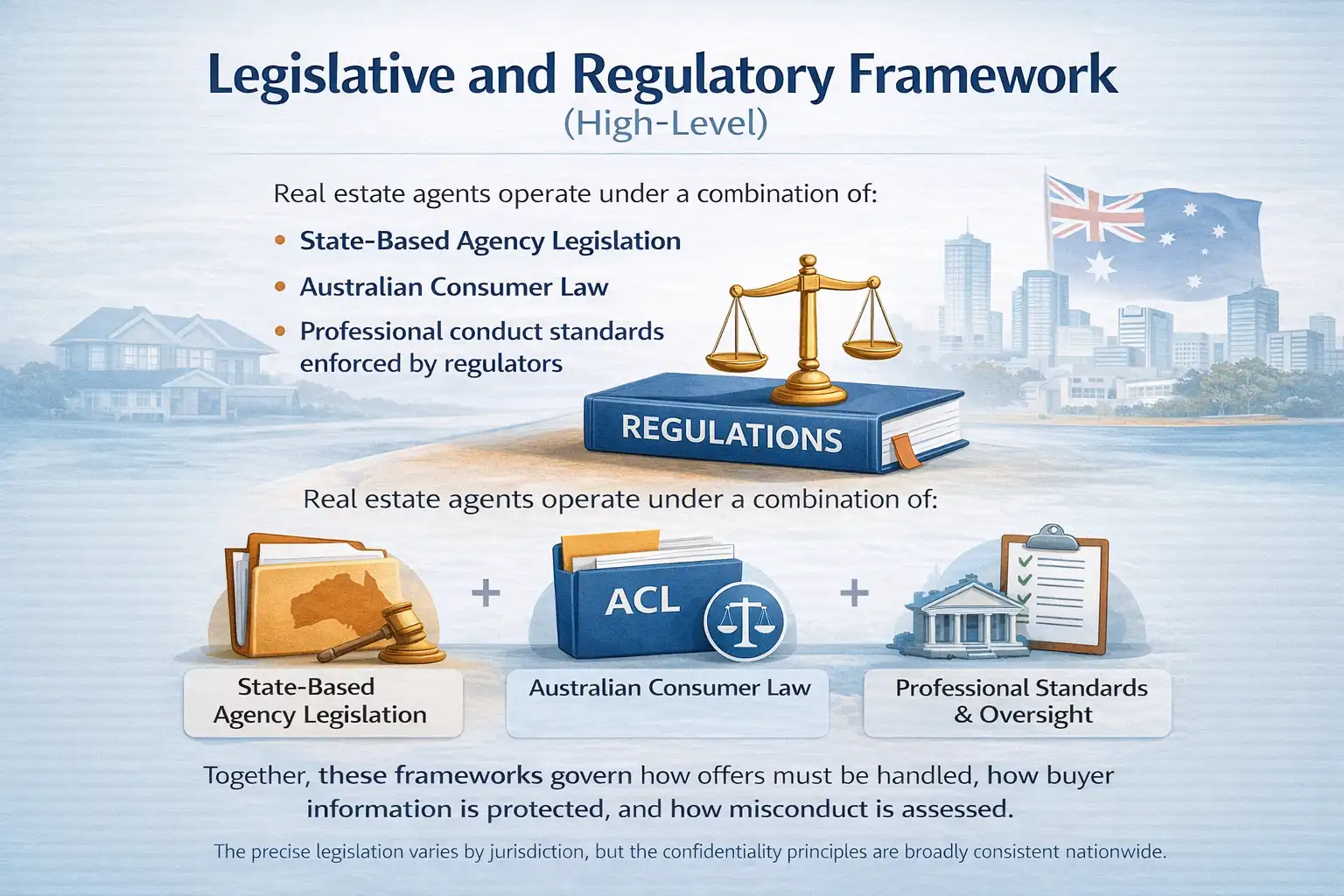
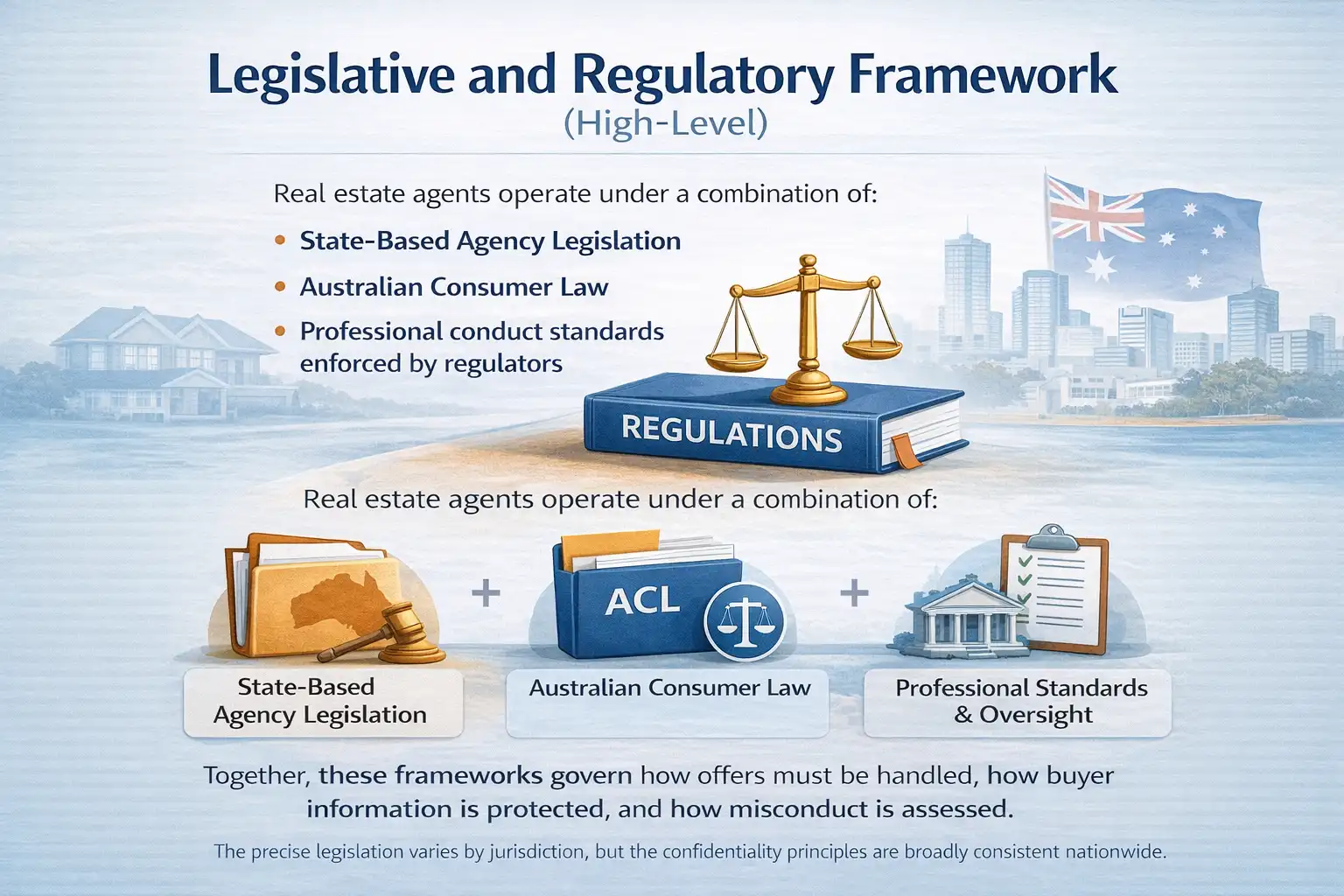
Real estate agents operate under a combination of:
- State-based agency legislation
- Australian Consumer Law
- Professional conduct standards enforced by regulators
Together, these frameworks govern how offers must be handled, how buyer information is protected, and how misconduct is assessed.
The precise legislation varies by jurisdiction, but the confidentiality principles are broadly consistent nationwide.
🔹 Multiple-Offer Handling in South Australia (Contextual Example)
In South Australia, real estate agents operate under state legislation such as the Land and Business (Sale and Conveyancing) Act 1994, alongside broader consumer protection laws.
In multiple-offer situations, agents typically:
- Notify interested parties that competition exists
- Invite buyers to submit their strongest offer by a set timeframe
This approach allows offers to be considered without disclosing competitor pricing or terms, and reduces the risk of conduct that could be misleading or unfair.
South Australia’s regulatory oversight is administered by Consumer and Business Services, which investigates complaints and applies disciplinary action where professional standards are breached.
🔹 Why Confidentiality Matters in Practice
Confidentiality rules are not simply procedural — they exist to support:
- Fair competition between buyers
- Accurate decision-making by sellers
- Confidence in the integrity of the transaction
If agents were permitted to disclose offer details freely, buyers could be pressured into decisions based on incomplete or distorted information, undermining trust in the market.
Examples of Conduct Regulators Have Acted On (Australia)
Australian regulators have taken enforcement action where agents have engaged in conduct such as:
- Claiming competing offers exist when they do not
- Disclosing buyer prices or terms without consent
- Using one buyer’s offer to unfairly influence another
These examples illustrate why confidentiality and accuracy are central to professional standards in real estate transactions.
South Australia Enforcement Example (2018)
In 2018, South Australia’s regulator sanctioned a real estate agent for professional misconduct. The action demonstrates how confidentiality and professional obligations are actively monitored and enforced at the state level.
Source: South Australian Government — Consumer and Business Services
Western Australia Enforcement Example (July 2025)
In July 2025, a Western Australian real estate agent received a two-year ban following findings of professional misconduct. The case highlights contemporary enforcement activity and shows that regulators continue to act where agent obligations are breached.
Source: Consumer Protection WA announcement
🔹 Where to Seek Jurisdiction-Specific Guidance
Because real estate regulation is handled at the state and territory level, buyers or sellers who believe an agent has acted improperly should contact the relevant government authority for their jurisdiction.
Final Summary
In Australia, real estate agents cannot disclose the details of other buyers’ offers without consent. This rule is grounded in confidentiality requirements, consumer protection law, and professional conduct standards enforced by state and territory regulators.
Understanding how these standards operate — and why they exist — helps buyers and sellers navigate competitive property transactions with greater clarity and confidence.
Frequently Asked Questions About Offer Disclosure in Australia
Can real estate agents disclose offers to other buyers in Australia?
In Australia, real estate agents cannot disclose the details of one buyer’s offer to another buyer unless the buyer who made the offer has given explicit consent. This includes the offer price, contract conditions, settlement terms, and the identity of the buyer. Agents may, however, confirm that multiple offers exist or that the seller is considering more than one buyer. These rules apply regardless of market conditions and are enforced at the state and territory level under consumer protection and agency legislation.
What information about other offers is an agent allowed to share?
An agent may provide general information indicating that competition exists, such as confirming that other offers have been received or that the seller is considering higher or alternative offers. However, agents must not disclose specific figures, terms, timelines, or buyer details from competing offers without consent. The distinction is between signalling competition and revealing confidential information, which remains protected even in competitive or fast-moving markets.
Who must give consent before an offer can be disclosed?
Consent must come from the buyer who made the offer. Seller approval alone does not authorise an agent to disclose another buyer’s offer details. Offers belong to the buyer who submitted them, even though they are presented for the seller’s consideration. Without the buyer’s explicit consent, disclosure of offer information is not permitted.
Do confidentiality rules apply to verbal offers as well as written offers?
Yes. Confidentiality obligations apply to all offers, whether they are made verbally or in writing. The format of the offer does not change the agent’s responsibility to protect the information it contains. Any price, condition, or term communicated as part of an offer is treated as confidential unless consent for disclosure has been provided.
Are offer disclosure rules different in auctions or hot markets?
No. Auction campaigns, high-demand markets, or multiple-offer situations do not alter confidentiality obligations. While agents may acknowledge strong competition or multiple interested parties, they must still avoid disclosing offer details. Market conditions do not override professional conduct standards or consumer protection requirements.
Why are real estate agents restricted from disclosing offer details?
Offer confidentiality exists to support fair competition, prevent misleading conduct, and protect buyer privacy. Disclosing offer details could unfairly influence negotiations, pressure buyers into decisions based on incomplete information, or distort the integrity of the sales process. These restrictions help ensure that offers are considered on their merits without improper advantage or manipulation.
What happens if a real estate agent discloses offer details improperly?
If an agent discloses offer details without consent, regulators may investigate the conduct and apply disciplinary action depending on the circumstances. Outcomes can include warnings, fines, licence conditions, suspension, or cancellation. Enforcement is handled by state and territory regulators, and confidentiality breaches are treated as serious professional matters.
Do these offer disclosure rules apply across all Australian states and territories?
Yes. While each state and territory has its own legislation and regulator, confidentiality principles are broadly consistent nationwide. Real estate agents across Australia are subject to similar standards regarding the handling of buyer offers, even though enforcement bodies and legislative references differ by jurisdiction.
Need More Information About Real Estate in South Australia?
If you’d like to learn more about buying or selling property in South Australia, our Real Estate Services page provides an overview of how we assist clients throughout the process.

